• 文献检索
  • 文档翻译
  • 深度研究
  • 学术资讯
  • Suppr Zotero 插件Zotero 插件
  • 邀请有礼
  • 套餐&价格
  • 历史记录
应用&插件
Suppr Zotero 插件Zotero 插件浏览器插件Mac 客户端Windows 客户端微信小程序
定价
高级版会员购买积分包购买API积分包
服务
文献检索文档翻译深度研究API 文档MCP 服务
关于我们
关于 Suppr公司介绍联系我们用户协议隐私条款
关注我们

Suppr 超能文献

核心技术专利:CN118964589B侵权必究
粤ICP备2023148730 号-1Suppr @ 2026

文献检索

告别复杂PubMed语法,用中文像聊天一样搜索,搜遍4000万医学文献。AI智能推荐,让科研检索更轻松。

立即免费搜索

文件翻译

保留排版,准确专业,支持PDF/Word/PPT等文件格式,支持 12+语言互译。

免费翻译文档

深度研究

AI帮你快速写综述,25分钟生成高质量综述,智能提取关键信息,辅助科研写作。

立即免费体验

一种用于预测肝癌根治性肝切除术后早期复发的新型预后列线图的开发。

Development of a novel prognostic nomogram for the early recurrence of liver cancer after curative hepatectomy.

作者信息

Xia Wuzheng, Peng Tianyi, Guan Renguo, Zhou Yu, Zeng Cong, Lin Ye, Wu Zhongshi, Tan Hongmei

机构信息

Department of Organ Transplant, Guangdong Provincial People's Hospital, Guangdong Academy of Medical Sciences, Guangzhou, China.

Department of Hepatobiliary Surgery, Guangdong Provincial People's Hospital, Guangdong Academy of Medical Sciences, Guangzhou, China.

出版信息

Ann Transl Med. 2021 Oct;9(20):1541. doi: 10.21037/atm-21-4837.

DOI:10.21037/atm-21-4837
PMID:34790747
原文链接:https://pmc.ncbi.nlm.nih.gov/articles/PMC8576734/
Abstract

BACKGROUND

Hepatocellular carcinoma (HCC) is one of the most common malignant cancers worldwide. Curative resection is an effective treatment but HCC recurrence rates remain high. This study aimed to establish a novel prognostic nomogram to assess the risk of recurrence in patients following curative resection.

METHODS

A total of 410 patients undergoing HCC curative resection were recruited from the Guangdong Provincial People's Hospital (GDPH). The cohort was divided into a training group (n=291) and a validation group (n=97). The risk factors for HCC early recurrence within 1 year of curative hepatectomy were identified. Finally, a multivariate prognostic nomogram was developed and validated.

RESULTS

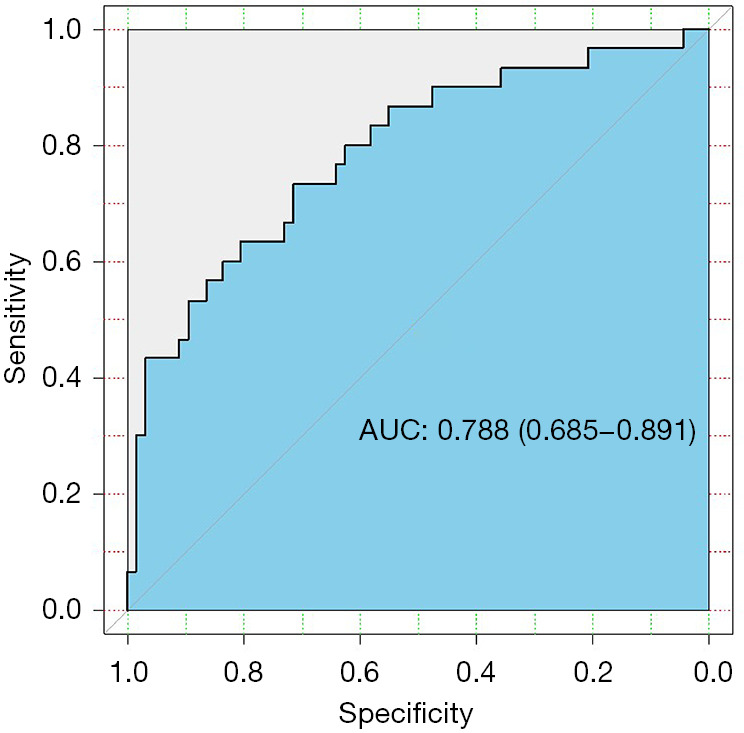
Age, tumor number, tumor capsule, portal vein tumor thrombi, pathological grade, vascular tumor emboli, activated partial thromboplastin time (APTT), and tumor size were identified as independent prognostic risk factors for HCC early recurrence within 1 year of curative hepatectomy. The area under the receiver operating characteristic (ROC) curve (AUC) was 0.806 [95% confidence interval (CI): 0.755 to 0.857; P<0.001], and no AUC/ROC statistical difference was detected between the training and validation sets.

CONCLUSIONS

The nomogram effectively predicted postoperative HCC recurrence within 1 year after curative hepatectomy, which may be a useful tool for the postoperative treatment or follow up for HCC patients.

摘要

背景

肝细胞癌(HCC)是全球最常见的恶性肿瘤之一。根治性切除术是一种有效的治疗方法,但HCC复发率仍然很高。本研究旨在建立一种新的预后列线图,以评估根治性切除术后患者的复发风险。

方法

从广东省人民医院招募了410例行HCC根治性切除术的患者。该队列分为训练组(n = 291)和验证组(n = 97)。确定了根治性肝切除术后1年内HCC早期复发的危险因素。最后,开发并验证了多因素预后列线图。

结果

年龄、肿瘤数量、肿瘤包膜、门静脉癌栓、病理分级、血管癌栓、活化部分凝血活酶时间(APTT)和肿瘤大小被确定为根治性肝切除术后1年内HCC早期复发的独立预后危险因素。受试者工作特征(ROC)曲线下面积(AUC)为0.806 [95%置信区间(CI):0.755至0.857;P < 0.001],训练集和验证集之间未检测到AUC/ROC统计学差异。

结论

该列线图有效地预测了根治性肝切除术后1年内HCC的术后复发,这可能是HCC患者术后治疗或随访的有用工具。

https://cdn.ncbi.nlm.nih.gov/pmc/blobs/591c/8576734/33b81a95aa63/atm-09-20-1541-f3.jpg
https://cdn.ncbi.nlm.nih.gov/pmc/blobs/591c/8576734/0cf89bbd57f9/atm-09-20-1541-f1.jpg
https://cdn.ncbi.nlm.nih.gov/pmc/blobs/591c/8576734/e300a8916c96/atm-09-20-1541-f2.jpg
https://cdn.ncbi.nlm.nih.gov/pmc/blobs/591c/8576734/33b81a95aa63/atm-09-20-1541-f3.jpg
https://cdn.ncbi.nlm.nih.gov/pmc/blobs/591c/8576734/0cf89bbd57f9/atm-09-20-1541-f1.jpg
https://cdn.ncbi.nlm.nih.gov/pmc/blobs/591c/8576734/e300a8916c96/atm-09-20-1541-f2.jpg
https://cdn.ncbi.nlm.nih.gov/pmc/blobs/591c/8576734/33b81a95aa63/atm-09-20-1541-f3.jpg

相似文献

1
Development of a novel prognostic nomogram for the early recurrence of liver cancer after curative hepatectomy.一种用于预测肝癌根治性肝切除术后早期复发的新型预后列线图的开发。
Ann Transl Med. 2021 Oct;9(20):1541. doi: 10.21037/atm-21-4837.
2
Novel Prognostic Nomograms for Predicting Early and Late Recurrence of Hepatocellular Carcinoma After Curative Hepatectomy.预测根治性肝切除术后肝细胞癌早期和晚期复发的新型预后列线图
Cancer Manag Res. 2020 Mar 9;12:1693-1712. doi: 10.2147/CMAR.S241959. eCollection 2020.
3
[The study of nomogram based on Ishak inflammation score for recurrence of hepatocellular carcinoma after curative resection].基于Ishak炎症评分的列线图对肝细胞癌根治性切除术后复发的研究
Zhonghua Wai Ke Za Zhi. 2018 Feb 1;56(2):124-129. doi: 10.3760/cma.j.issn.0529-5815.2018.02.009.
4
Nomogram Based on Inflammatory Biomarkers to Predict the Recurrence of Hepatocellular Carcinoma-A Multicentre Experience.基于炎症生物标志物预测肝细胞癌复发的列线图——一项多中心经验
J Inflamm Res. 2022 Sep 5;15:5089-5102. doi: 10.2147/JIR.S378099. eCollection 2022.
5
Pre- to postoperative alpha-fetoprotein ratio-based nomogram to predict tumor recurrence in patients with hepatocellular carcinoma.基于术前至术后甲胎蛋白比值的列线图预测肝细胞癌患者的肿瘤复发情况
Front Oncol. 2023 Apr 14;13:1134933. doi: 10.3389/fonc.2023.1134933. eCollection 2023.
6
Prognostic Nomograms Stratify Survival of Patients with Hepatocellular Carcinoma Without Portal Vein Tumor Thrombosis After Curative Resection.预后列线图对根治性切除术后无门静脉肿瘤血栓形成的肝细胞癌患者的生存情况进行分层。
Oncologist. 2017 May;22(5):561-569. doi: 10.1634/theoncologist.2016-0231. Epub 2017 Apr 24.
7
Development and Validation of a Model Including Distinct Vascular Patterns to Estimate Survival in Hepatocellular Carcinoma.开发并验证一种包含不同血管模式的模型,以评估肝癌患者的生存情况。
JAMA Netw Open. 2021 Sep 1;4(9):e2125055. doi: 10.1001/jamanetworkopen.2021.25055.
8
Prognostic Nomograms for Patients with Hepatocellular Carcinoma After Curative Hepatectomy, with a Focus on Recurrence Timing and Post-Recurrence Management.根治性肝切除术后肝细胞癌患者的预后列线图,重点关注复发时间和复发后管理
J Hepatocell Carcinoma. 2020 Oct 27;7:233-256. doi: 10.2147/JHC.S271498. eCollection 2020.
9
Preoperative serum liver enzyme markers for predicting early recurrence after curative resection of hepatocellular carcinoma.用于预测肝细胞癌根治性切除术后早期复发的术前血清肝酶标志物。
Hepatobiliary Pancreat Dis Int. 2015 Apr;14(2):178-85. doi: 10.1016/s1499-3872(15)60353-8.
10
Nomogram for prediction of hepatocellular carcinoma recurrence after liver resection.肝切除术后肝细胞癌复发预测列线图
Hepatobiliary Pancreat Dis Int. 2025 Jun;24(3):269-276. doi: 10.1016/j.hbpd.2024.09.006. Epub 2024 Sep 19.

引用本文的文献

1
Assessment of Tumor Burden Score as a Feasible and Reliable Tool for Prognosis Prediction for Hepatocellular Carcinoma Undergoing Hepatectomy: A Multicenter, Retrospective Study.评估肿瘤负荷评分作为肝切除术后肝细胞癌预后预测的可行且可靠工具:一项多中心回顾性研究
J Hepatocell Carcinoma. 2025 Feb 10;12:247-260. doi: 10.2147/JHC.S488927. eCollection 2025.
2
Hepatoprotective effects of aspirin on diethylnitrosamine-induced hepatocellular carcinoma in rats by reducing inflammation levels and PD-L1 expression.阿司匹林通过降低炎症水平和 PD-L1 表达对二乙基亚硝胺诱导的大鼠肝癌的肝保护作用。
Sci Rep. 2023 Dec 4;13(1):21362. doi: 10.1038/s41598-023-48812-z.
3

本文引用的文献

1
DNA Damage Repair Status Predicts Opposite Clinical Prognosis Immunotherapy and Non-Immunotherapy in Hepatocellular Carcinoma.DNA 损伤修复状态预测肝癌免疫治疗和非免疫治疗的相反临床预后。
Front Immunol. 2021 Jul 15;12:676922. doi: 10.3389/fimmu.2021.676922. eCollection 2021.
2
Magnetic Resonance Diffusion Kurtosis Imaging versus Diffusion-Weighted Imaging in Evaluating the Pathological Grade of Hepatocellular Carcinoma.磁共振扩散峰度成像与扩散加权成像在评估肝细胞癌病理分级中的应用
Cancer Manag Res. 2020 Jun 29;12:5147-5158. doi: 10.2147/CMAR.S254371. eCollection 2020.
3
Novel Prognostic Nomograms for Predicting Early and Late Recurrence of Hepatocellular Carcinoma After Curative Hepatectomy.
Development of preoperative and postoperative machine learning models to predict the recurrence of huge hepatocellular carcinoma following surgical resection.
术前和术后机器学习模型的开发,用于预测巨大肝细胞癌手术切除后的复发情况。
Oncol Lett. 2023 May 12;26(1):275. doi: 10.3892/ol.2023.13861. eCollection 2023 Jul.
4
Derivation and validation of machine learning models for preoperative estimation of microvascular invasion risk in hepatocellular carcinoma.用于术前评估肝细胞癌微血管侵犯风险的机器学习模型的推导与验证
Ann Transl Med. 2023 Mar 31;11(6):249. doi: 10.21037/atm-22-2828. Epub 2023 Jan 6.
5
Establishment and validation of a predictive model of recurrence in primary hepatocellular carcinoma after resection.原发性肝细胞癌切除术后复发预测模型的建立与验证
J Gastrointest Oncol. 2023 Feb 28;14(1):278-286. doi: 10.21037/jgo-22-1303. Epub 2023 Feb 15.
6
Adjuvant ICIs Plus Targeted Therapies Reduce HCC Recurrence after Hepatectomy in Patients with High Risk of Recurrence.辅助免疫检查点抑制剂联合靶向治疗可降低复发风险高的肝癌患者肝切除术后的 HCC 复发率。
Curr Oncol. 2023 Jan 31;30(2):1708-1719. doi: 10.3390/curroncol30020132.
7
Differential Response to Sorafenib Administration for Advanced Hepatocellular Carcinoma.索拉非尼治疗晚期肝细胞癌的差异反应。
Biomedicines. 2022 Sep 14;10(9):2277. doi: 10.3390/biomedicines10092277.
预测根治性肝切除术后肝细胞癌早期和晚期复发的新型预后列线图
Cancer Manag Res. 2020 Mar 9;12:1693-1712. doi: 10.2147/CMAR.S241959. eCollection 2020.
4
Defining and predicting early recurrence after liver resection of hepatocellular carcinoma: a multi-institutional study.定义和预测肝癌肝切除术后早期复发:多机构研究。
HPB (Oxford). 2020 May;22(5):677-689. doi: 10.1016/j.hpb.2019.09.006. Epub 2019 Oct 10.
5
Management of adverse events associated with tyrosine kinase inhibitors: Improving outcomes for patients with hepatocellular carcinoma.酪氨酸激酶抑制剂相关不良反应的管理:改善肝细胞癌患者的预后。
Cancer Treat Rev. 2019 Jul;77:20-28. doi: 10.1016/j.ctrv.2019.05.004. Epub 2019 May 15.
6
Nivolumab for the treatment of hepatocellular carcinoma.纳武利尤单抗治疗肝细胞癌。
Expert Rev Anticancer Ther. 2018 Dec;18(12):1169-1175. doi: 10.1080/14737140.2018.1535315. Epub 2018 Oct 22.
7
Development of pre and post-operative models to predict early recurrence of hepatocellular carcinoma after surgical resection.建立术前和术后模型以预测肝癌切除术后早期复发。
J Hepatol. 2018 Dec;69(6):1284-1293. doi: 10.1016/j.jhep.2018.08.027. Epub 2018 Sep 18.
8
Characteristics of Early Recurrence After Curative Liver Resection for Solitary Hepatocellular Carcinoma.单发肝细胞癌根治性切除术后早期复发的特征。
J Gastrointest Surg. 2019 Feb;23(2):304-311. doi: 10.1007/s11605-018-3927-2. Epub 2018 Sep 13.
9
Global cancer statistics 2018: GLOBOCAN estimates of incidence and mortality worldwide for 36 cancers in 185 countries.全球癌症统计数据 2018:GLOBOCAN 对全球 185 个国家/地区 36 种癌症的发病率和死亡率的估计。
CA Cancer J Clin. 2018 Nov;68(6):394-424. doi: 10.3322/caac.21492. Epub 2018 Sep 12.
10
Hepatocellular Carcinoma: Causes, Mechanism of Progression and Biomarkers.肝细胞癌:病因、进展机制及生物标志物
Curr Chem Genom Transl Med. 2018 Jun 29;12:9-26. doi: 10.2174/2213988501812010009. eCollection 2018.