Deng Jiaxin, Su Mingli, Hu Jiancong, Lin Dezheng, Li Juan, Liu Wei, Zhang Jiawei, Zhong Qinghua, Guo Xuefeng
Department of Endoscopic Surgery, the Sixth Affiliated Hospital, Sun Yat-sen University, Guangzhou, China.
Guangdong Provincial Key Laboratory of Colorectal and Pelvic Floor Diseases, the Sixth Affiliated Hospital, Sun Yat-sen University, Guangzhou, China.
Ann Transl Med. 2021 Oct;9(20):1595. doi: 10.21037/atm-21-4660.
Defecation disorders after ileostomy reversal are among the most common complications for rectal cancer patients, and significantly diminish their quality of life. The aim of this study was to identify the risk factors associated with frequent defecation early after ileostomy reversal for rectal cancer patients.
We retrospectively collected the data of rectal cancer patients who underwent ileostomy reversal from January 2018 to December 2019 at the Sixth Affiliated Hospital of Sun Yat-sen University. We divided patients into two groups: a no frequent defecation group (≤7 times/day) and a frequent defecation group (>7 times/day).
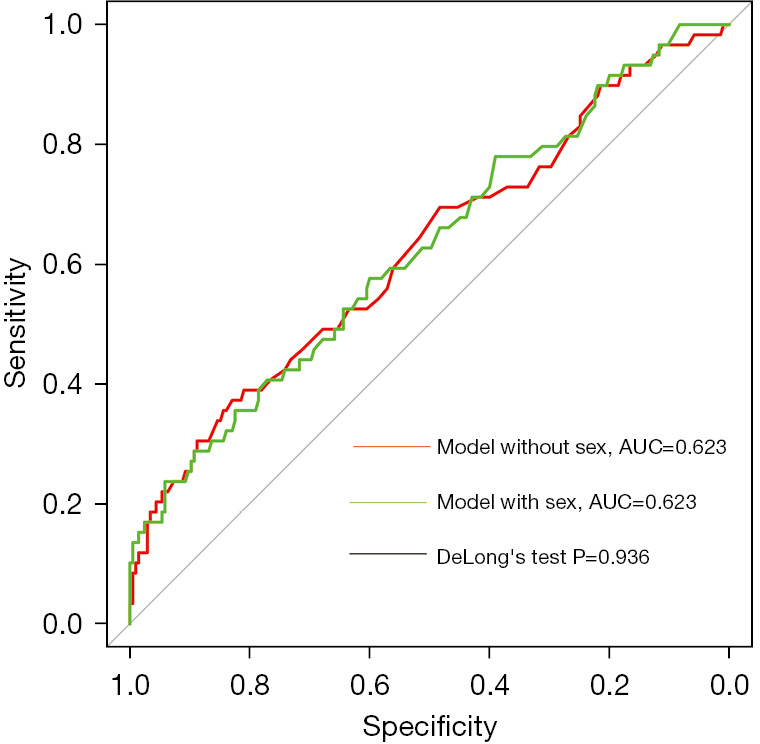
Of the 264 included patients, 59 patients (22.35%) had frequent defecation within 1 month after ileostomy closure and were defined as the frequent defecation group. There were no significant differences between the two groups in terms of gender, age, hypertension, and diabetes. Univariate and multivariate analyses showed that proctitis (P=0.04) and anastomotic stenosis (P=0.02) were independent risk factors for frequent defecation. Four factors, including proctitis, anastomotic stenosis, hypertension, and age were included to construct the nomogram. The consistency index of the nomogram was 0.949 and the area under the curve value was 0.623.
For rectal cancer patients, proctitis and anastomotic stenosis were correlated with frequent defecation within 1 month after ileostomy closure. Surgeons should pay attention to the rectal examination before ileostomy reversal surgery.
直肠癌患者回肠造口还纳术后排便障碍是最常见的并发症之一,严重降低了他们的生活质量。本研究的目的是确定直肠癌患者回肠造口还纳术后早期频繁排便的相关危险因素。
我们回顾性收集了2018年1月至2019年12月在中山大学附属第六医院接受回肠造口还纳术的直肠癌患者的数据。我们将患者分为两组:非频繁排便组(≤7次/天)和频繁排便组(>7次/天)。
在纳入的264例患者中,59例(22.35%)在回肠造口关闭后1个月内有频繁排便,被定义为频繁排便组。两组在性别、年龄、高血压和糖尿病方面无显著差异。单因素和多因素分析显示,直肠炎(P=0.04)和吻合口狭窄(P=0.02)是频繁排便的独立危险因素。纳入直肠炎、吻合口狭窄、高血压和年龄四个因素构建列线图。列线图的一致性指数为0.949,曲线下面积值为0.623。
对于直肠癌患者,直肠炎和吻合口狭窄与回肠造口关闭后1个月内频繁排便相关。外科医生在回肠造口还纳手术前应注意直肠检查。