
间接遗传效应交互作用系数 ψ:理论上必不可少但经验上被忽视。
The Indirect Genetic Effect Interaction Coefficient ψ: Theoretically Essential and Empirically Neglected.
机构信息
Centre for Biological Diversity, School of Biology, University of St Andrews, St Andrews, Fife KY16 9TH, UK.
出版信息
J Hered. 2022 Feb 17;113(1):79-90. doi: 10.1093/jhered/esab056.
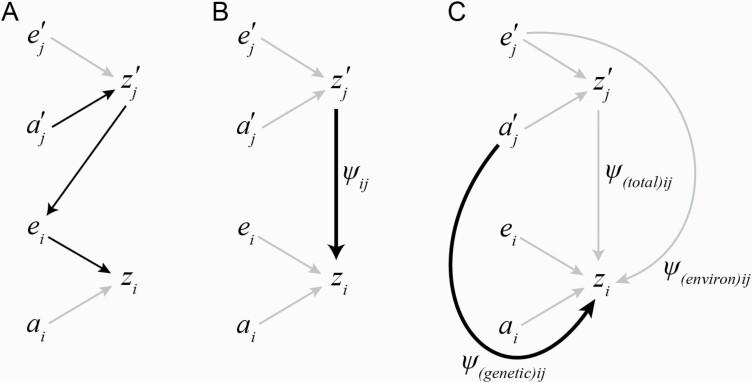
The interaction effect coefficient ψ has been a much-discussed, fundamental parameter of indirect genetic effect (IGE) models since its formal mathematical description in 1997. The coefficient simultaneously describes the form of changes in trait expression caused by genes in the social environment and predicts the evolutionary consequences of those IGEs. Here, we report a striking mismatch between theoretical emphasis on ψ and its usage in empirical studies. Surveying all IGE research, we find that the coefficient ψ has not been equivalently conceptualized across studies. Several issues related to its proper empirical measurement have recently been raised, and these may severely distort interpretations about the evolutionary consequences of IGEs. We provide practical advice on avoiding such pitfalls. The majority of empirical IGE studies use an alternative variance-partitioning approach rooted in well-established statistical quantitative genetics, but several hundred estimates of ψ (from 15 studies) have been published. A significant majority are positive. In addition, IGEs with feedback, that is, involving the same trait in both interacting partners, are far more likely to be positive and of greater magnitude. Although potentially challenging to measure without bias, ψ has critically-developed theoretical underpinnings that provide unique advantages for empirical work. We advocate for a shift in perspective for empirical work, from ψ as a description of IGEs, to ψ as a robust predictor of evolutionary change. Approaches that "run evolution forward" can take advantage of ψ to provide falsifiable predictions about specific trait interactions, providing much-needed insight into the evolutionary consequences of IGEs.
自 1997 年正式用数学方法描述以来,互作效应系数 ψ 一直是间接遗传效应(IGE)模型中备受关注的基本参数。该系数同时描述了基因在社会环境中引起的表型表达变化的形式,并预测了这些 IGE 的进化后果。在这里,我们报告了理论上对 ψ 的强调与其实证研究中的使用之间存在明显的不匹配。调查所有的 IGE 研究,我们发现该系数在研究之间并没有被等同地概念化。最近,人们提出了与正确测量其相关的几个问题,这些问题可能严重扭曲了对 IGE 进化后果的解释。我们提供了一些实用的建议来避免这些陷阱。大多数经验 IGE 研究使用基于成熟的统计数量遗传学的替代方差划分方法,但已经发表了几百个 ψ 的估计值(来自 15 项研究)。其中大部分是正的。此外,具有反馈的 IGE,即相互作用的两个伙伴中涉及到相同的特征,更有可能是正的且幅度更大。虽然没有偏见地进行测量可能具有挑战性,但 ψ 具有经过批判性发展的理论基础,为实证工作提供了独特的优势。我们主张从将 ψ 作为 IGE 的描述转变为将 ψ 作为进化变化的可靠预测因子,从而改变实证工作的视角。“向前运行进化”的方法可以利用 ψ 对特定特征相互作用提供可验证的预测,从而深入了解 IGE 的进化后果。



 Zotero 插件