Department of Medicine (Neurology), McMaster University, Population Health Research Institute, Hamilton Health Sciences, Hamilton, ON, Canada.
Department of Clinical Neurosciences, 2129University of Calgary, Calgary, AB, Canada.
Int J Stroke. 2022 Aug;17(7):799-805. doi: 10.1177/17474930211058012. Epub 2021 Nov 18.
Covert brain infarcts are associated with important neurological morbidity. Their incidence in patients with embolic stroke of undetermined source (ESUS) is unknown.
To assess the incidence of covert brain infarcts and cerebral microbleeds using MRI in a prospective substudy of the NAVIGATE ESUS randomized trial and to evaluate the effects of antithrombotic therapies.
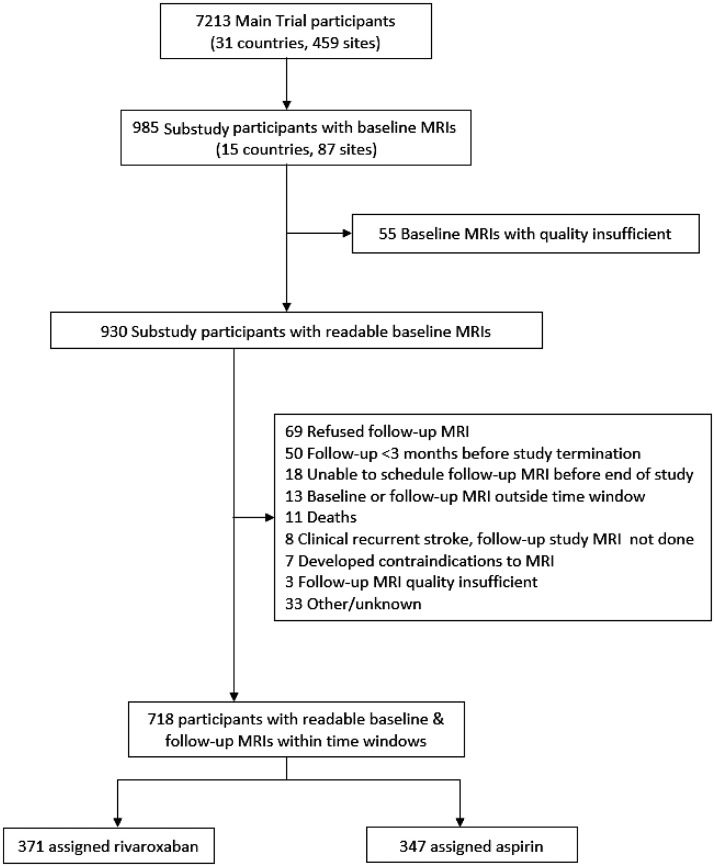
At 87 sites in 15 countries, substudy participants were randomly assigned to receive rivaroxaban 15 mg daily or aspirin 100 mg daily and underwent brain MRI near randomization and after study termination. The primary outcome was incident brain infarct (clinical ischemic stroke or covert brain infarct). Brain infarcts and microbleeds were ascertained centrally by readers unaware of treatment. Treatment effects were estimated using logistic regression.
Among the 718 substudy participants with interpretable, paired MRIs, the mean age was 67 years and 61% were men with a median of 52 days between the qualifying ischemic stroke and randomization and a median of seven days between randomization and baseline MRI. During the median (IQR) 11 (12) month interval between scans, clinical ischemic strokes occurred in 27 (4%) participants, while 60 (9%) of the remaining participants had an incident covert brain infarct detected by MRI. Assignment to rivaroxaban was not associated with reduction in the incidence of brain infarct (OR 0.77, 95% CI 0.49, 1.2) or of covert brain infarct among those without clinical stroke (OR 0.85, 95% CI 0.50, 1.4). New microbleeds were observed in 7% and did not differ among those assigned rivaroxaban vs. aspirin (HR 0.95, 95% CI 0.52-1.7).
Incident covert brain infarcts occurred in twice as many ESUS patients as a clinical ischemic stroke. Treatment with rivaroxaban compared with aspirin did not significantly reduce the incidence of covert brain infarcts or increase the incidence of microbleeds, but the confidence intervals for treatment effects were wide. https://www.clinicaltrials.gov. Unique identifier: NCT02313909.
隐匿性脑梗死与重要的神经功能缺损相关。其在不明来源栓塞性卒中(ESUS)患者中的发生率尚不清楚。
通过 NAVIGATE ESUS 随机试验的前瞻性亚研究,采用 MRI 评估隐匿性脑梗死和脑微出血的发生率,并评估抗血栓治疗的效果。
在 15 个国家的 87 个研究中心,亚组参与者被随机分配接受利伐沙班 15mg 每日或阿司匹林 100mg 每日,并在随机分组和研究结束时进行脑部 MRI。主要结局是新发脑梗死(临床缺血性卒中和隐匿性脑梗死)。脑梗死和微出血由不知道治疗情况的中心读片者确定。采用 logistic 回归估计治疗效果。
在 718 例可解释配对 MRI 的亚组参与者中,平均年龄为 67 岁,61%为男性,从符合条件的缺血性卒中和随机分组之间的中位时间为 52 天,从随机分组到基线 MRI 的中位时间为 7 天。在两次扫描之间的中位(IQR)11(12)个月随访期间,27 例(4%)参与者发生临床缺血性卒,而其余 60 例(9%)参与者中有 60 例通过 MRI 检测到新发隐匿性脑梗死。与 rivaroxaban 相比,接受 rivaroxaban 治疗与脑梗死发生率(OR 0.77,95%CI 0.49,1.2)或无临床卒中年发生隐匿性脑梗死的发生率(OR 0.85,95%CI 0.50,1.4)无关。新发微出血占 7%, rivaroxaban 与阿司匹林组之间无差异(HR 0.95,95%CI 0.52-1.7)。
与临床缺血性卒中年相比,ESUS 患者发生隐匿性脑梗死的几率更高。与阿司匹林相比,利伐沙班治疗并未显著降低隐匿性脑梗死的发生率或增加微出血的发生率,但治疗效果的置信区间较宽。https://www.clinicaltrials.gov。独特标识符:NCT02313909。