Department of Thoracic Surgery, Tongji Hospital, Tongji Medical College, Huazhong University of Science and Technology, Wuhan, China.
Department of Neurology, Tongji Hospital, Tongji Medical College, Huazhong University of Science and Technology, Wuhan, China.
Interact Cardiovasc Thorac Surg. 2022 Mar 31;34(4):576-583. doi: 10.1093/icvts/ivab294.
To compare the perioperative and follow-up outcomes of patients with myasthenia gravis (MG) receiving subxiphoid-subcostal or unilateral thoracoscopic thymectomy and to identify the factors affecting MG prognosis.
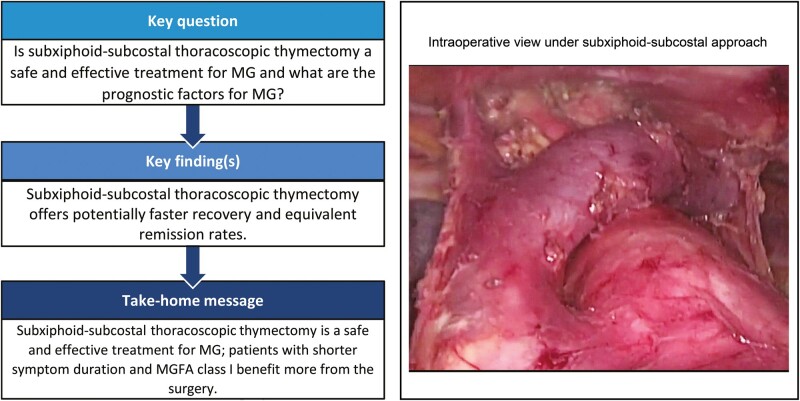
From January 2013 to December 2019, a total of 137 consecutive MG patients received subxiphoid-subcostal thoracoscopic thymectomy (STT, n = 65) or conventional unilateral thoracoscopic thymectomy (UTT, n = 72). The primary outcomes of this study were perioperative complications, duration and expenses of hospitalization, VAS score and complete stable remission (CSR).
The patients receiving STT had significantly shorter drainage duration and postoperative hospital stay and lower hospitalization expenses (P < 0.01). Pain scores on postoperative Days 1, 3, 7 and 14 were significantly lower in patients undergoing STT (P < 0.01). The average follow-up was 54.3 ± 24.18 months, with a CSR rate of 30.6% and an overall effective rate of 87.3%. Through uni- and multivariable analyses, shorter symptom duration and Myasthenia Gravis Foundation of America (MGFA) class I were independent predictors for CSR in MG patients receiving thymectomy.
The present study not only showed that STT was a safe and feasible technique for MG, with a potentially faster postoperative recovery, lower hospitalization expenses, less postoperative pain and equivalent remission rate, but also revealed that shorter symptom duration and MGFA class I were favourable prognostic factors for CSR.
比较经剑突下肋缘下与单侧胸腔镜胸腺切除术治疗重症肌无力(MG)患者的围手术期和随访结果,并确定影响 MG 预后的因素。
本研究纳入了 2013 年 1 月至 2019 年 12 月期间 137 例连续接受经剑突下肋缘下胸腔镜胸腺切除术(STT,n=65)或传统单侧胸腔镜胸腺切除术(UTT,n=72)的 MG 患者。本研究的主要结局为围手术期并发症、住院时间和费用、视觉模拟量表(VAS)评分和完全稳定缓解(CSR)。
STT 组患者的引流时间、术后住院时间和住院费用明显缩短(P<0.01)。STT 组患者术后第 1、3、7 和 14 天的疼痛评分明显较低(P<0.01)。平均随访时间为 54.3±24.18 个月,CSR 率为 30.6%,总有效率为 87.3%。通过单因素和多因素分析,发现症状持续时间较短和美国重症肌无力基金会(MGFA)Ⅰ级是接受胸腺切除术的 MG 患者 CSR 的独立预测因素。
本研究不仅表明 STT 是一种安全可行的 MG 治疗技术,具有潜在更快的术后恢复、更低的住院费用、更少的术后疼痛和相当的缓解率,而且还揭示了较短的症状持续时间和 MGFA Ⅰ级是 CSR 的有利预后因素。