Capodanno Ylenia, Altieri Barbara, Elders Richard, Colao Annamaria, Faggiano Antongiulio, Schrader Joerg
Laboratory of Fundamental Oncology, National Cancer Center Research Institute, Chuo-ku, Tokyo 103-0045, Japan.
Division of Endocrinology and Diabetes, Department of Internal Medicine, University Hospital of Wuerzburg, Oberduerrbacher Strasse 6, Wuerzburg 97080, Germany.
Transl Oncol. 2022 Jan;15(1):101269. doi: 10.1016/j.tranon.2021.101269. Epub 2021 Nov 15.
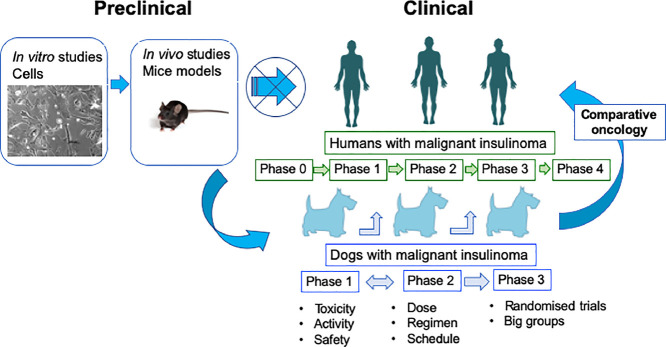
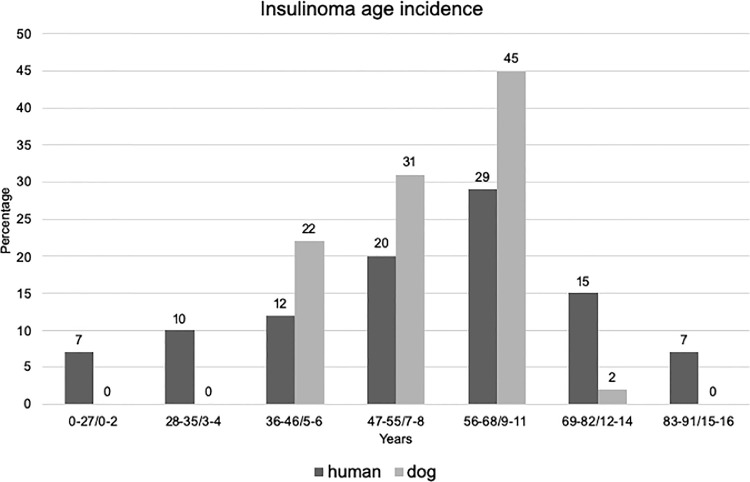
Insulinomas are considered rare indolent neuroendocrine neoplasms in human medicine, however when metastases occur no curative treatment is available thus, novel therapies are needed. Recently advances have been made in unraveling the pathophysiology of malignant insulinoma still major challenges hinder the development of a functional model to study them. Canine malignant insulinoma have similar recurrence and a poor prognosis as human malignant insulinoma. Additionally, both human and canine patients share extensively the same environment, tend to develop insulinoma seemingly spontaneously with an etiological role for hormones, at a similar incidence and stage of lifespan, with metastasis commonly to liver and regional lymph nodes, which are unresponsive to current therapies. However, the occurrence of metastases in dogs is as high as 95% compared with only 5-16% in human studies. From a comparative oncology perspective, the shared features with human insulinoma but higher incidence of metastasis in canine insulinoma suggests the latter as a model for human malignant insulinomas. With the common purpose of increasing survival rates of human and veterinary patients, in this review we are going to compare and analyze clinical, pathological and molecular aspects of canine and human insulinomas to evaluate the suitability of the canine model for future translational clinical studies.
胰岛素瘤在人类医学中被认为是罕见的惰性神经内分泌肿瘤,然而,当发生转移时,没有可用的治愈性治疗方法,因此需要新的疗法。最近在揭示恶性胰岛素瘤的病理生理学方面取得了进展,但仍然存在重大挑战阻碍了用于研究它们的功能模型的开发。犬恶性胰岛素瘤与人类恶性胰岛素瘤具有相似的复发率和不良预后。此外,人类和犬类患者在很大程度上共享相同的环境,似乎倾向于自发地发生胰岛素瘤,激素在病因学上起作用,发病率和寿命阶段相似,常见转移至肝脏和区域淋巴结,对当前治疗无反应。然而,犬类中转移的发生率高达95%,而在人类研究中仅为5 - 16%。从比较肿瘤学的角度来看,与人类胰岛素瘤的共同特征但犬类胰岛素瘤转移发生率更高,表明后者可作为人类恶性胰岛素瘤的模型。出于提高人类和兽医患者生存率的共同目的,在本综述中,我们将比较和分析犬类和人类胰岛素瘤的临床、病理和分子方面,以评估犬类模型对未来转化临床研究的适用性。