Department of Virology, Faculty of Medical Sciences, Tarbiat Modares University, P.O. Box 14155-331, Tehran, Iran.
Division of Infectious Diseases and Immunology, Department of Medicine, University of Massachusetts Medical School, 364 Plantation Street, Worcester, MA, 01605, USA.
Virol J. 2021 Nov 18;18(1):223. doi: 10.1186/s12985-021-01695-w.
B-cell proliferative disorders, such as post-transplant lymphoproliferative disease (PTLD), are increased among persons afflicted by T-cell compromise. Most are Epstein-Barr virus (EBV) + and can first present with a focal lesion. Direct introduction of oncolytic viruses into localized tumors provides theoretical advantages over chemotherapy, immunotherapy and radiation therapy by reducing systemic toxicity. Despite extensive study as a vehicle for gene therapy, adeno-associated viruses (AAV) have rarely been applied to human cancer research due to technical and theoretical obstacles. Moreover, human B-cells have historically been described as resistant to AAV infection. Nonetheless, advances using different recombinant (r)AAV serotypes with unique tropisms to deliver cytotoxic therapy suggested a localized anti-tumor approach was feasible.
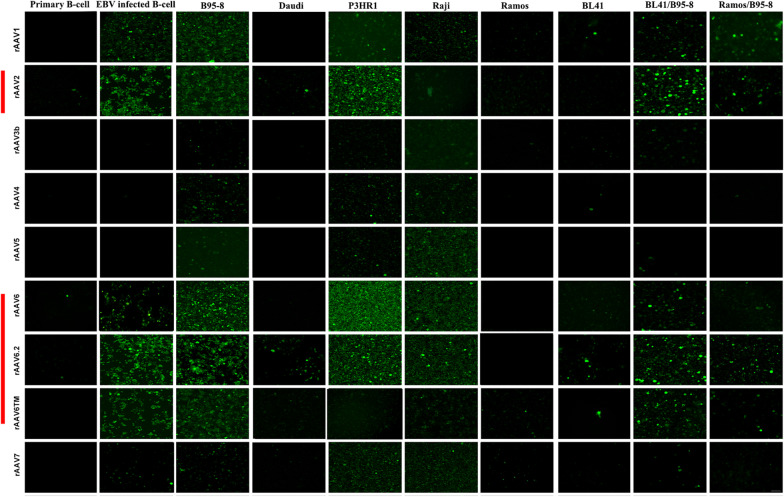
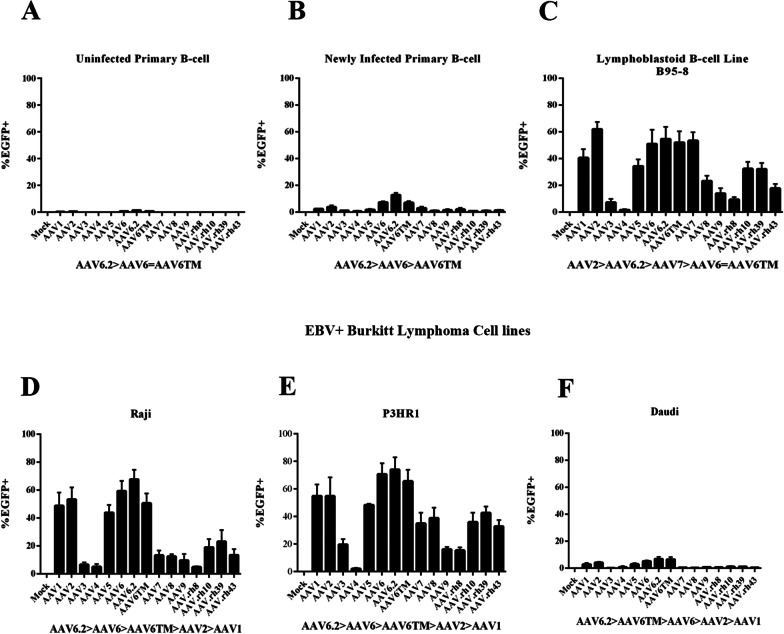
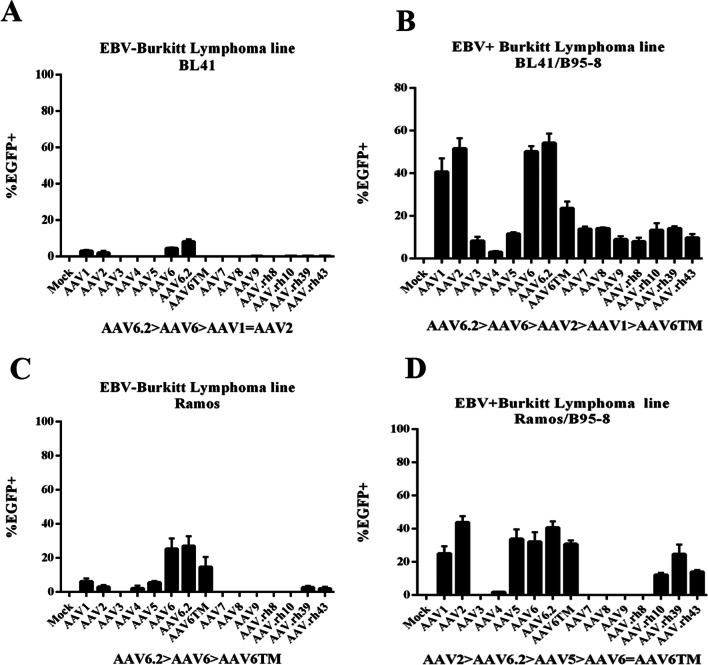
As a prelude to the development of a therapeutic vehicle, the ability of fifteen distinct EGFP-bearing rAAV serotypes to transduce human B-cells, including primary, immortalized, and B-cell tumor lines ± EBV was assessed by confocal microscopy, flow cytometry and subsequently cell viability assay.
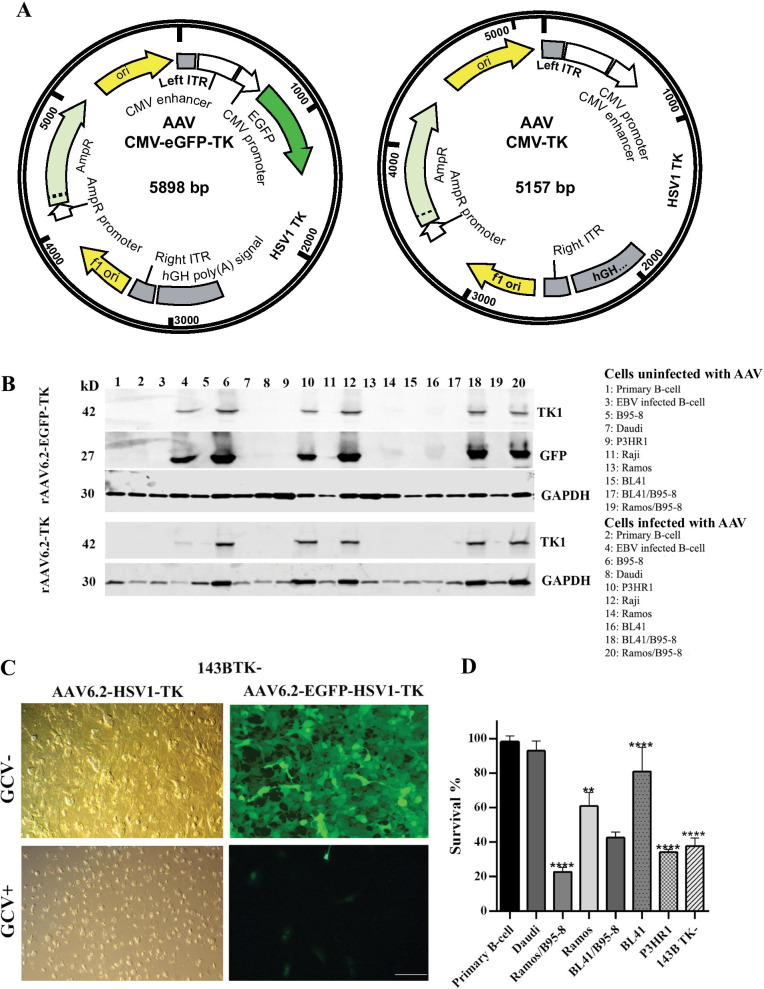
Rank order analysis revealed augmented transduction by rAAV6.2 and closely related virions. EBV infection of EBV-negative B-cell tumor lines and EBV immortalization of primary B-cells increased susceptibility to rAAV6.2 transduction. As a proof of concept, transduction by rAAV6.2 encoding herpes simplex virus type 1 (HSV1)-thymidine kinase (TK) eliminated TK-negative rhabdomyosarcoma cells and diminished viability of transduced B-cell lines upon incubation with ganciclovir.
rAAV serotypes differentially transduce human B-cell lines reversing the dogma that human B-cells are refractory to AAV infection. EBV + B-cells display increased susceptibility to rAAV6.2 infection, uncovering a new method for improved nucleic acid transfer into transfection-resistant B-cell lines. The introduction of a functional suicide gene into the rAAV6.2 genome identifies a candidate vector for the development of rAAV-based oncolytic therapy targeting focal EBV-bearing B-lymphoproliferative disorders.
T 细胞受损的患者中,B 细胞增生性疾病(例如移植后淋巴组织增生性疾病,PTLD)的发病率增加。大多数为 EBV(+),可首先表现为局灶性病变。与化疗、免疫疗法和放射疗法相比,将溶瘤病毒直接引入局部肿瘤具有理论优势,可降低全身毒性。尽管腺相关病毒(AAV)已被广泛研究作为基因治疗载体,但由于技术和理论上的障碍,很少应用于人类癌症研究。此外,人类 B 细胞曾被描述为对 AAV 感染具有抗性。尽管如此,使用具有独特嗜性的不同重组(r)AAV 血清型进行细胞毒性治疗的研究进展表明,局部抗肿瘤方法是可行的。
作为治疗载体开发的前奏,通过共聚焦显微镜、流式细胞术以及随后的细胞活力测定,评估了十五种不同携带 EGFP 的 rAAV 血清型对包括原代、永生化和 B 细胞肿瘤系的人 B 细胞的转导能力,± EBV。
秩和分析显示 rAAV6.2 和密切相关的病毒粒子的转导能力增强。EBV 感染 EBV 阴性 B 细胞肿瘤系和 EBV 永生化原代 B 细胞增加了 rAAV6.2 转导的易感性。作为概念验证,rAAV6.2 编码单纯疱疹病毒 1 (HSV1)-胸苷激酶(TK)的转导消除了 TK 阴性横纹肌肉瘤细胞,并在孵育时降低了转导的 B 细胞系的活力。
rAAV 血清型对人 B 细胞系的转导能力不同,这推翻了人类 B 细胞对 AAV 感染有抗性的观点。EBV(+)B 细胞对 rAAV6.2 感染的易感性增加,揭示了一种改进核酸转移到转染抗性 B 细胞系的新方法。功能性自杀基因的引入到 rAAV6.2 基因组中确定了一种候选载体,用于开发针对局灶性 EBV 携带 B 淋巴细胞增生性疾病的基于 rAAV 的溶瘤治疗。