Population Informatics LabTexas A&M School of Public HealthCollege StationTXUSA.
Department of Health Policy and ManagementTexas A&M School of Public HealthCollege StationTXUSA.
Hepatol Commun. 2022 May;6(5):1186-1197. doi: 10.1002/hep4.1863. Epub 2021 Nov 19.
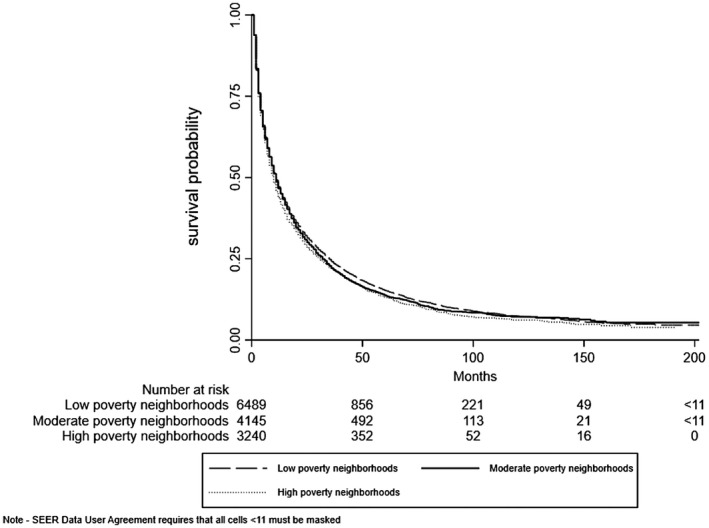
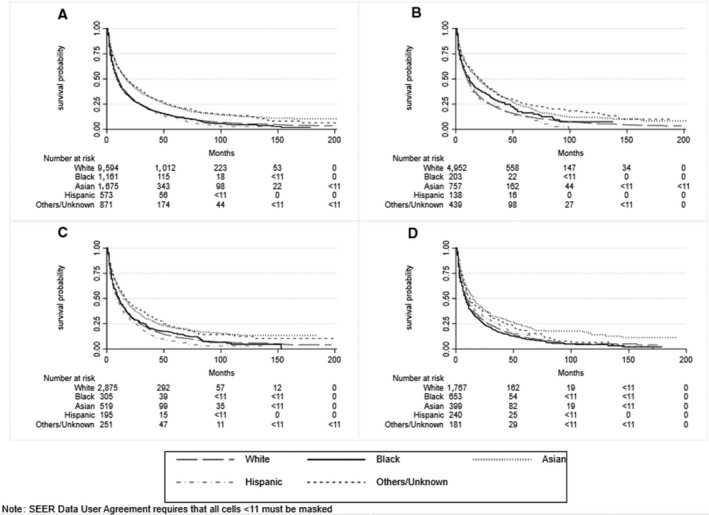
Hepatocellular carcinoma (HCC) disproportionately affects racial, ethnic, and low socioeconomic status (SES) populations. However, the interaction between race, ethnicity, and neighborhood SES in HCC prognosis is not well explored. This study evaluates the interaction between race and ethnicity and neighborhood SES on curative treatment utilization and overall survival among patients with HCC in the United States. We conducted a retrospective cohort study of 13,874 patients aged ≥65 years diagnosed with HCC from 2001 through 2015 using the Surveillance, Epidemiology, and End Results Medicare-linked database. We performed multivariable logistic regression to examine the association between race, ethnicity, and curative treatment receipt across SES. We also evaluated the association between curative treatment receipt and overall survival using a Cox proportional hazards model. Among 13,874 patients, only 2,617 (18.9%) patients received curative treatment. Overall, Black patients had lower odds of receiving curative treatment than White patients (odds ratio [OR], 0.76; 95% confidence interval [CI], 0.64-0.91). When stratified by neighborhood SES, Black patients living in high-poverty neighborhoods had lower odds of curative treatment receipt (OR, 0.64; 95% CI, 0.49-0.84) and worse survival (hazard ratio, 1.13; 95% CI, 1.02-1.25). Conversely, Hispanic and Asian patients had similar curative treatment receipt compared to White patients across all socioeconomic levels. Conclusion: Disparities in curative treatment receipt and overall survival are pronounced between Black and White patients. Black-White disparities appear to be moderated by neighborhood SES and are particularly evident among those living in high-poverty neighborhoods.
肝细胞癌(HCC)在不同种族、民族和低社会经济地位(SES)人群中发病率较高。然而,种族、民族和社区 SES 对 HCC 预后的相互作用尚未得到充分探讨。本研究评估了美国 HCC 患者中种族和民族与社区 SES 之间的相互作用对根治性治疗利用和总体生存率的影响。我们使用监测、流行病学和最终结果医疗保险相关数据库,对 2001 年至 2015 年期间年龄≥65 岁的 13874 例 HCC 患者进行了回顾性队列研究。我们进行了多变量逻辑回归分析,以研究 SES 背景下种族和民族与接受根治性治疗之间的关联。我们还使用 Cox 比例风险模型评估了接受根治性治疗与总体生存率之间的关联。在 13874 例患者中,仅有 2617 例(18.9%)患者接受了根治性治疗。总体而言,黑种人患者接受根治性治疗的可能性低于白种人患者(比值比 [OR],0.76;95%置信区间 [CI],0.64-0.91)。按社区 SES 分层时,居住在高贫困社区的黑种人患者接受根治性治疗的可能性较低(OR,0.64;95% CI,0.49-0.84),生存率较差(风险比,1.13;95% CI,1.02-1.25)。相比之下,西班牙裔和亚裔患者在所有社会经济水平上接受根治性治疗的可能性与白种人患者相似。结论:黑种人和白种人患者在接受根治性治疗和总体生存率方面存在显著差异。黑种人和白种人之间的差异似乎受到社区 SES 的调节,在居住在高贫困社区的人群中尤为明显。