Department of Nephrology, Nagoya City University Graduate School of Medical Sciences, Nagoya, Japan.
Department of Gastroenterology and Metabolism, Nagoya City University Graduate School of Medical Sciences, Nagoya, Japan.
J Diabetes Investig. 2022 Apr;13(4):638-646. doi: 10.1111/jdi.13717. Epub 2021 Dec 6.
AIMS/INTRODUCTION: Sodium-glucose cotransporter 2 inhibitors (SGLT2i) were reported to increase hemoglobin levels in short-term clinical trials. Whether it is also true in real clinical practice is unknown.
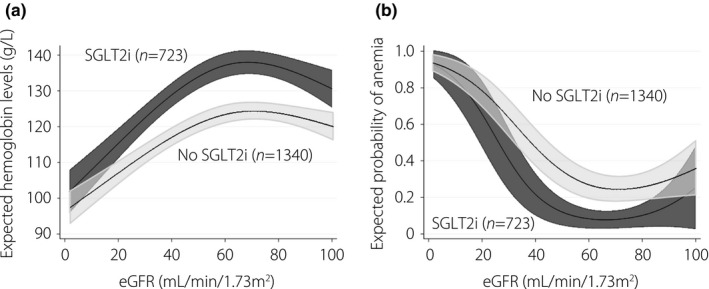
This is a retrospective cohort study. Inclusion criterion was diabetes patients who visited our outpatient clinic from January 2019 to August 2020. Exposure of interest was the use of SGLT2i. Outcomes were hemoglobin levels. For the cross-sectional analyses, non-linear regression models were fitted with restricted cubic splines to investigate the association between hemoglobin levels and estimated glomerular filtration rate (eGFR) for users and non-users of SGLT2i. For the case-control study, cases (anemia defined as hemoglobin <120 g/L for men, <110 g/L for women or the use of erythropoiesis stimulating agents) and controls were matched by age, sex and eGFR.
Among 2,063 diabetes patients, 723 were taking SGLT2i. In the cross-sectional analyses, hemoglobin levels were higher among SGLT2i users compared with non-users at eGFR >15 mL/min/1.73 m . For the case-control study, 197 cases and controls were matched. Conditional logistic regression showed that the use of SGLT2i was associated with significantly lower prevalence of anemia (odd ratio 0.35, 95% confidence interval 0.21-0.58). Adjusted mean differences in hemoglobin levels between users and propensity score-matched non-users of SGLT2i were 7.0 g/L (95% confidence interval 3.0-10.0 g/L) at 6 months. Among SGLT2i users, the odds of an increase in 6-month hemoglobin were similar across eGFR categories, except for eGFR <15 mL/min/1.73 m .
The use of SGLT2i was associated with higher hemoglobin levels and lower prevalence of anemia in real clinical practice.
目的/引言:钠-葡萄糖共转运蛋白 2 抑制剂(SGLT2i)在短期临床试验中被报道能提高血红蛋白水平。但在实际临床实践中是否如此尚不清楚。
这是一项回顾性队列研究。纳入标准为 2019 年 1 月至 2020 年 8 月期间在我院门诊就诊的糖尿病患者。感兴趣的暴露因素是 SGLT2i 的使用。结局是血红蛋白水平。对于横断面分析,使用受限立方样条进行非线性回归模型拟合,以研究 SGLT2i 用户和非用户的血红蛋白水平与估计肾小球滤过率(eGFR)之间的关系。对于病例对照研究,将病例(定义为男性血红蛋白<120g/L,女性血红蛋白<110g/L或使用红细胞生成刺激剂)和对照按年龄、性别和 eGFR 进行匹配。
在 2063 名糖尿病患者中,有 723 名患者服用 SGLT2i。在横断面分析中,与 SGLT2i 非使用者相比,eGFR>15mL/min/1.73m 者的血红蛋白水平更高。对于病例对照研究,匹配了 197 例病例和对照。条件 logistic 回归显示,SGLT2i 的使用与贫血的患病率显著降低相关(比值比 0.35,95%置信区间 0.21-0.58)。SGLT2i 使用者与倾向评分匹配的 SGLT2i 非使用者之间的血红蛋白水平调整平均差异为 6 个月时 7.0g/L(95%置信区间 3.0-10.0g/L)。在 SGLT2i 使用者中,除 eGFR<15mL/min/1.73m 外,6 个月血红蛋白升高的几率在不同 eGFR 类别中相似。
在实际临床实践中,SGLT2i 的使用与较高的血红蛋白水平和较低的贫血患病率相关。