Laboratory for Molecular Pharmacology, Department of Biomedical Sciences, Faculty of Health and Medical Sciences, University of Copenhagen, Copenhagen, Denmark.
Department of Drug Design and Pharmacology, Faculty of Health and Medical Sciences, University of Copenhagen, Copenhagen, Denmark.
J Biol Chem. 2022 Feb;298(2):101413. doi: 10.1016/j.jbc.2021.101413. Epub 2021 Nov 19.
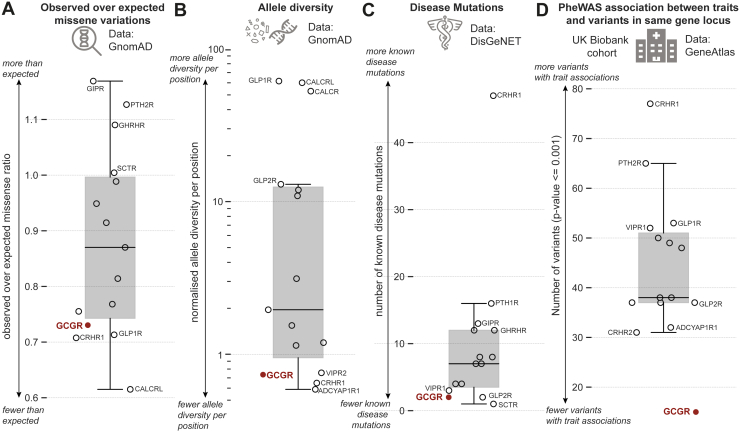
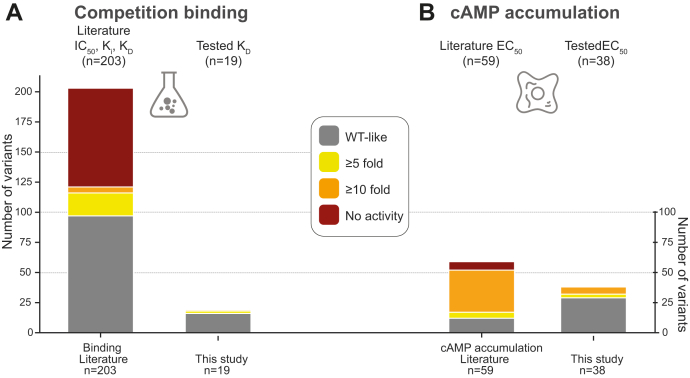
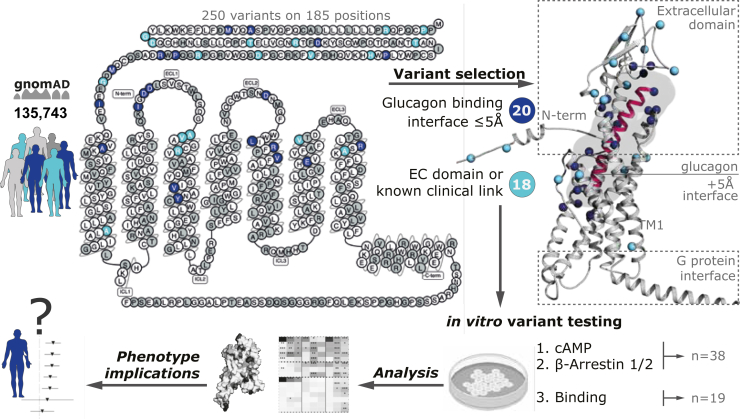
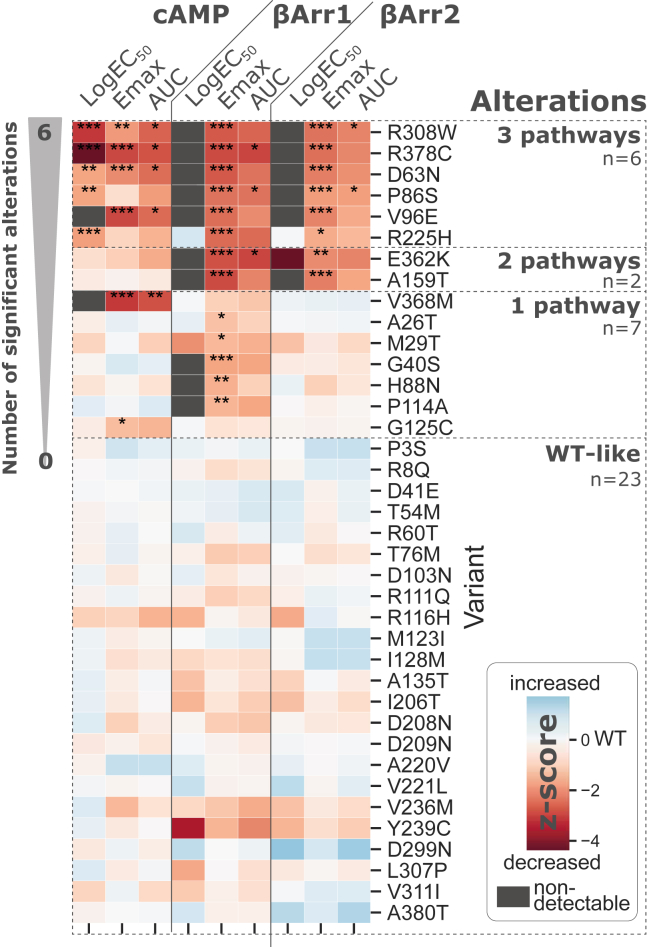
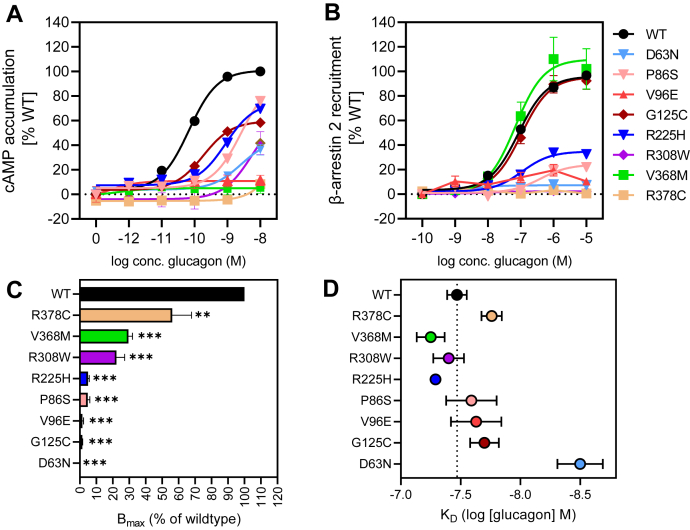
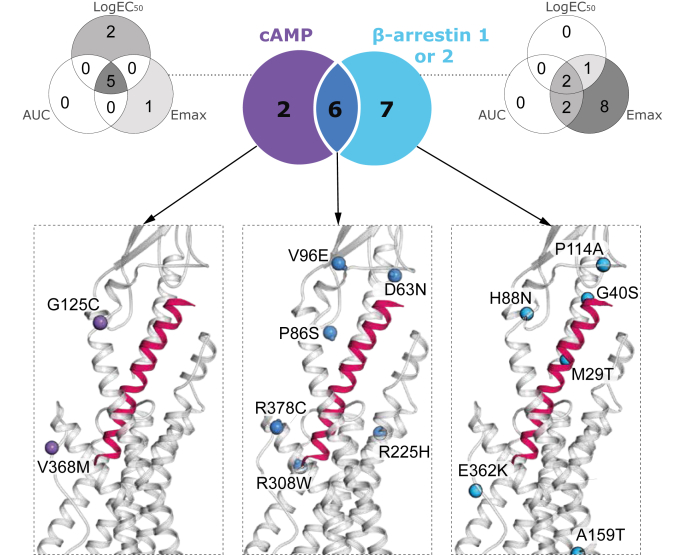
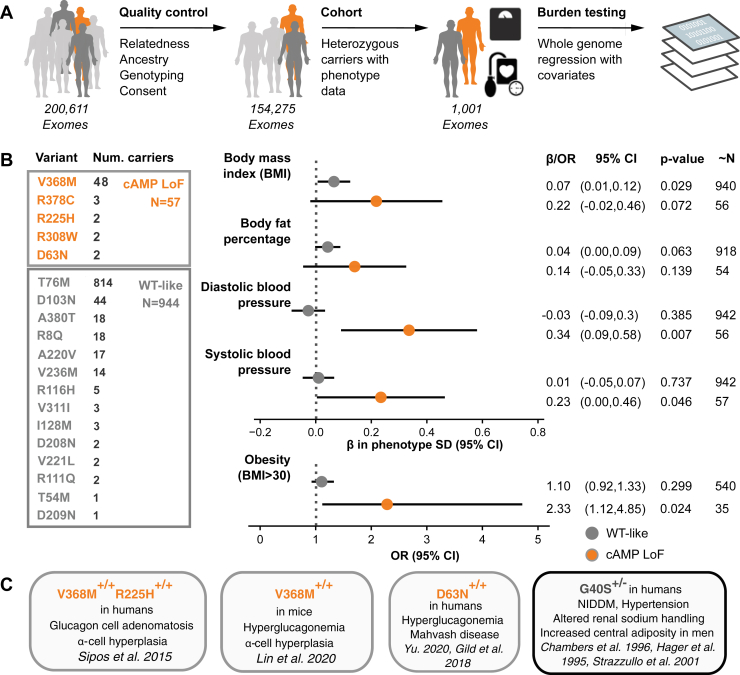
Naturally occurring missense variants of G protein-coupled receptors with loss of function have been linked to metabolic disease in case studies and in animal experiments. The glucagon receptor, one such G protein-coupled receptor, is involved in maintaining blood glucose and amino acid homeostasis; however, loss-of-function mutations of this receptor have not been systematically characterized. Here, we observed fewer glucagon receptor missense variants than expected, as well as lower allele diversity and fewer variants with trait associations as compared with other class B1 receptors. We performed molecular pharmacological phenotyping of 38 missense variants located in the receptor extracellular domain, at the glucagon interface, or with previously suggested clinical implications. These variants were characterized in terms of cAMP accumulation to assess glucagon-induced Gα coupling, and of recruitment of β-arrestin-1/2. Fifteen variants were impaired in at least one of these downstream functions, with six variants affected in both cAMP accumulation and β-arrestin-1/2 recruitment. For the eight variants with decreased Gα signaling (D63N, P86S, V96E, G125C, R225H, R308W, V368M, and R378C) binding experiments revealed preserved glucagon affinity, although with significantly reduced binding capacity. Finally, using the UK Biobank, we found that variants with wildtype-like Gα signaling did not associate with metabolic phenotypes, whereas carriers of cAMP accumulation-impairing variants displayed a tendency toward increased risk of obesity and increased body mass and blood pressure. These observations are in line with the essential role of the glucagon system in metabolism and support that Gα is the main signaling pathway effecting the physiological roles of the glucagon receptor.
在病例研究和动物实验中,具有失活功能的 G 蛋白偶联受体的天然错义变异与代谢疾病有关。胰高血糖素受体就是这样一种 G 蛋白偶联受体,它参与维持血糖和氨基酸的体内平衡;然而,这种受体的功能丧失突变尚未得到系统的描述。在这里,我们观察到的胰高血糖素受体错义变异比预期的要少,等位基因多样性较低,与其他 B1 类受体相比,与表型相关的变异较少。我们对位于受体细胞外结构域、胰高血糖素结合界面或具有先前提示临床意义的 38 个错义变异进行了分子药理学表型分析。这些变异在评估胰高血糖素诱导的 Gα 偶联的 cAMP 积累和β-arrestin-1/2 募集方面的功能进行了特征分析。在至少一种下游功能中存在缺陷的 15 个变异,其中 6 个变异在 cAMP 积累和β-arrestin-1/2 募集方面均受到影响。对于 8 个 Gα 信号降低的变异(D63N、P86S、V96E、G125C、R225H、R308W、V368M 和 R378C),结合实验表明保留了胰高血糖素亲和力,尽管结合能力显著降低。最后,使用英国生物银行,我们发现具有野生型 Gα 信号的变异与代谢表型没有关联,而 cAMP 积累受损变异的携带者则表现出肥胖和体重增加以及血压升高的风险增加的趋势。这些观察结果与胰高血糖素系统在代谢中的重要作用一致,并支持 Gα 是影响胰高血糖素受体生理作用的主要信号通路。