
COVID-19 肺炎所致呼吸衰竭患者行头盔持续气道正压通气治疗中的护理评估:病例系列研究。
Nursing evaluation during treatment with helmet continuous positive airway pressure in patients with respiratory failure due to COVID-19 pneumonia: A case series.
机构信息
Department of Emergency Medicine, ASST Grande Ospedale Metropolitano Niguarda, Milan, Italy.
Department of Emergency Medicine, ASST Grande Ospedale Metropolitano Niguarda, Milan, Italy.
出版信息
Aust Crit Care. 2022 Jan;35(1):46-51. doi: 10.1016/j.aucc.2021.10.001. Epub 2021 Oct 23.
BACKGROUND
During COVID-19 outbreak, with the increasing number of patients presenting with acute respiratory failure, a large use of non invasive positive pressure ventilation was done in the emergency departments and medical wards despite the lack of recommendations.
OBJECTIVES
This study describes the clinical characteristics of patients presenting to the hospital with acute respiratory failure due to COVID-19 related pneumonia undergoing treatment with helmet continuous positive airway pressure (CPAP) with a strict nursing evaluation and monitoring.
METHODS
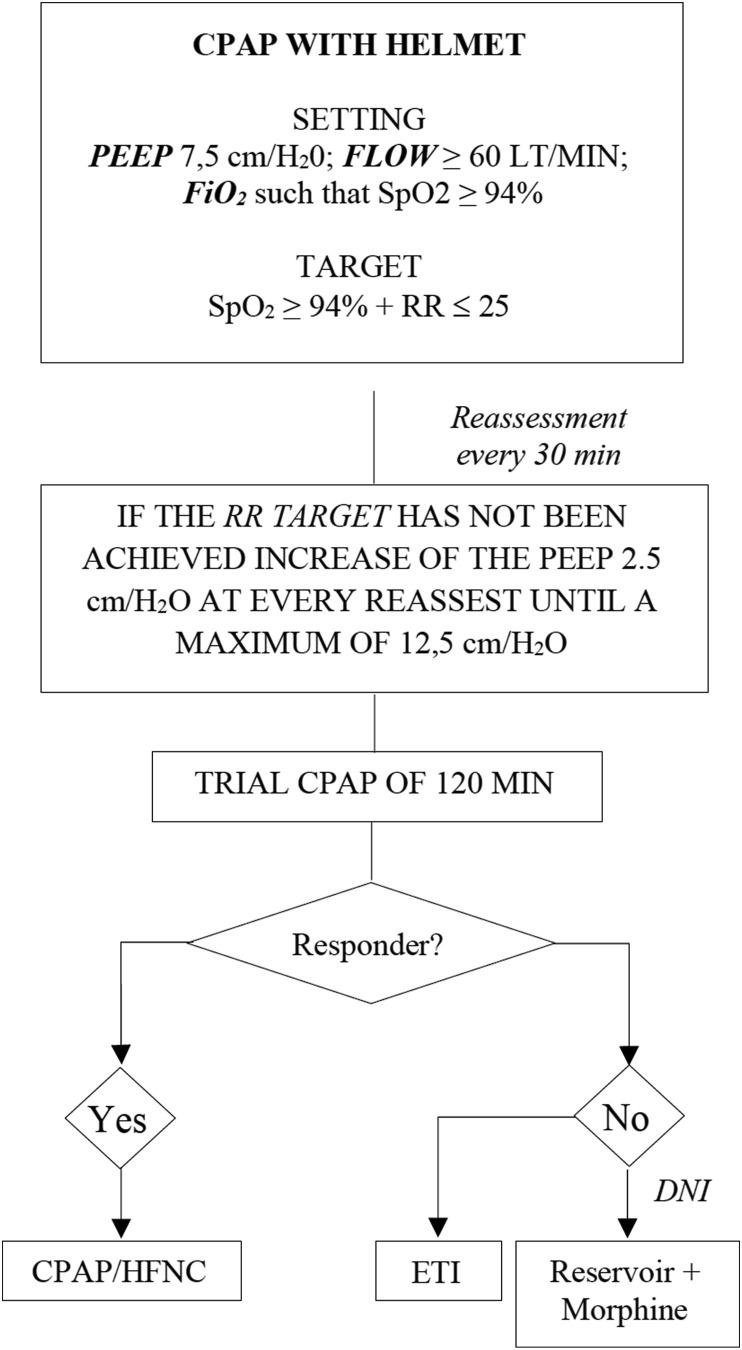
A case series study enrolling adult patients admitted to an emergency department of an Italian hospital with acute respiratory failure due to COVID-19 pneumonia from March 18th to April 18th, 2020, was conducted. Only patients who strictly followed a local CPAP protocol were enrolled.
RESULTS
A total of 52 patients were included in this study. Thirty-eight patients (73%) were judged eligible for endotracheal intubation (ETI). Eighteen (34.6%) were intubated. Sixteen (30.8%) patients died: seven (38.9%) and nine (26.5%) in the eligible-for-ETI and non eligible-for-ETI group, respectively. The median hospital length of stay was different in the ETI and non-ETI group: 26 days (interquartile range [IQR]: 16-37) vs 15 days [IQR 9-17] (p = 0.005). The median invasive mechanical ventilation time was 11 days [IQR 7-21] with an ICU length of stay of 14.5 days [IQR 10-28]. During the CPAP trial, among patients eligible for ETI variations over time for positive end-expiratory pressure (p = 0.003) and respiratory rate (p = 0.059) were found between intubated and non-intubated patients.
CONCLUSIONS
A short closed monitored CPAP trial could be considered for acute respiratory failure due to COVID-19 pneumonia before considering ETI. A progressive positive end-expiratory pressure titration should target reduction in a patient's respiratory rate. More studies are needed to evaluate the efficacy and predictors of failure of CPAP and non-invasive positive pressure ventilation in patients with acute respiratory failure due to COVID-19 pneumonia.
背景
在 COVID-19 疫情期间,由于急性呼吸衰竭患者数量不断增加,尽管缺乏相关建议,急诊科和医疗病房仍大量使用无创正压通气。
目的
本研究描述了因 COVID-19 相关肺炎导致急性呼吸衰竭而接受头盔持续气道正压通气(CPAP)治疗的患者的临床特征,并进行了严格的护理评估和监测。
方法
对 2020 年 3 月 18 日至 4 月 18 日期间因 COVID-19 肺炎导致急性呼吸衰竭而入住意大利一家医院急诊科的成年患者进行了病例系列研究。仅纳入严格遵循当地 CPAP 方案的患者。
结果
本研究共纳入 52 例患者。38 例(73%)患者被认为适合行气管插管(ETI)。18 例(34.6%)患者进行了插管。16 例(30.8%)患者死亡:适合 ETI 组 7 例(38.9%),不适合 ETI 组 9 例(26.5%)。ETI 组和非 ETI 组的中位住院时间不同:26 天(四分位距 [IQR]:16-37)与 15 天 [IQR 9-17](p=0.005)。有创机械通气时间中位数为 11 天 [IQR 7-21],ICU 住院时间为 14.5 天 [IQR 10-28]。在 CPAP 试验期间,在适合 ETI 的患者中,呼气末正压(p=0.003)和呼吸频率(p=0.059)随时间的变化在插管和非插管患者之间存在差异。
结论
对于 COVID-19 肺炎引起的急性呼吸衰竭,在考虑 ETI 之前,可以考虑进行短期密切监测的 CPAP 试验。逐步进行呼气末正压滴定,以降低患者的呼吸频率。需要更多的研究来评估 CPAP 和无创正压通气在 COVID-19 肺炎引起的急性呼吸衰竭患者中的疗效和失败预测因素。


 Zotero 插件