
系统性和靶向性前列腺活检的最新进展
Recent Advances in Systematic and Targeted Prostate Biopsies.
作者信息
Devetzis Konstantinos, Kum Francesca, Popert Richard
机构信息
King's College School of Medicine, London, UK.
Department of Urology, 1st Floor Southwark Wing, Guy's Hospital, London, SE1 9RT, UK.
出版信息
Res Rep Urol. 2021 Nov 13;13:799-809. doi: 10.2147/RRU.S291963. eCollection 2021.
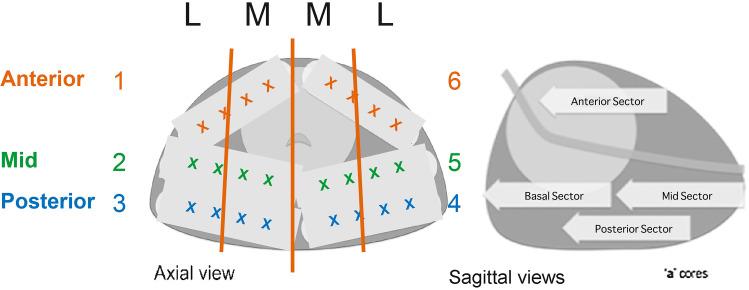
Prostate biopsy is the definitive investigation to diagnose prostate cancer. The ideal procedure would be one that offers fast and efficient results safely as an outpatient procedure. Historically, transrectal ultrasound (TRUS) biopsy is considered the gold standard but transrectal biopsy can under-sample the anterior and apical regions of the prostate and is associated with a risk of prostate biopsy-related sepsis, which may require intensive care admission. Transperineal (TP) biopsy addresses the inefficient sampling of TRUS biopsy but historically has been done under general anaesthetic, which makes it difficult to incorporate into timed diagnostic pathways such as the National Health Service (NHS) 2-week cancer pathway. TRUS biopsy has remained the mainstay of clinical diagnosis because of its simplicity; however, the recent development of simpler local anaesthetic transperineal techniques has transformed outpatient biopsy practice. These techniques practically eliminate prostate biopsy-related sepsis, have a shallow learning curve and offer effective sampling of all areas of the prostate in an outpatient setting. The effectiveness of TP biopsy has been enhanced by the introduction of multiparametric MRI prior to biopsy, the use of PSA density for risk stratification in equivocal cases and combined with more efficient targeted and systematic biopsies techniques, such as the Ginsburg Protocol, has improved the tolerability and diagnostic yield of local anaesthetic TP biopsies, reducing the risk of complications from the oversampling associated with transperineal template mapping biopsies. Areas where the literature remains unclear is the optimum number of cores needed to detect clinically significant disease (CSD) in patients with a definable lesion on MRI, in particular, whether there is a need for systematic biopsy in the face of equivocal MRI findings to ensure no CSD is missed. The Covid-19 pandemic has had a profound impact on prostate cancer referrals and prostate biopsy techniques within the UK; prior to the pandemic 65% of all prostate biopsies were TRUS, since the pandemic the proportions have reversed such that now over 65% of all prostate biopsies in the NHS are transperineal.
前列腺活检是诊断前列腺癌的决定性检查。理想的检查方法应是一种能够作为门诊手术安全地提供快速且有效结果的方法。从历史上看,经直肠超声(TRUS)活检被视为金标准,但经直肠活检可能无法对前列腺的前部和尖部区域进行充分取样,并且存在与前列腺活检相关的脓毒症风险,这可能需要入住重症监护病房。经会阴(TP)活检解决了TRUS活检取样效率低下的问题,但从历史上看,它是在全身麻醉下进行的,这使得它难以纳入诸如英国国家医疗服务体系(NHS)两周癌症诊疗路径等有时间限制的诊断流程。由于其操作简单,TRUS活检一直是临床诊断的主要手段;然而,最近更简单的局部麻醉经会阴技术的发展改变了门诊活检的做法。这些技术几乎消除了与前列腺活检相关的脓毒症,学习曲线较浅,并能在门诊环境中对前列腺的所有区域进行有效取样。在活检前引入多参数MRI、在可疑病例中使用PSA密度进行风险分层,并结合更有效的靶向和系统活检技术(如金斯堡方案),提高了局部麻醉TP活检的耐受性和诊断率,降低了经会阴模板定位活检过度取样相关并发症的风险。文献中仍不明确的领域是,对于MRI上有明确病变的患者,检测临床显著疾病(CSD)所需的最佳活检样本数量,特别是在MRI结果不明确的情况下,是否需要进行系统活检以确保不漏诊CSD。新冠疫情对英国的前列腺癌转诊和前列腺活检技术产生了深远影响;在疫情之前,所有前列腺活检中有65%是TRUS活检,自疫情以来,这一比例发生了逆转,现在NHS中所有前列腺活检中有超过65%是经会阴活检。



 Zotero 插件