Myeloma Center, University of Arkansas for Medical Sciences, Little Rock, AR.
Division of Hematology Oncology, Medical College of Wisconsin, Milwaukee, WI.
Blood Adv. 2022 Feb 8;6(3):808-817. doi: 10.1182/bloodadvances.2021005822.
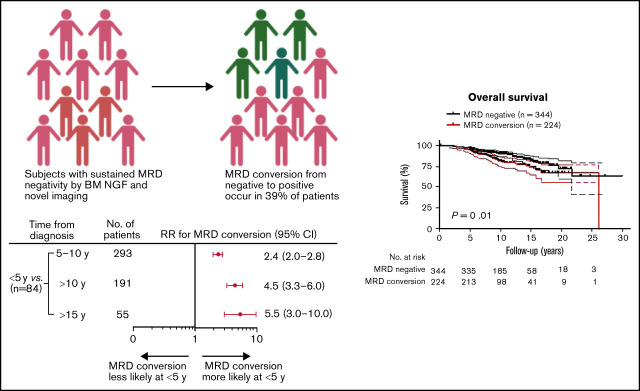
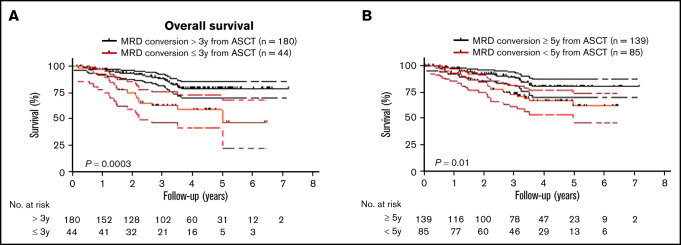
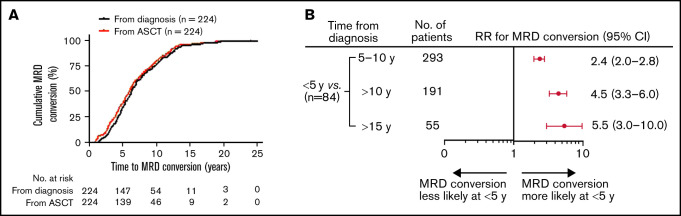
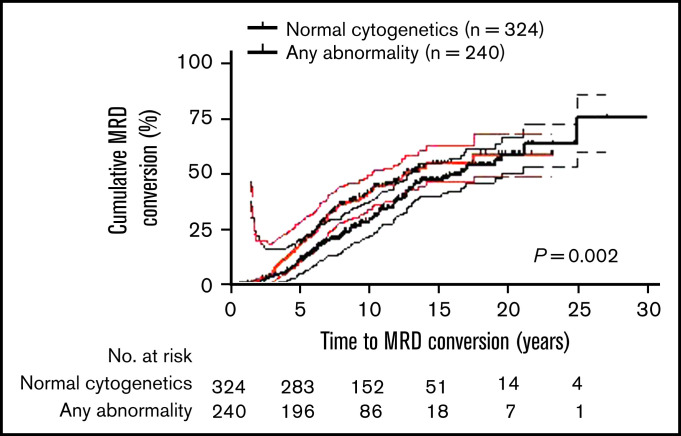
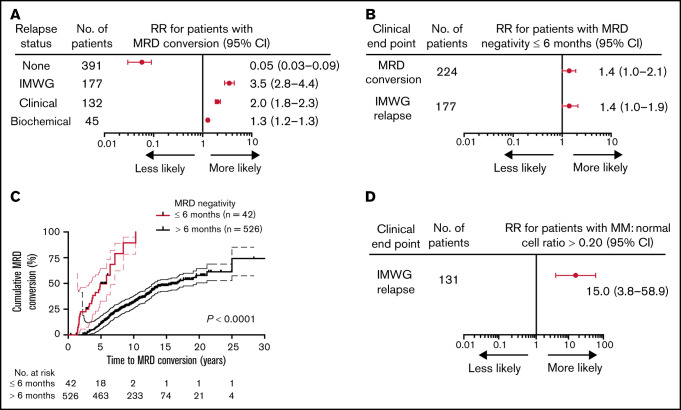
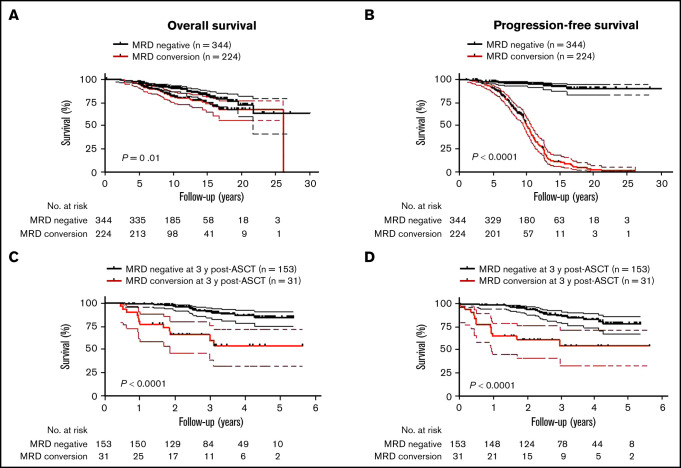
Multiple myeloma (MM) patients frequently attain a bone marrow (BM) minimal residual disease (MRD) negativity status in response to treatment. We identified 568 patients who achieved BM MRD negativity following autologous stem cell transplantation (ASCT) and maintenance combination therapy with an immunomodulatory agent and a proteasome inhibitor. BM MRD was evaluated by next-generation flow cytometry (sensitivity of 10-5 cells) at 3- to 6-month intervals. With a median follow-up of 9.9 years from diagnosis (range, 0.4-30.9), 61% of patients maintained MRD negativity, whereas 39% experienced MRD conversion at a median of 6.3 years (range, 1.4-25). The highest risk of MRD conversion occurred within the first 5 years after treatment and was observed more often in patients with abnormal metaphase cytogenetic abnormalities (95% vs 84%; P = .001). MRD conversion was associated with a high risk of relapse and preceded it by a median of 1.0 years (range, 0-4.9). However, 27% of MRD conversion-positive patients had not yet experienced a clinical relapse, with a median follow-up of 9.3 years (range, 2.2-21.2). Landmark analyses using time from ASCT revealed patients with MRD conversion during the first 3 years had an inferior overall and progression-free survival compared with patients with sustained MRD negativity. MRD conversion correctly predicted relapse in 70%, demonstrating the utility of serial BM MRD assessment to complement standard laboratory and imaging to make informed salvage therapy decisions.
多发性骨髓瘤(MM)患者在治疗后常可达到骨髓(BM)微小残留病(MRD)阴性状态。我们鉴定了 568 例患者,他们在自体造血干细胞移植(ASCT)和免疫调节剂与蛋白酶体抑制剂联合维持治疗后达到 BM-MRD 阴性。通过下一代流式细胞术(敏感性为 10-5 细胞)每 3-6 个月评估一次 BM-MRD。自诊断以来中位随访 9.9 年(范围 0.4-30.9 年),61%的患者保持 MRD 阴性,而 39%的患者在中位 6.3 年(范围 1.4-25 年)时发生 MRD 转化。治疗后前 5 年内发生 MRD 转化的风险最高,且在存在异常中期细胞遗传学异常的患者中更常见(95%比 84%;P=.001)。MRD 转化与复发风险高相关,且其在复发前中位时间为 1.0 年(范围 0-4.9 年)。然而,27%的 MRD 转化阳性患者尚未经历临床复发,中位随访时间为 9.3 年(范围 2.2-21.2 年)。使用从 ASCT 开始的时间进行 landmark 分析显示,在第 1-3 年内发生 MRD 转化的患者与持续 MRD 阴性的患者相比,总生存和无进展生存均较差。MRD 转化正确预测了 70%的复发,证明了连续 BM-MRD 评估的实用性,可补充标准实验室和影像学检查,以做出明智的挽救治疗决策。