Chuang Min-Chun, Yang Yao-Hsu, Hsieh Meng-Jer, Lin Yu-Ching, Yang Tsung-Ming, Chen Pau-Chung, Hung Ming-Szu
Department of Pulmonary and Critical Care Medicine, Chang-Gung Memorial Hospital at Chiayi, Chang-Gung Medical Foundation, No. 6, West Section, Chia-Pu Road, Pu-Tz City, Chiayi, 613, Taiwan.
Department of Respiratory Therapy, School of Medicine, Chang-Gung University, Taoyuan City, Taiwan.
BMC Cancer. 2021 Nov 22;21(1):1257. doi: 10.1186/s12885-021-08999-8.
Studies have indicated that individuals taking aspirin have a reduced risk of cancers and have also established chemo-preventive benefit of aspirin in colorectal cancer. However, research on the association between aspirin use and the survival in patients with lung cancer has revealed inconsistent results. In this study, we investigated the effect of aspirin use on the survival of inoperable non-small cell lung cancer (NSCLC) patients.
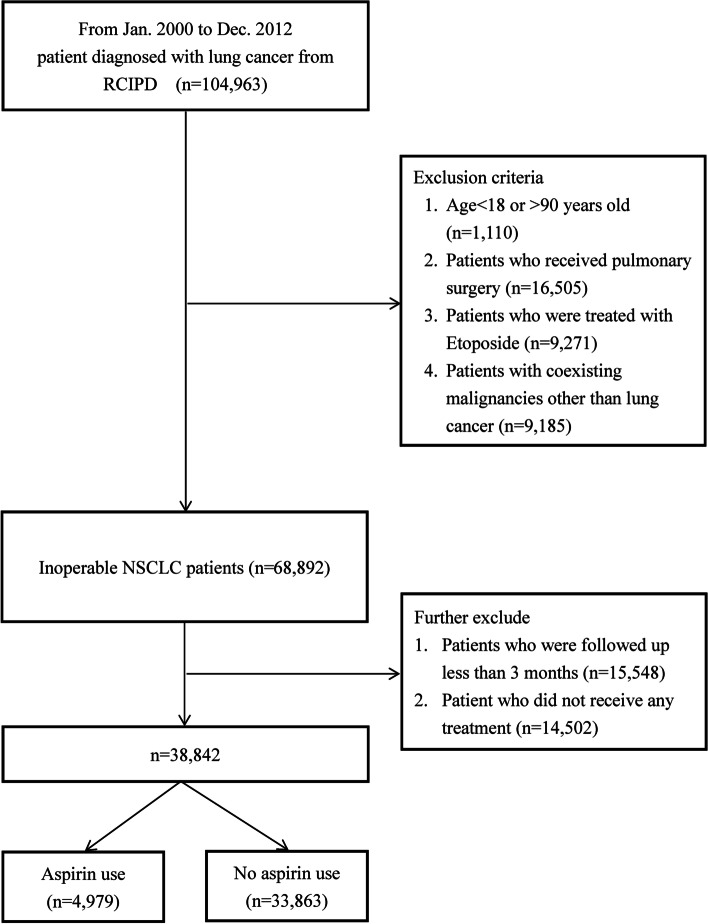
We identified a cohort of 38,842 patients diagnosed with NSCLC between 2000 and 2012 using the Taiwan's National Health Insurance Research Database and used propensity score matching to reduce possible confounding factors. In total, 9864 patients (4932 matched pairs) were included in the matched cohort. Aspirin exposure was analyzed to identify a possible association with mortality in patients with inoperable NSCLC. Time-dependent Cox regression models were used to calculate the hazard ratios (HRs) and the 95% confidence intervals (95% CIs) that corresponded with aspirin exposure.
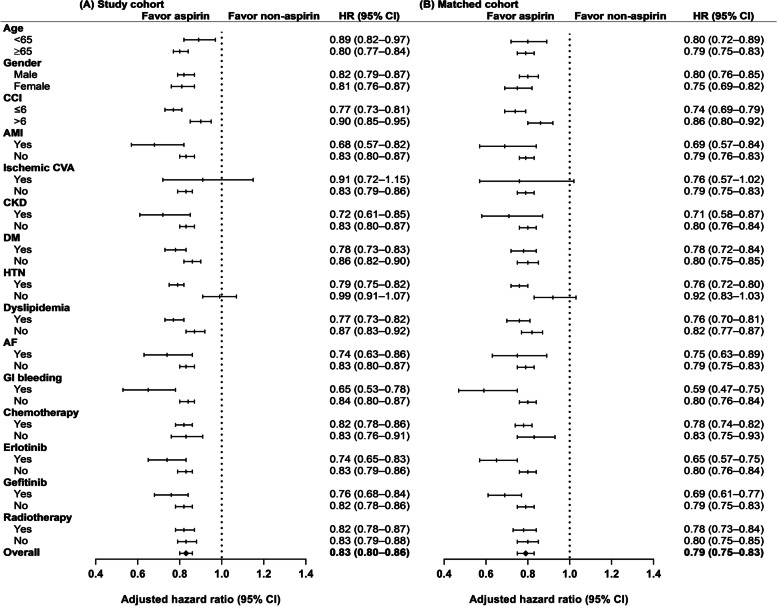
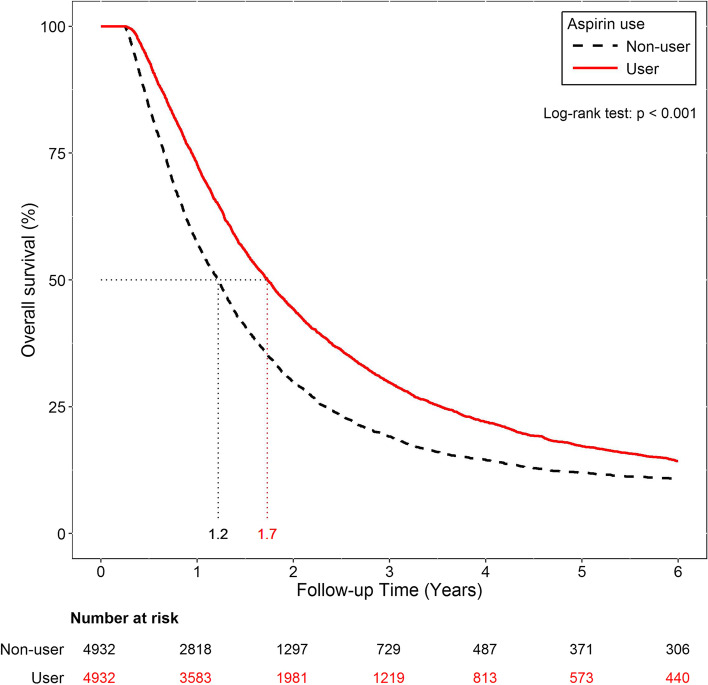
A total of 4979 patients used aspirin at the time of diagnosis of NSCLC. The median overall survival (OS) of the aspirin users was 1.73 (interquartile range, 0.94-3.53) years compared with the 1.30 (interquartile range, 0.69-2.62) years of the non-aspirin users. The Cox proportional hazard model with the time-dependent covariate revealed that aspirin use was associated with a significantly longer OS (HR: 0.83, 95.0% CI: 0.80-0.86). After controlling the sociodemographic characteristics (age, sex, income, and level of urbanization) and lung cancer treatments by propensity score matching, the aspirin users still had a significantly longer OS than the non-aspirin users (HR: 0.79, 95.0% CI: 0.75-0.83).
Aspirin use is associated with a longer OS in patients with inoperable NSCLC, suggesting that aspirin has a potential anticancer effect. These results warrant further randomized clinical trials to evaluate the actual role of aspirin in the treatment of NSCLC patients.
研究表明,服用阿司匹林的个体患癌症的风险降低,并且已证实阿司匹林在结直肠癌中有化学预防作用。然而,关于阿司匹林使用与肺癌患者生存率之间关联的研究结果并不一致。在本研究中,我们调查了阿司匹林使用对无法手术的非小细胞肺癌(NSCLC)患者生存率的影响。
我们使用台湾国民健康保险研究数据库,确定了一组在2000年至2012年期间被诊断为NSCLC的38842例患者,并使用倾向评分匹配来减少可能的混杂因素。匹配队列中总共纳入了9864例患者(4932对匹配)。分析阿司匹林暴露情况,以确定其与无法手术的NSCLC患者死亡率之间的可能关联。使用时间依赖性Cox回归模型计算与阿司匹林暴露相对应的风险比(HR)和95%置信区间(95%CI)。
共有4979例患者在诊断NSCLC时使用了阿司匹林。阿司匹林使用者的中位总生存期(OS)为1.73年(四分位间距,0.94 - 3.53年),而非阿司匹林使用者为1.30年(四分位间距,0.69 - 2.62年)。具有时间依赖性协变量的Cox比例风险模型显示,使用阿司匹林与显著更长的OS相关(HR: 0.83,95.0%CI:0.80 - 0.86)。通过倾向评分匹配控制社会人口统计学特征(年龄、性别、收入和城市化水平)和肺癌治疗后,阿司匹林使用者的OS仍显著长于非阿司匹林使用者(HR:0.79,95.0%CI:0.75 - 0.83)。
使用阿司匹林与无法手术的NSCLC患者更长的OS相关,表明阿司匹林具有潜在的抗癌作用。这些结果值得进一步进行随机临床试验,以评估阿司匹林在NSCLC患者治疗中的实际作用。