
多参数心血管磁共振联合雷卡地诺生负荷灌注检查在小儿心脏移植后是安全的,可识别排斥反应和心脏移植物血管病的病史。
Multi-parametric cardiovascular magnetic resonance with regadenoson stress perfusion is safe following pediatric heart transplantation and identifies history of rejection and cardiac allograft vasculopathy.
机构信息
Department of Cardiology, Ann and Robert H. Lurie Children's Hospital of Chicago, Chicago, USA.
Department of Pediatrics, Feinberg School of Medicine, Northwestern University, Chicago, USA.
出版信息
J Cardiovasc Magn Reson. 2021 Nov 22;23(1):135. doi: 10.1186/s12968-021-00803-7.
BACKGROUND
The progressive risk of graft failure in pediatric heart transplantation (PHT) necessitates close surveillance for rejection and coronary allograft vasculopathy (CAV). The current gold standard of surveillance via invasive coronary angiography is costly, imperfect and associated with complications. Our goal was to assess the safety and feasibility of a comprehensive multi-parametric CMR protocol with regadenoson stress perfusion in PHT and evaluate for associations with clinical history of rejection and CAV.
METHODS
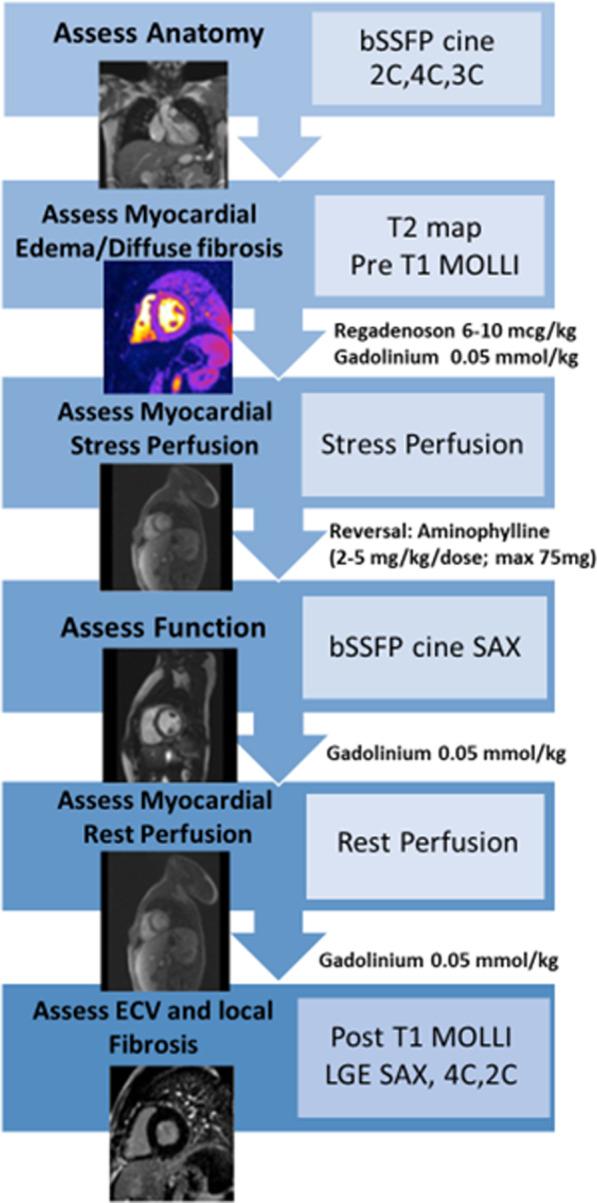
We performed a retrospective review of 26 PHT recipients who underwent stress CMR with tissue characterization and compared with 18 age-matched healthy controls. CMR protocol included myocardial T2, T1 and extracellular volume (ECV) mapping, late gadolinium enhancement (LGE), qualitative and semi-quantitative stress perfusion (myocardial perfusion reserve index; MPRI) and strain imaging. Clinical, demographics, rejection score and CAV history were recorded and correlated with CMR parameters.
RESULTS
Mean age at transplant was 9.3 ± 5.5 years and median duration since transplant was 5.1 years (IQR 7.5 years). One patient had active rejection at the time of CMR, 11/26 (42%) had CAV 1 and 1/26 (4%) had CAV 2. Biventricular volumes were smaller and cardiac output higher in PHT vs. healthy controls. Global T1 (1053 ± 42 ms vs 986 ± 42 ms; p < 0.001) and ECV (26.5 ± 4.0% vs 24.0 ± 2.7%; p = 0.017) were higher in PHT compared to helathy controls. Significant relationships between changes in myocardial tissue structure and function were noted in PHT: increased T2 correlated with reduced LVEF (r = - 0.57, p = 0.005), reduced global circumferential strain (r = - 0.73, p < 0.001) and reduced global longitudinal strain (r = - 0.49, p = 0.03). In addition, significant relationships were noted between higher rejection score and global T1 (r = 0.38, p = 0.05), T2 (r = 0.39, p = 0.058) and ECV (r = 0.68, p < 0.001). The presence of even low-grade CAV was associated with higher global T1, global ECV and maximum segmental T2. No major side effects were noted with stress testing. MPRI was analyzed with good interobserver reliability and was lower in PHT compared to healthy controls (0.69 ± - 0.21 vs 0.94 ± 0.22; p < 0.001).
CONCLUSION
In a PHT population with low incidence of rejection or high-grade CAV, CMR demonstrates important differences in myocardial structure, function and perfusion compared to age-matched healthy controls. Regadenoson stress perfusion CMR could be safely and reliably performed. Increasing T2 values were associated with worsening left ventricular function and increasing T1/ECV values were associated with rejection history and low-grade CAV. These findings warrant larger prospective studies to further define the role of CMR in PHT graft surveillance.
背景
小儿心脏移植(PHT)中移植物衰竭的风险逐渐增加,因此需要密切监测排斥反应和冠状动脉移植血管病(CAV)。目前通过有创冠状动脉造影进行监测的金标准既昂贵又不完善,且存在相关并发症。我们的目标是评估在 PHT 中使用带有钆对比剂的压力灌注的全面多参数心脏磁共振(CMR)方案的安全性和可行性,并评估其与排斥反应和 CAV 临床病史的相关性。
方法
我们对 26 名接受压力 CMR 检查的 PHT 受者进行了回顾性分析,并与 18 名年龄匹配的健康对照者进行了比较。CMR 方案包括心肌 T2、T1 和细胞外容积(ECV)映射、晚期钆增强(LGE)、定性和半定量压力灌注(心肌灌注储备指数;MPRI)和应变成像。记录了临床、人口统计学、排斥反应评分和 CAV 病史,并与 CMR 参数相关联。
结果
移植时的平均年龄为 9.3±5.5 岁,移植后中位数时间为 5.1 年(IQR 7.5 年)。1 名患者在 CMR 时存在活跃性排斥反应,11/26(42%)名患者存在 1 级 CAV,1/26(4%)名患者存在 2 级 CAV。与健康对照组相比,PHT 的双心室容积较小,心输出量较高。与健康对照组相比,PHT 的整体 T1(1053±42ms 比 986±42ms;p<0.001)和 ECV(26.5±4.0%比 24.0±2.7%;p=0.017)更高。在 PHT 中,心肌组织结构和功能的变化之间存在显著相关性:T2 的增加与 LVEF 的降低相关(r=-0.57,p=0.005),整体圆周应变降低(r=-0.73,p<0.001)和整体纵向应变降低(r=-0.49,p=0.03)。此外,更高的排斥反应评分与整体 T1(r=0.38,p=0.05)、T2(r=0.39,p=0.058)和 ECV(r=0.68,p<0.001)之间存在显著相关性。即使存在低级别 CAV,也与更高的整体 T1、整体 ECV 和最大节段 T2 相关。压力测试无主要副作用。MPRI 的观察者间可靠性良好,与健康对照组相比,PHT 中的 MPRI 较低(0.69±-0.21 比 0.94±0.22;p<0.001)。
结论
在 PHT 人群中,排斥反应或高级 CAV 的发生率较低,与年龄匹配的健康对照组相比,CMR 显示心肌结构、功能和灌注存在重要差异。带有钆对比剂的压力灌注 CMR 可以安全可靠地进行。T2 值的增加与左心室功能的恶化相关,而 T1/ECV 值的增加与排斥反应病史和低级别 CAV 相关。这些发现需要更大的前瞻性研究来进一步确定 CMR 在 PHT 移植物监测中的作用。



 Zotero 插件