School of Energy Engineering, Yulin University, Yulin, 719000, China.
State Key Laboratory of Continental Dynamics, Department of Geology, Northwest University, Xi'an, 710069, China.
Sci Rep. 2021 Nov 22;11(1):22712. doi: 10.1038/s41598-021-02053-0.
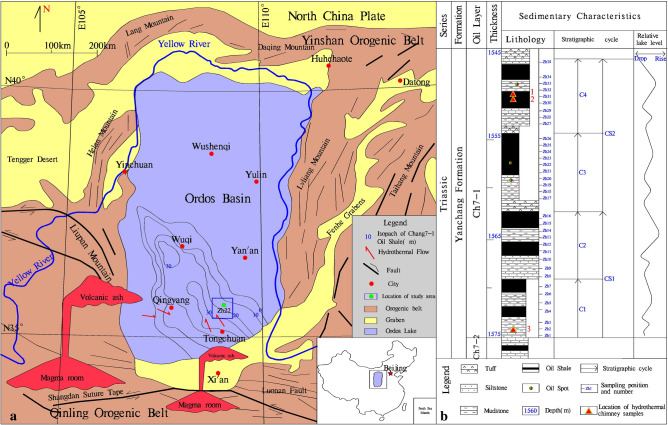
Because few well-preserved hydrothermal chimneys have been found in terrestrial sedimentary rocks, research on paleo-thermal vents in geological history is relatively sparse. In this study, we present our original discovery of "hydrothermal chimneys" from the Chang 7 source rocks of the Triassic Yanchang Formation in the Ordos Basin, China, and provide the best evidence for deciphering hydrothermal activity preserved in the geological record (i.e., sedimentary rocks). Three possible chimney samples (i.e., samples 1551.6, 1551.6-2 and 1574.4) were collected for this study; they were interbedded with mudstones and oil shales, indicative of a deep-lake sedimentary environment. All three samples consist mainly of anhydrite, pyrite, and dolomite with the formation of mineral zoning across the walls of these structures, suggesting a sulfate-dominated stage and a carbonate-sulfide replacement stage. Moreover, their in situ geochemistry is characterized by high Eu, U, Th, Sr, Mn and U/Th ratios, which are typical indicators of hydrothermal vents. In addition, their S isotopes range from 7.89% to 10.88%, near the values of magma sulfur, implying a possible magmatic trigger for these hydrothermal vents. All this evidence shows that the Triassic sedimentary rocks of the Ordos Basin probably contain hydrothermal chimneys. Comparing ancient hydrothermal chimneys to modern hydrothermal chimneys, we should note the important implications of ancient chimneys; their formation mechanism may have been related to oil production, and they are possible indicators for future oil investigations. Further, they have great significance for studying the hydrothermal properties of primary dolomite.
由于在陆相沉积岩中很少发现保存完好的热液烟囱,因此对地质历史时期古热液喷口的研究相对较少。在本研究中,我们首次在鄂尔多斯盆地三叠系延长组的长 7 烃源岩中发现了“热液烟囱”,为破译地质记录(即沉积岩)中保存的热液活动提供了最佳证据。为此研究采集了三个可能的烟囱样本(即样品 1551.6、1551.6-2 和 1574.4),它们与泥岩和油页岩互层,表明其形成于深湖沉积环境。这三个样本主要由硬石膏、黄铁矿和白云石组成,这些结构的壁上形成了矿物分带,表明经历了硫酸盐占主导的阶段和碳酸盐-硫化物交代阶段。此外,其原地地球化学特征为高 Eu、U、Th、Sr、Mn 和 U/Th 比值,这些都是热液喷口的典型指标。此外,它们的 S 同位素范围为 7.89%至 10.88%,接近岩浆硫的范围,暗示这些热液喷口可能存在岩浆触发。所有这些证据表明,鄂尔多斯盆地三叠系沉积岩中可能含有热液烟囱。将古代热液烟囱与现代热液烟囱进行比较,我们应该注意到古代烟囱的重要意义;其形成机制可能与石油生产有关,并且可能是未来石油调查的指示标志。此外,它们对研究原生白云石的热液性质具有重要意义。