Zhang Wenhua, Hong Deng, Lei Meikang, Hu Xiaoli, Hou Jianbo, Xie Wen, Xu Dunming, Yi Xionghai, Li You
Technic Center of Hangzhou Customs, Hangzhou 310016, China.
Zhejiang Academy of Science and Technology for Inspection and Quarantine, Hangzhou 310016, China.
Se Pu. 2021 Dec;39(12):1347-1354. doi: 10.3724/SP.J.1123.2021.06045.
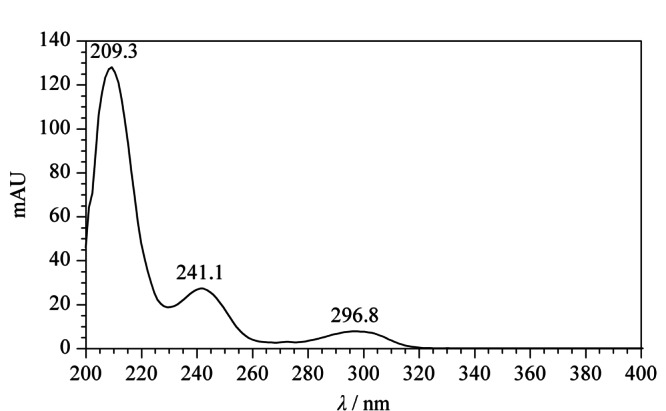
Clenbuterol enantiomers differ greatly in their bioactivities. By optimizing the conditions for chromatographic separation and method validation, ultra-performance convergence chromatography (UPC) was adopted to separate the enantiomers of clenbuterol. Standard solutions of (+)-clenbuterol and (-)-clenbuterol were stored at -18 ℃ for 1, 3, 5, 7, 14, 30, and 60 d, and then, their stability was monitored. The impacts of different chromatographic columns, cosolvents, system backpressure, and chromatographic column temperature on the separation of the two enantiomers were investigated. Acquity Trefoil AMY1 (150 mm×3.0 mm, 2.5 μm) was used for separation, and CO-0.5% (v/v) ammonium acetate was used as the mobile phase. Gradient elution at a flow rate of 2.0 mL/min was adopted. The detection wavelength was set to 241 nm, and the injection volume was set to 10 μL. The backpressure was set to 13.8 MPa, and the column temperature was maintained at 40 ℃. The two enantiomers showed good linear relationships in the range of 1.0 to 20.0 mg/L with correlation coefficients greater than 0.9997. The limits of detection (LODs, =3) of (+)-clenbuterol and (-)-clenbuterol were both 0.5 mg/L. The relative standard deviation (RSD, =6) for the peak area of the 10.0 mg/L mixed standard working solution with six replicate injections ranged from 0.65% to 0.76%. The effectiveness and practicability of this method were demonstrated by using it to detect standard clenbuterol racemate. The (+)-clenbuterol and (-)-clenbuterol contents were 5.6 mg/L and 5.5 mg/L, respectively, in the standard clenbuterol racemates, as determined by the external standard method of quantification. The detection results suggested that the content ratio of (+)-clenbuterol and (-)-clenbuterol was close to 1.02∶1.00, which is consistent with the literature data. The established method has the advantages of rapid analysis, good separation effect, and low consumption of organic solvents, and it is suitable for the separation of clenbuterol enantiomers. This method can also provide technical support for the separation of other chiral drugs, analysis of the effects of chiral drugs, and assessment of product quality.
克仑特罗对映体的生物活性差异很大。通过优化色谱分离条件和方法验证,采用超高效汇聚色谱法(UPC)分离克仑特罗对映体。将(+)-克仑特罗和(-)-克仑特罗标准溶液在-18℃下储存1、3、5、7、14、30和60天,然后监测其稳定性。研究了不同色谱柱、共溶剂、系统背压和色谱柱温度对两种对映体分离的影响。采用Acquity Trefoil AMY1(150 mm×3.0 mm,2.5μm)进行分离,以CO-0.5%(v/v)乙酸铵为流动相。采用梯度洗脱,流速为2.0 mL/min。检测波长设定为241 nm,进样量设定为10μL。背压设定为13.8 MPa,柱温保持在40℃。两种对映体在1.0至20.0 mg/L范围内呈良好的线性关系,相关系数大于0.9997。(+)-克仑特罗和(-)-克仑特罗的检测限(LOD,n = 3)均为0.5 mg/L。10.0 mg/L混合标准工作溶液六次重复进样的峰面积相对标准偏差(RSD,n = 6)在0.65%至0.76%之间。通过用该方法检测标准克仑特罗外消旋体,证明了该方法的有效性和实用性。采用外标法定量测定,标准克仑特罗外消旋体中(+)-克仑特罗和(-)-克仑特罗的含量分别为5.6 mg/L和 5.5 mg/L。检测结果表明,(+)-克仑特罗与(-)-克仑特罗的含量比接近1.02∶1.00,与文献数据一致。所建立的方法具有分析速度快、分离效果好、有机溶剂消耗低等优点,适用于克仑特罗对映体的分离。该方法还可为其他手性药物的分离、手性药物效果分析及产品质量评估提供技术支持。