Department of Plastic Surgery, 522567Amsterdam University Medical Center, Emma Children's Hospital, AZ, Amsterdam, the Netherlands.
Department of Dentistry, University of Dundee Dental Hospital & School, Dundee, Scotland, UK.
Cleft Palate Craniofac J. 2023 Feb;60(2):189-196. doi: 10.1177/10556656211057368. Epub 2021 Nov 23.
This study aimed to identify commonly used classification systems by cleft providers around the world, including the perceived indications and limitations of each system.
A cross-sectional survey.
A total of 197 registrants from three international cleft/craniofacial meetings.
Participants were sent a web-based questionnaire concerning cleft classification systems.
Frequency of commonly used classification systems, their perceived indications and limitations.
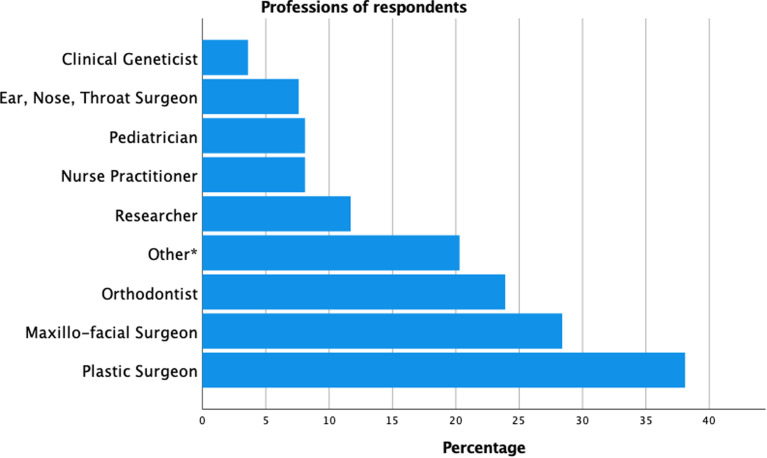
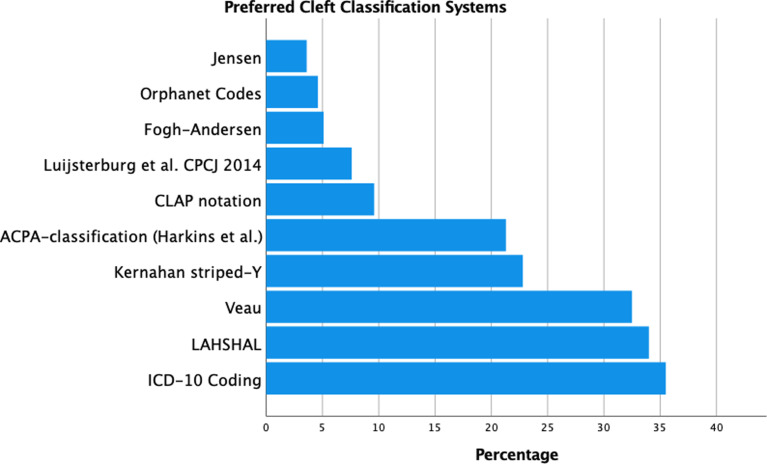
A total of 197 respondents from 166 different centers completed the questionnaire. Healthcare professionals from all disciplines responded, with the most frequent respondents being plastic surgeons (38.1%), maxillofacial surgeons (28.4%) and orthodontists (23.9%). Eighteen different classification systems were in use. The most frequently used systems were the International Statistical Classification of Diseases and Related Health Problems (ICD-10) (35.5%), LAHSHAL (34.0%), and Veau (32.5%) classification systems. Most respondents (32.5%) indicated that anatomical and morphological characteristics are essential components of a classification system. However, respondents indicated that their current classification systems lacked sufficient description of cleft extension and severity.
Great variety in the use of classification systems exists among craniofacial specialists internationally. The results recommend the usage of the LAHSHAL classification of OFCs, due to its comprehensiveness, relatively high implementation rate globally, convenience of usage and complementarity with the ICD-10 system. Moreover, it can overcome deficiencies inextricably linked to ICD-10, such as incapacity to describe laterality and clefts of the alveolus. More international exposure to the merits of using the LAHSHAL classification system would be highly recommended.
本研究旨在确定全球唇腭裂医生常用的分类系统,包括对每个系统的适应证和局限性的认识。
横断面调查。
来自三个国际唇腭裂/颅面会议的共 197 名注册者。
向参与者发送了一份关于唇腭裂分类系统的网络问卷。
常用分类系统的频率、它们的适应证和局限性。
来自 166 个不同中心的 197 名应答者完成了问卷。所有学科的医疗保健专业人员都做出了回应,最常见的应答者是整形外科医生(38.1%)、颌面外科医生(28.4%)和正畸医生(23.9%)。共使用了 18 种不同的分类系统。使用最频繁的系统是国际疾病分类和相关健康问题统计分类(ICD-10)(35.5%)、LAHSHAL(34.0%)和 Veau(32.5%)分类系统。大多数应答者(32.5%)表示,解剖学和形态学特征是分类系统的重要组成部分。然而,应答者表示他们目前的分类系统缺乏对裂隙延伸和严重程度的充分描述。
国际颅面专家对分类系统的使用存在很大差异。结果推荐使用 LAHSHAL 颅面裂隙分类,因为它全面、在全球范围内的实施率相对较高、使用方便,并且与 ICD-10 系统互补。此外,它可以克服与 ICD-10 相关的固有缺陷,如不能描述偏侧性和牙槽裂。强烈建议更多地了解使用 LAHSHAL 分类系统的优点。