Department of Psychiatry and Psychotherapy, Tübingen Center for Mental Health (TüCMH), Neurophysiology and Interventional Neuropsychiatry, University of Tübingen, Calwerstraße 14, 72076, Tübingen, Germany.
J Neural Transm (Vienna). 2022 Jun;129(5-6):649-659. doi: 10.1007/s00702-021-02444-7. Epub 2021 Nov 23.
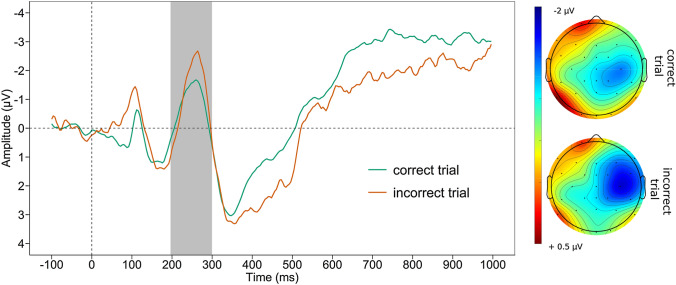
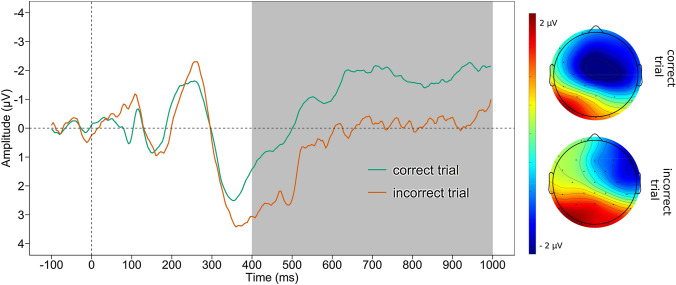
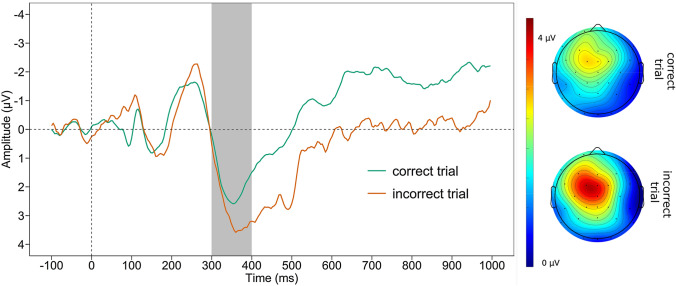
Major depression disorder (MDD) is characterized by cognitive control (CC) dysfunctions associated with increased attention toward negative information. The paced auditory serial addition task (PASAT) has been used as a targeted training of CC and studies show promising effects on depressive symptoms. However, neural mechanisms underlying its efficacy are still unclear. Based on previous findings of feedback-locked event-related potentials in healthy subjects, we investigated neural signatures during PASAT performance in 46 depressed patients. We found significantly larger amplitudes after negative than positive feedback for the P300 and late positive potential (LPP). However, this difference was not significant for the feedback-related negativity (FRN). Moreover, no associations of valence-specific ERPs and PASAT performance nor depressive symptoms were found. This indicates that depressed patients seem unable to use neural activation in late feedback processing stages (P300, LPP) to adapt accordingly. Moreover, lack of valence-specific neural reaction in early feedback processing stages (FRN) might point toward emotional indifference in depressed patients.Trial registration number: NCT03518749 Date of registration: May 8, 2018.
重度抑郁症(MDD)的特征是认知控制(CC)功能障碍,与对负面信息的过度关注有关。 paced auditory serial addition task(PASAT)已被用作 CC 的靶向训练,研究表明对抑郁症状有明显的效果。然而,其疗效的神经机制仍不清楚。基于健康受试者中反馈锁定事件相关电位的先前发现,我们研究了 46 名抑郁症患者在进行 PASAT 时的神经特征。我们发现,与正反馈相比,负反馈时 P300 和晚期正电位(LPP)的振幅明显更大。然而,反馈相关负波(FRN)的差异并不显著。此外,没有发现效价特异性 ERPs 与 PASAT 表现或抑郁症状之间存在关联。这表明抑郁症患者似乎无法利用晚期反馈处理阶段(P300、LPP)的神经激活来进行相应的调整。此外,早期反馈处理阶段(FRN)中缺乏效价特异性神经反应可能表明抑郁症患者情绪冷漠。试验注册号:NCT03518749 注册日期:2018 年 5 月 8 日。