Department of Clinical Biochemistry, Royal Free Hospital, London, United Kingdom.
UCL Research Department of Infection & Population Health, Royal Free Hospital, London, United Kingdom.
PLoS One. 2021 Nov 23;16(11):e0260313. doi: 10.1371/journal.pone.0260313. eCollection 2021.
BACKGROUND/AIMS: Non-alcoholic fatty liver disease (NAFLD) represents a significant public health issue. Identifying patients with simple steatosis from those with non-alcoholic steatohepatitis (NASH) is crucial since NASH is correlated with increased morbidity and mortality. Serum-based markers, including adipokines and cytokines, are important in the pathogenesis and progression of NAFLD. Here we assessed the usefulness of such markers in patients with NAFLD.
This prospective, cross-sectional study included 105 adult patients with varying severity of NAFLD. Twelve serum-based markers were measured by 3 biochip platforms and 2 enzyme-linked immunosorbent assay (ELISA) methods. We also developed a NAFLD individual fibrosis index (NIFI) using the serum-based markers mostly correlated with fibrosis severity.
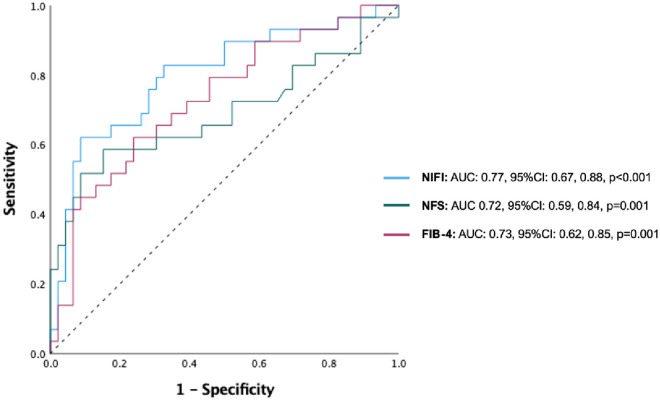
Sixty-one out of 105 patients were male (58.1%) with mean age was 53.5 years. Higher Interleukin-6 (IL-6) increased (p = 0.0321) and lower Matrix Metalloproteinase-9 (MMP-9) serum levels (p = 0.0031) were associated with higher fibrosis as measured by Fibroscan® in multivariable regression analysis. Using receiver-operating characteristic (ROC) curve analysis for the NIFI, area under the curve for predicting Fibroscan values ≥ 7.2 kPa was 0.77 (95%CI: 0.67, 0.88, p<0.001), with sensitivity of 89.3%, specificity of 57.9% and a positive likelihood ratio of 2.8.
Increasing fibrosis severity in NAFLD is associated with differential expression of IL-6 and MMP-9. NIFI could be valuable for the prediction of advanced NAFLD fibrosis and potentially help avoid unnecessary interventions such as liver biopsy in low-risk patients.
背景/目的:非酒精性脂肪性肝病(NAFLD)是一个重大的公共卫生问题。从非酒精性脂肪性肝炎(NASH)患者中鉴别出单纯性脂肪变性患者非常重要,因为 NASH 与发病率和死亡率的增加相关。血清标志物,包括脂肪因子和细胞因子,在 NAFLD 的发病机制和进展中起重要作用。在此,我们评估了这些标志物在 NAFLD 患者中的应用价值。
这是一项前瞻性、横断面研究,纳入了 105 例不同严重程度的 NAFLD 成年患者。通过 3 种生物芯片平台和 2 种酶联免疫吸附测定(ELISA)方法检测了 12 种血清标志物。我们还使用与纤维化严重程度最相关的血清标志物开发了一种 NAFLD 个体纤维化指数(NIFI)。
105 例患者中 61 例(58.1%)为男性,平均年龄为 53.5 岁。多变量回归分析显示,白细胞介素 6(IL-6)水平升高(p=0.0321)和基质金属蛋白酶 9(MMP-9)血清水平降低(p=0.0031)与 Fibroscan®检测到的更高纤维化程度相关。使用 NIFI 的 ROC 曲线分析,预测 Fibroscan 值≥7.2kPa 的曲线下面积为 0.77(95%CI:0.67,0.88,p<0.001),敏感性为 89.3%,特异性为 57.9%,阳性似然比为 2.8。
NAFLD 纤维化程度的增加与 IL-6 和 MMP-9 的差异表达相关。NIFI 可能对预测晚期 NAFLD 纤维化有价值,并可能有助于避免对低风险患者进行不必要的干预,如肝活检。