Department of Spine Surgery and Orthopaedics, Xiangya Hospital, Central-South University, Changsha, China.
National Clinical Research Center for Geriatric Disorder, Xiangya Hospital, Central-South University, Changsha, China.
BMC Musculoskelet Disord. 2021 Nov 23;22(1):973. doi: 10.1186/s12891-021-04864-8.
Surgical management of cervical kyphosis in patients with NF-1 is a challenging task. Presently, anterior-only (AO), posterior-only (PO) and combined anterior-posterior (AP) spinal fusion are common surgical strategies. However, the choice of surgical strategy and application of Halo traction remain controversial. Few studies have shown and recommended posterior-only approach for cervical kyphosis correction in patients with NF-1. The aim of this study is to evaluate the safety and the effectiveness of halo Traction combined with posterior-only approach correction for treatment of cervical kyphosis with NF-1.
Twenty-six patients with severe cervical kyphosis due to NF-1 were reviewed retrospectively between January 2010 and April 2018. All the cases underwent halo traction combined with posterior instrumentation and fusion surgery. Correction result, neurologic status and complications were analyzed.
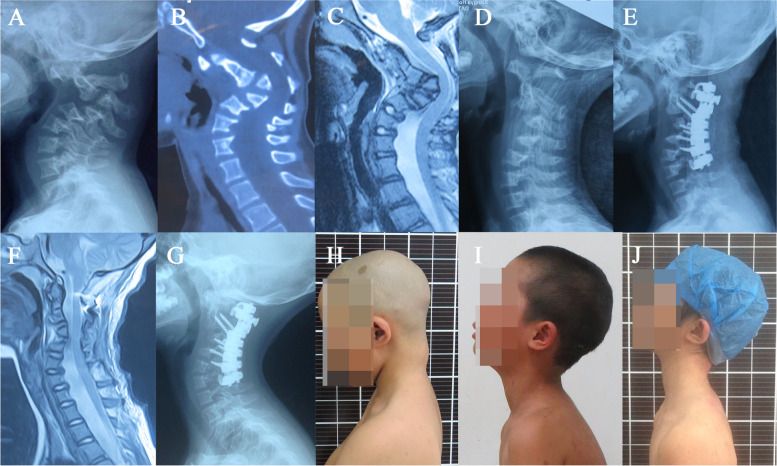
In this study, cervical kyphosis Cobb angle decreased from initial 61.3 ± 19.7 degrees to postoperative 10.6 ± 3.7 degrees (P<0.01), with total correction rate of 82.7%, which consist of 45.8% from halo traction and 36.9% from surgical correction. JOA scores were improved from preoperative 13.3 ± 1.6 to postoperative 16.2 ± 0.7 (P<0.01). Neurological status was also improved. There was no correction loss and the neurological status was stable in mean 43 months follow-up. Three patients experienced minor complications and one patient underwent a second surgery.
Halo traction combined with PO approach surgery is safe and effective method for cervical kyphosis correction in patients with NF-1. A satisfied correction result, and successful bone fusion can be achieved via this procedure, even improvement of neurological deficits can also be obtained. Our study suggested that halo traction combined with PO approach surgery is another consideration for cervical kyphosis correction in patients with NF-1.
NF-1 患者颈椎后凸的手术治疗是一项具有挑战性的任务。目前,前路(AO)、后路(PO)和前后路联合(AP)脊柱融合是常见的手术策略。然而,手术策略的选择和 Halo 牵引的应用仍存在争议。很少有研究表明并推荐后路方法用于 NF-1 患者颈椎后凸的矫正。本研究旨在评估 Halo 牵引联合后路手术治疗 NF-1 患者颈椎后凸的安全性和有效性。
回顾性分析 2010 年 1 月至 2018 年 4 月期间 26 例 NF-1 患者严重颈椎后凸的病例。所有患者均接受 Halo 牵引联合后路内固定融合术。分析矫正结果、神经状态和并发症。
本研究中,颈椎后凸 Cobb 角从术前的 61.3°±19.7°降低至术后的 10.6°±3.7°(P<0.01),总矫正率为 82.7%,其中 Halo 牵引矫正 45.8%,手术矫正 36.9%。JOA 评分从术前的 13.3±1.6 提高到术后的 16.2±0.7(P<0.01)。神经功能也得到改善。平均随访 43 个月,无矫正丢失,神经状态稳定。3 例患者出现轻微并发症,1 例患者行二次手术。
Halo 牵引联合后路手术是治疗 NF-1 患者颈椎后凸的安全有效方法。通过该手术可获得满意的矫正效果和成功的骨融合,甚至可以改善神经功能缺损。我们的研究表明,Halo 牵引联合后路手术是治疗 NF-1 患者颈椎后凸的另一种选择。