Liu Haiying, Huang Xin, Xu Jinwei, Mao Honghui, Li Yaohao, Ren Keke, Ma Guaiguai, Xue Qian, Tao Huiren, Wu Shengxi, Wang Wenting
Department of Neurobiology, School of Basic Medicine, Fourth Military Medical University, Xi'an, 710032, PR China.
Department of Neurology, Xijing Hospital, Fourth Military Medical University, Xi'an, 710032, China.
Neurobiol Stress. 2021 Nov 12;15:100417. doi: 10.1016/j.ynstr.2021.100417. eCollection 2021 Nov.
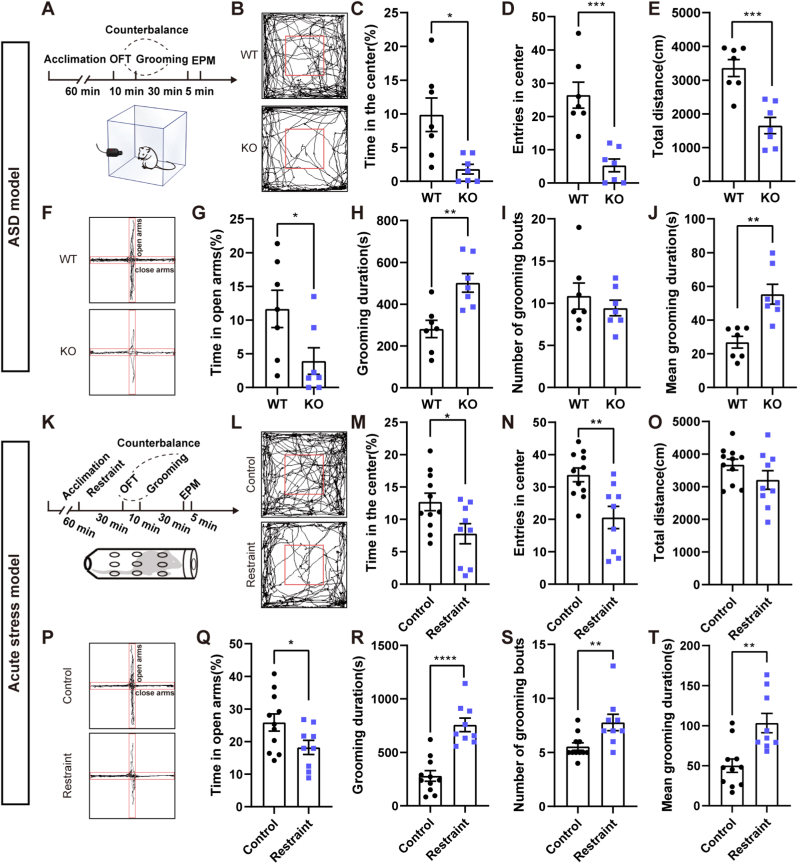
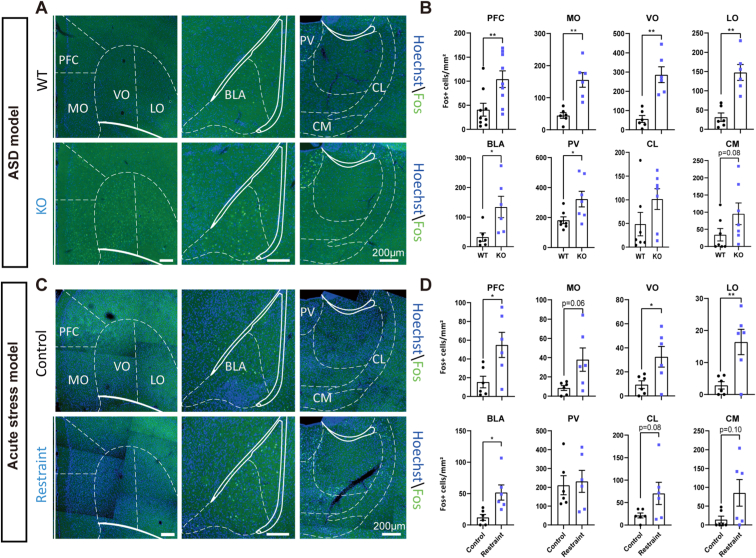
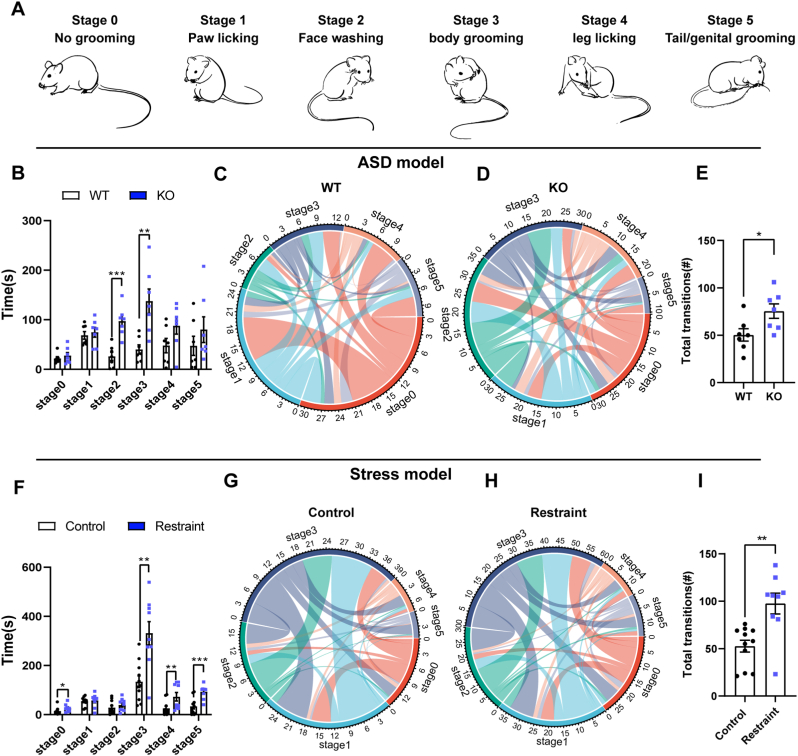
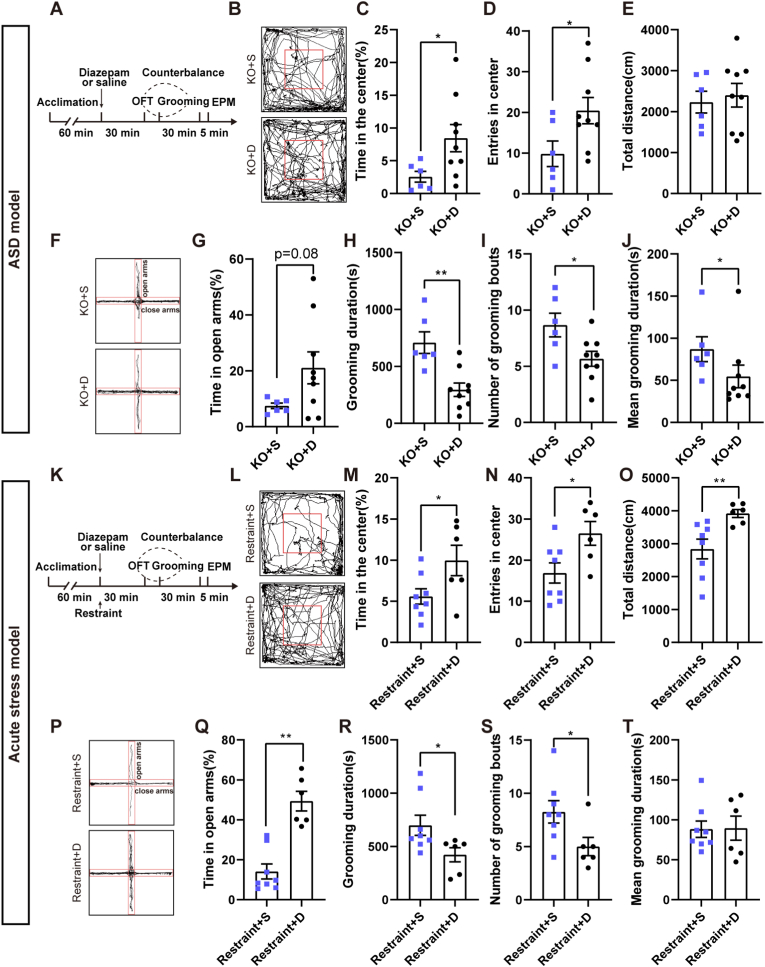
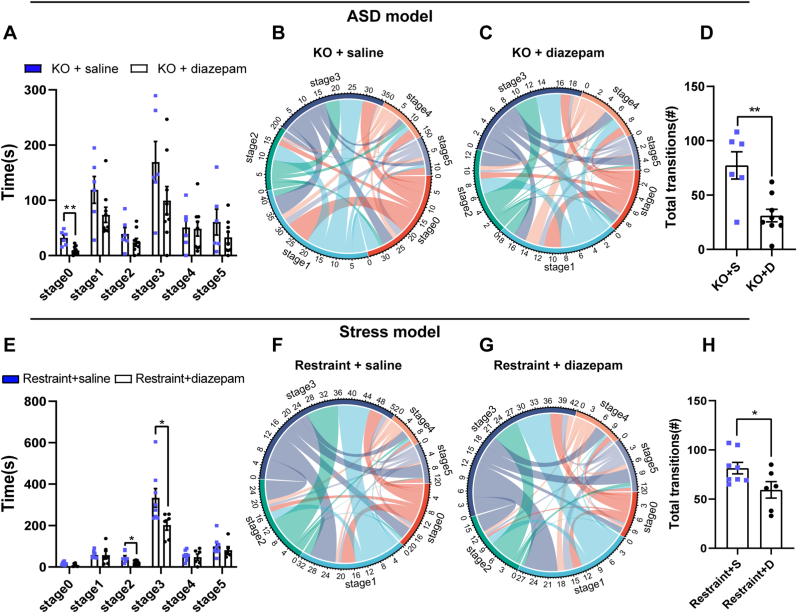
Self-grooming is an innate, cephalo-caudal progression of body cleaning behaviors that are found in normal rodents but exhibit repetitive and stereotyped patterns in several mouse models, such as autism spectrum disorders (ASDs). It is also recognized as a marker of stress and anxiety. Mice with gene knockout (KO) exhibit typical ASD-like behavioral abnormalities, including stereotyped self-grooming and increased levels of anxiety. However, the exact relationship between anxiety and stereotyped self-grooming in certain types of animal models is not clear. We selected three animal models with high anxiety to compare their self-grooming parameters. First, we confirmed that KO mice (ASD model), acute restraint stress mouse model (stress model), and chronic inflammatory pain mouse model (pain model) all showed increased anxiety levels in the open field test (OFT) and elevated plus maze (EPM). We found that only the ASD model and the stress model produced increased total grooming duration. The pain model only exhibited an increasing trend of mean self-grooming duration. We used the grooming analysis algorithm to examine the self-grooming microstructure and assess the cephalo-caudal progression of grooming behavior. The results showed distinct self-grooming microstructures in these three models. The anxiolytic drug diazepam relieved the anxiety level and the total time of grooming in the ASD and stress models. The grooming microstructure was not restored in KO mice but was partially relieved in the stress model, which suggested that anxiety aggravated stereotyped self-grooming duration but not the grooming microstructure in the ASD mouse model. Our results indicated that stereotyped behavior and anxiety may be shared by separate, but interacting, neural circuits in distinct disease models, which may be useful to understand the mechanisms and develop potential treatments for stereotyped behaviors and anxiety.
自我梳理是一种先天性的、从头至尾顺序进行的身体清洁行为,在正常啮齿动物中可见,但在一些小鼠模型(如自闭症谱系障碍(ASD))中表现出重复且刻板的模式。它也被认为是应激和焦虑的一个指标。基因敲除(KO)小鼠表现出典型的ASD样行为异常,包括刻板的自我梳理和焦虑水平升高。然而,在某些类型的动物模型中,焦虑与刻板的自我梳理之间的确切关系尚不清楚。我们选择了三种焦虑水平高的动物模型来比较它们的自我梳理参数。首先,我们证实KO小鼠(ASD模型)、急性束缚应激小鼠模型(应激模型)和慢性炎性疼痛小鼠模型(疼痛模型)在旷场试验(OFT)和高架十字迷宫(EPM)中均表现出焦虑水平升高。我们发现,只有ASD模型和应激模型的总梳理持续时间增加。疼痛模型仅表现出平均自我梳理持续时间的增加趋势。我们使用梳理分析算法来检查自我梳理的微观结构,并评估梳理行为的从头至尾顺序。结果显示这三种模型的自我梳理微观结构明显不同。抗焦虑药物地西泮缓解了ASD模型和应激模型中的焦虑水平以及梳理总时间。KO小鼠的梳理微观结构未恢复,但在应激模型中部分缓解,这表明焦虑加剧了ASD小鼠模型中刻板的自我梳理持续时间,但未影响梳理微观结构。我们的结果表明,在不同的疾病模型中,刻板行为和焦虑可能由不同但相互作用的神经回路共同导致,这可能有助于理解刻板行为和焦虑的机制并开发潜在的治疗方法。