Tetui Moses, Ssekamatte Tonny, Akilimali Pierre, Sirike Judith, Fonseca-Rodríguez Osvaldo, Atuyambe Lynn, Makumbi Fredrick Edward
School of Pharmacy, Waterloo University, Waterloo, ON, Canada.
Department of Epidemiology and Global Health, Umeå University, Umeå, Sweden.
Front Glob Womens Health. 2021 Feb 10;1:599774. doi: 10.3389/fgwh.2020.599774. eCollection 2020.
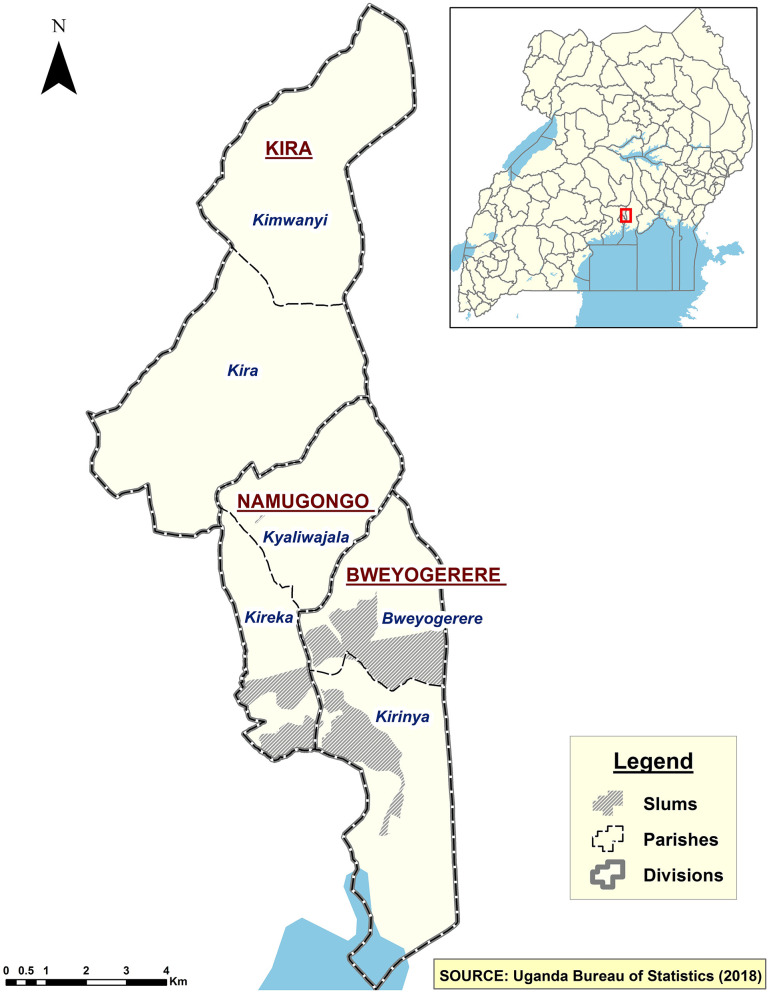
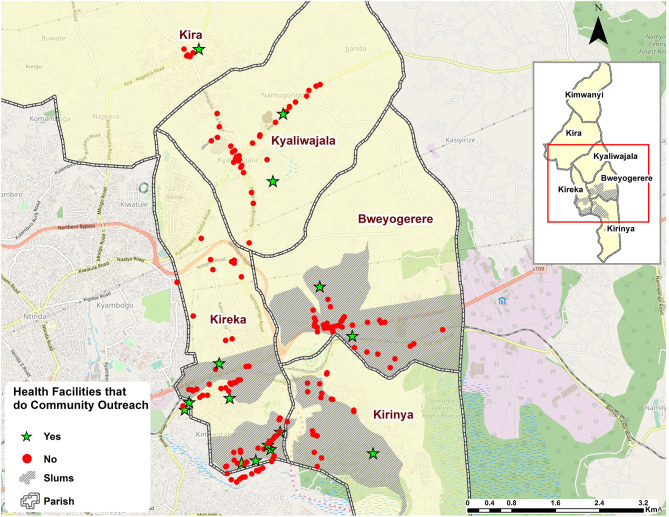
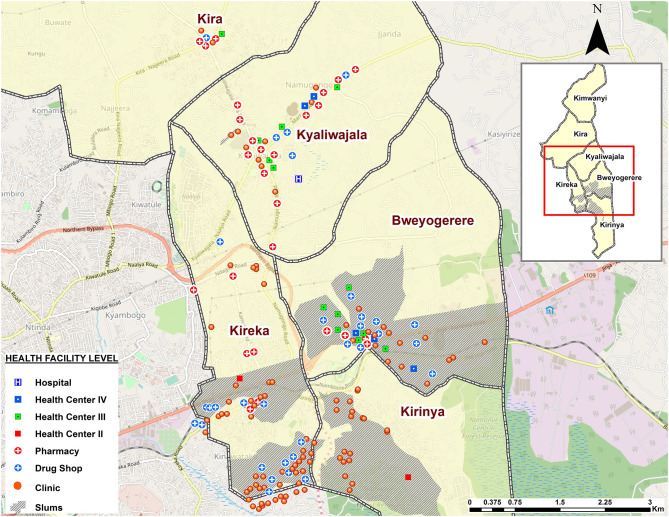
Access to family planning (FP) services remains a challenge, particularly in informal urban settlements. The unmet need for FP in these settings is high, with a correspondingly high prevalence of unintended pregnancies that may lead to unsafe abortions. However, there is a paucity of quality data on the distribution of FP services in such settings in Uganda. This paper described the geospatial distribution of FP services in Kira Municipality, Wakiso District, Uganda. This was a cross-sectional study in which we determined the availability and distribution of FP services in Kira Municipality. Community mapping and analysis were conducted using ArcGIS (version 10.1) and ArcGIS Online. Stata version 13.1 was used for data analysis. Chi-square test was used to compare the contraceptive provision and availability among facilities from informal and formal settlements. Of the 176 healthcare facilities surveyed, only 42% ( = 74) offered contraceptives in informal settlements. The majority of the facilities were privately owned small clinics (95%). At least 80% of the facilities provided three or more modern contraceptive methods, with no difference ( = 0.107) between facilities in informal and formal settlements. Only 30.7% ( = 0.001) of the facilities provided at least one long-acting contraceptive. Similarly, 20 and 12% ( = 0.001) of the facilities had implants and intrauterine devices (IUDs) on the day of the survey. Almost 25% of the facilities did not offer contraceptive services (counseling and commodities) to unmarried adolescents. Most facilities were small privately-owned clinics, offering at least three modern contraceptive methods. The unavailability of long-acting reversible methods in the informal settings may affect the quality of FP services due to limited choice. The inequity in service provision that disfavors the unmarried adolescent may increase unwanted/unintended pregnancies. We recommend that local governments and partners work toward filling the existing commodities gap and addressing the discrimination against unmarried adolescents in such settings.
获得计划生育(FP)服务仍然是一项挑战,尤其是在城市非正式住区。在这些地区,未满足的计划生育需求很高,意外怀孕的发生率相应也很高,这可能导致不安全堕胎。然而,关于乌干达此类地区计划生育服务分布的高质量数据匮乏。本文描述了乌干达瓦基索区基拉市计划生育服务的地理空间分布。这是一项横断面研究,我们确定了基拉市计划生育服务的可及性和分布情况。使用ArcGIS(版本10.1)和ArcGIS Online进行社区绘图和分析。使用Stata 13.1版本进行数据分析。采用卡方检验比较非正式住区和正式住区各医疗机构的避孕措施提供情况和可及性。在接受调查的176个医疗机构中,只有42%(n = 74)在非正式住区提供避孕药具。大多数医疗机构是私人开办的小诊所(95%)。至少80%的医疗机构提供三种或更多种现代避孕方法,非正式住区和正式住区的医疗机构之间没有差异(P = 0.107)。只有30.7%(P = 0.001)的医疗机构提供至少一种长效避孕方法。同样,在调查当天,20%和12%(P = 0.001)的医疗机构有皮下埋植剂和宫内节育器(IUD)。近25%的医疗机构没有为未婚青少年提供避孕服务(咨询和药具)。大多数医疗机构是私人开办的小诊所,提供至少三种现代避孕方法。非正式住区长效可逆避孕方法的缺乏可能会因选择有限而影响计划生育服务的质量。不利于未婚青少年的服务提供不平等可能会增加意外怀孕。我们建议地方政府和合作伙伴努力填补现有的药具缺口,并解决此类地区对未婚青少年的歧视问题。