Chen Zhiyan, Zhang Duoduo, Sun Zhengyi, Yu Qi
National Clinical Research Center for Obstetric & Gynecologic Diseases, Department of Obstetrics and Gynecology, Peking Union Medical College Hospital, Chinese Academy of Medical Sciences & Peking Union Medical College, Beijing, China.
Front Physiol. 2021 Nov 8;12:696854. doi: 10.3389/fphys.2021.696854. eCollection 2021.
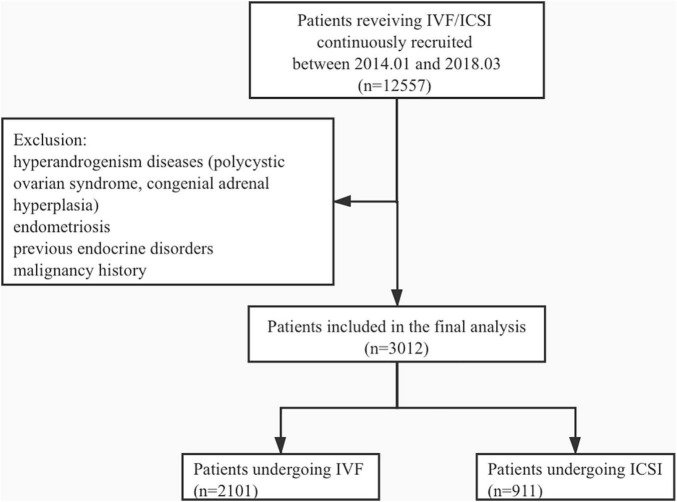
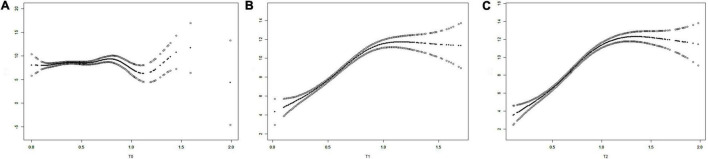
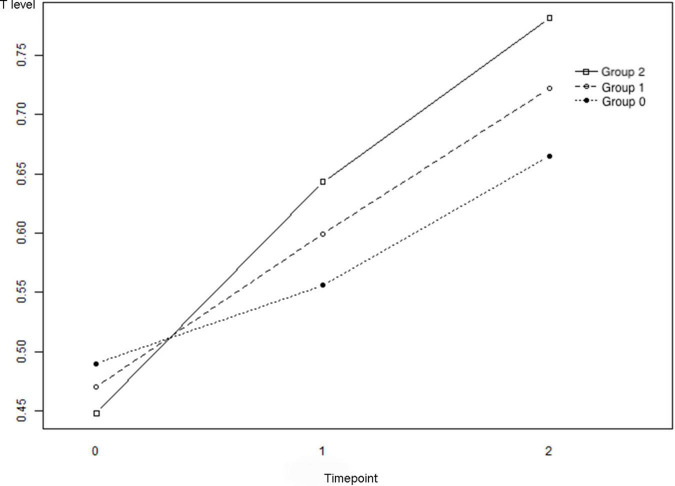
We aimed to investigate the relationship between testosterone (T) levels and pregnancy outcomes in patients with tubal or male infertility at different times during fertilization (IVF)/intracytoplasmic sperm injection (ICSI) cycles. Patients with tubal or male infertility and normal androgen levels undergoing IVF/ICSI were consecutively recruited. We performed a longitudinal analysis of T levels at three time points (i.e., T0: baseline, T1: trigger day, and T2: day after the trigger day) in three groups with different pregnancy outcomes (i.e., group 1: no pregnancy; group 2: clinical pregnancy but no live birth; and group 3: live birth) as repeated measurement data using linear mixed-effects models. We also plotted fitted curves depicting the relationship between T levels and a number of oocytes retrieved at different time points and identified the inflection points of the curves. In total, 3,012 patients were recruited. Groups 1 and 3 had improvements in T levels at the three time points. After refitting, the slope in group 3 was significantly higher than that in group 1 ( = 0.000). Curves that reflected the association between T levels and numbers of retrieved oocytes presented an upward trend before a certain inflection point, after which the curves had no obvious changes or fell with increasing T levels. The inflection points for T0, T1, and T2 were calculated as 0.45, 0.94, and 1.09, respectively. A faster upward trend in T levels might be associated with better pregnancy outcomes. Within a range lower than a T level inflection point, more oocytes and embryos could be obtained with increasing T levels.
我们旨在研究在体外受精(IVF)/卵胞浆内单精子注射(ICSI)周期的不同时间,输卵管性或男性不育患者的睾酮(T)水平与妊娠结局之间的关系。连续招募接受IVF/ICSI且雄激素水平正常的输卵管性或男性不育患者。我们使用线性混合效应模型,对具有不同妊娠结局的三组患者(即第1组:未妊娠;第2组:临床妊娠但未活产;第3组:活产)在三个时间点(即T0:基线,T1:扳机日,T2:扳机日后一天)的T水平进行纵向分析,将其作为重复测量数据。我们还绘制了拟合曲线,描绘不同时间点T水平与回收卵母细胞数量之间的关系,并确定曲线的拐点。总共招募了3012名患者。第1组和第3组在三个时间点的T水平均有改善。重新拟合后,第3组的斜率显著高于第1组(P = 0.000)。反映T水平与回收卵母细胞数量之间关联的曲线在某个拐点之前呈上升趋势,之后曲线无明显变化或随着T水平升高而下降。T0、T1和T2的拐点分别计算为0.45、0.94和1.09。T水平更快的上升趋势可能与更好的妊娠结局相关。在低于T水平拐点的范围内,随着T水平升高可获得更多的卵母细胞和胚胎。