Takekawa Akira, Kajiura Masayuki, Fukuda Hiroya
Graduate School of Frontier Science, Konan University, Kobe, JPN.
Graduate School of Human Development and Environment, Kobe University, Kobe, JPN.
Cureus. 2021 Oct 18;13(10):e18866. doi: 10.7759/cureus.18866. eCollection 2021 Oct.
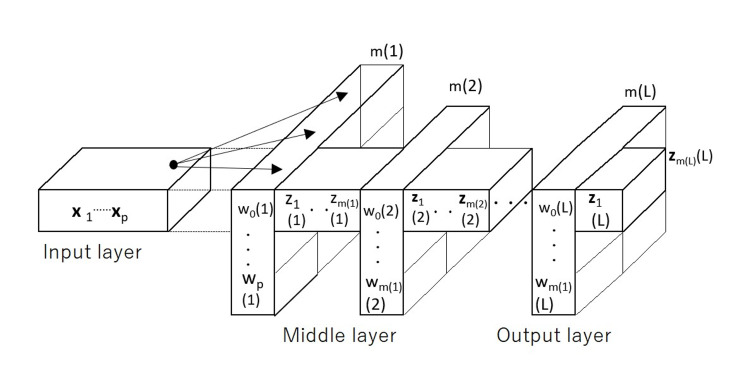
Deep learning is used to classify data into several groups based on nonlinear curved surfaces. In this paper, we focus on the theoretical analysis of deep learning using the rectified linear unit (ReLU) activation function. Because layers approximate a nonlinear curved surface, increasing the number of layers improves the approximation accuracy of the curved surface. While neurons perform a layer-by-layer approximation of the most appropriate hyperplanes, increasing their number cannot improve the results obtained via canonical correlation analysis (CCA). These results illustrate the functions of layers and neurons in deep learning with ReLU.
深度学习用于基于非线性曲面将数据分类为若干组。在本文中,我们专注于使用整流线性单元(ReLU)激活函数的深度学习的理论分析。由于各层近似非线性曲面,增加层数可提高曲面的近似精度。虽然神经元对最合适的超平面进行逐层近似,但增加神经元数量并不能改善通过典型相关分析(CCA)获得的结果。这些结果说明了ReLU深度学习中层和神经元的功能。