Palliative Care Unit, Department of Oncology, Hematology and BMT, University Medical Center Eppendorf, Martinistrasse 52, 20246, Hamburg, Germany.
Department of Medical Psychology, University Medical Center Eppendorf, Hamburg, Germany.
BMC Palliat Care. 2021 Nov 25;20(1):182. doi: 10.1186/s12904-021-00880-6.
We investigated the need for additional professional support and associated factors in patients (pts) at initiation and in the course of in- and outpatient specialist palliative care (I-SPC/O-SPC).
Pts entering an urban SPC network consecutively completed questionnaires on psychosocial/spiritual problems and support needs within 72 h (T0) as well as within the first 6 weeks (T1) of SPC. Hierarchical linear regression analysis was used to investigate the impact of sociodemographic / disease-related variables, psychological / physical burden, social support, and SPC setting on the extent of support needs.
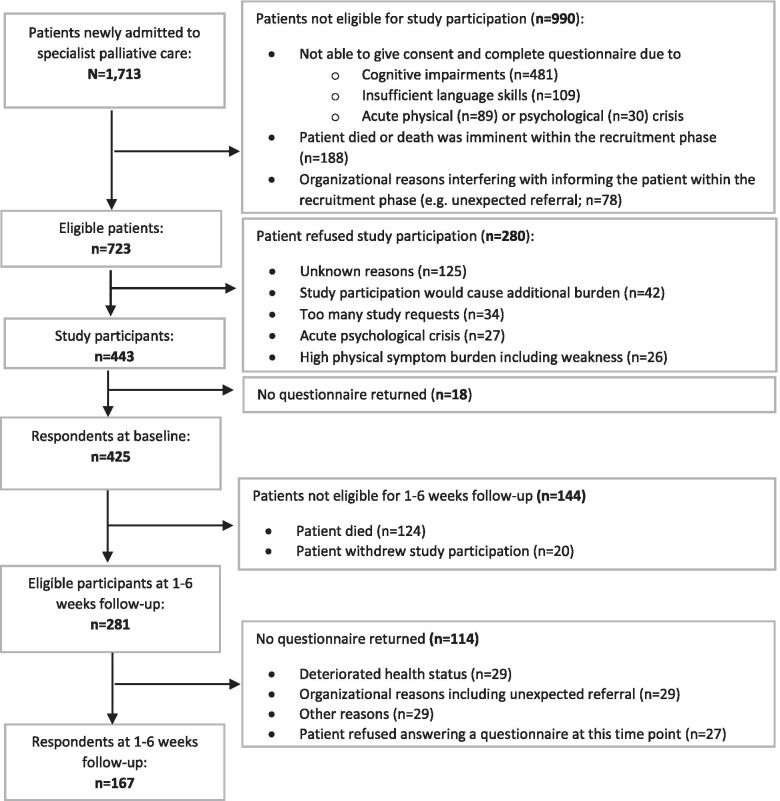
Four hundred twenty-five pts (70 years, 48% female, 91% cancer, 67% O-SPC) answered at T0, and 167 at T1. At T0, main problems related to transportation, usual activities, and dependency (83-89%). At T1, most prevalent problems also related to transportation and usual activities and additionally to light housework (82-86%). At T0, support needs were highest for transportation, light housework, and usual activities (35-41%). Cross-sectional comparisons of SPC settings revealed higher problem scores in O-SPC compared to I-SPC at T0 (p = .039), but not at T1. Support need scores were higher in O-SPC at T0 (p < .001), but lower at T1 (p = .039). Longitudinal analyses showed a decrease of support need scores over time, independent from the SPC setting. At T0, higher distress (p = .047), anxiety/depression (p < .001), physical symptom burden (p < .001) and I-SPC (p < .001) were associated with higher support need scores (at T1: only higher distress, p = .037).
Need for additional professional psychosocial/spiritual support was identified in up to 40% of pts. with higher need at the beginning of O-SPC than of I-SPC. During SPC, this need decreased in both settings, but got lower in O-SPC than in I-SPC over time. Support need scores were not only associated with psychological, but also physical burden.
我们调查了患者(pts)在开始和门诊专家姑息治疗(I-SPC/O-SPC)过程中对额外专业支持的需求以及相关因素。
连续进入城市 SPC 网络的 pts 在 SPC 开始后 72 小时内(T0)以及前 6 周内(T1)完成关于心理社会/精神问题和支持需求的问卷。使用分层线性回归分析来调查社会人口学/疾病相关变量、心理/身体负担、社会支持以及 SPC 环境对支持需求程度的影响。
425 名 pts(70 岁,48%女性,91%癌症,67%O-SPC)在 T0 时回答了问题,167 名 pts 在 T1 时回答了问题。在 T0 时,主要问题与交通、日常活动和依赖有关(83-89%)。在 T1 时,最常见的问题也与交通和日常活动有关,此外还与轻家务有关(82-86%)。在 T0 时,对交通、轻家务和日常活动的支持需求最高(35-41%)。SPC 环境的横断面比较显示,O-SPC 的问题评分在 T0 时高于 I-SPC(p=0.039),但在 T1 时并非如此。在 T0 时,O-SPC 的支持需求评分较高(p<0.001),但在 T1 时较低(p=0.039)。纵向分析显示,无论 SPC 环境如何,支持需求评分随时间下降。在 T0 时,较高的痛苦(p=0.047)、焦虑/抑郁(p<0.001)、身体症状负担(p<0.001)和 I-SPC(p<0.001)与较高的支持需求评分相关(在 T1 时:仅较高的痛苦,p=0.037)。
高达 40%的 pts 需要额外的专业心理社会/精神支持,O-SPC 开始时的需求高于 I-SPC。在 SPC 期间,这一需求在两个环境中都有所下降,但随着时间的推移,O-SPC 的需求下降幅度比 I-SPC 更大。支持需求评分不仅与心理负担有关,还与身体负担有关。