Department of Orthopedic Surgery, West China Hospital, Sichuan University, No. 37 Guo Xue Rd, Chengdu, 610041, China.
Department of Operation Room and Anesthesia Center, West China Hospital, Sichuan University, No. 37 Guo Xue Rd, Chengdu, 610041, China.
J Orthop Surg Res. 2021 Nov 25;16(1):693. doi: 10.1186/s13018-021-02840-5.
Heterotopic ossification (HO) is a common complication after cervical disc replacement (CDR). Biomechanical factors including endplate coverage and intervertebral disc height change may be related to HO formation. However, there is a dearth of quantitative analysis for endplate coverage, intervertebral height change and their combined effects on HO.
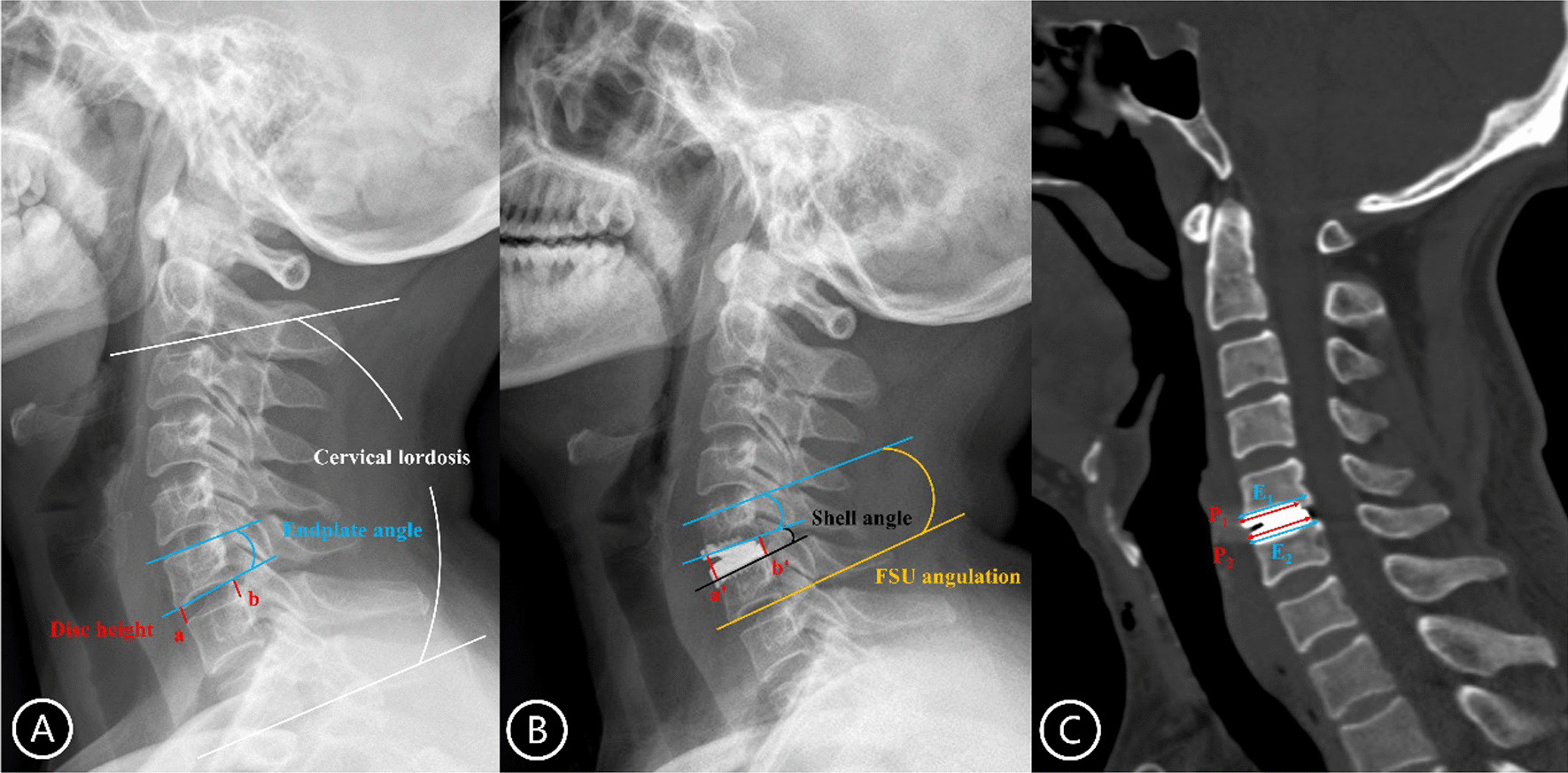
Patients who underwent single-level or two-level CDR with Prestige-LP were retrospectively reviewed. Clinical outcomes were evaluated through Japanese Orthopaedic Association (JOA) score, Neck Disability Index (NDI) score, and visual analogue scale (VAS) score. Radiological data, including the prosthesis-endplate depth ratio, intervertebral height change, posterior heterotopic ossification (PHO) and angular parameters, were collected. Logistic regression analysis was used to identify the potential risk factors. Receiver operating characteristic curves were plotted and the cut-off values of each potential factors were calculated.
A total of 138 patients with 174 surgical segments were evaluated. Both the prosthesis-endplate depth ratio (P < 0.001) and post-operative disc height change (P < 0.001) were predictive factors for PHO formation. The area under the curve (AUC) of the prosthesis-endplate depth ratio, disc height change and their combined effects represented by the combined parameter (CP) were 0.728, 0.712 and 0.793, respectively. The risk of PHO significantly increased when the prosthesis-endplate depth ratio < 93.77% (P < 0.001, OR = 6.909, 95% CI 3.521-13.557), the intervertebral height change ≥ 1.8 mm (P < 0.001, OR = 5.303, 95% CI 2.592-10.849), or the CP representing the combined effect < 84.88 (P < 0.001, OR = 10.879, 95% CI 5.142-23.019).
Inadequate endplate coverage and excessive change of intervertebral height are both potential risk factors for the PHO after CDR. Endplate coverage less than 93.8% or intervertebral height change more than 1.8 mm would increase the risk of PHO. The combination of these two factors may exacerbate the non-uniform distribution of stress in the bone-implant interface and promote HO development.
颈椎间盘置换术后(CDR)异位骨化(HO)是一种常见的并发症。生物力学因素,包括终板覆盖和椎间盘高度变化,可能与 HO 的形成有关。然而,对于终板覆盖、椎间盘高度变化及其对 HO 的综合影响,缺乏定量分析。
回顾性分析接受单节段或双节段 Prestige-LP 颈椎间盘置换术的患者。通过日本骨科协会(JOA)评分、颈椎残障指数(NDI)评分和视觉模拟评分(VAS)评估临床结果。收集假体-终板深度比、椎间盘高度变化、后路异位骨化(PHO)和角度参数等影像学资料。采用 logistic 回归分析确定潜在的危险因素。绘制受试者工作特征曲线(ROC)并计算每个潜在因素的截断值。
共评估了 138 例患者的 174 个手术节段。假体-终板深度比(P<0.001)和术后椎间盘高度变化(P<0.001)均为 PHO 形成的预测因素。假体-终板深度比、椎间盘高度变化及其综合效应(CP)的曲线下面积(AUC)分别为 0.728、0.712 和 0.793。当假体-终板深度比<93.77%(P<0.001,OR=6.909,95%CI 3.521-13.557)、椎间盘高度变化≥1.8mm(P<0.001,OR=5.303,95%CI 2.592-10.849)或 CP 代表综合效应<84.88 (P<0.001,OR=10.879,95%CI 5.142-23.019)时,PHO 的风险显著增加。
终板覆盖不足和椎间盘高度变化过大都是 CDR 后 PHO 的潜在危险因素。终板覆盖<93.8%或椎间盘高度变化>1.8mm 会增加 PHO 的风险。这两个因素的结合可能会加剧骨-植入物界面的应力非均匀分布,并促进 HO 的发展。