Adejumo Prisca O, Aniagwu Toyin I G, Awolude Olutosin A, Oni Abiodun O, Ajayi Olubunmi O, Fagbenle Omolara, Ogungbade Dasola, Kochheiser Makayla, Ogundiran Temidayo, Olopade Olufunmilayo I
Department of Nursing, College of Medicine, University of Ibadan, Ibadan, 200284, Nigeria.
School of Occupational Health Nursing, University College Hospital, Ibadan, 200212, Nigeria.
Ecancermedicalscience. 2021 Sep 7;15:1283. doi: 10.3332/ecancer.2021.1283. eCollection 2021.
A high frequency of BRCA mutations has been established in Nigerian breast cancer (BC) patients. Recently, patients' and first-degree relatives' interest have been raised on cancer genetic risk assessment through our awareness activities in Nigeria. This led to the emergence of nurse-led cancer genetic counselling (CGC) and testing aimed at providing standard-of-care for individuals at increased risk of hereditary breast and ovarian cancers.
In June 2018, CGC and testing of patients with BC and ovarian cancer (OC) commenced in collaboration with Color Genomics Inc. for a 30-panel gene testing. Previously trained nurses in CGC at the University College Hospital, Ibadan offered genetic counselling (GC) to willing patients with BC and gynaecological cancer in four out-patient oncology clinics and departments for the pilot study. Consultation consisted of CGC, patient's history, pedigree and sample collection for genetic testing (GT).
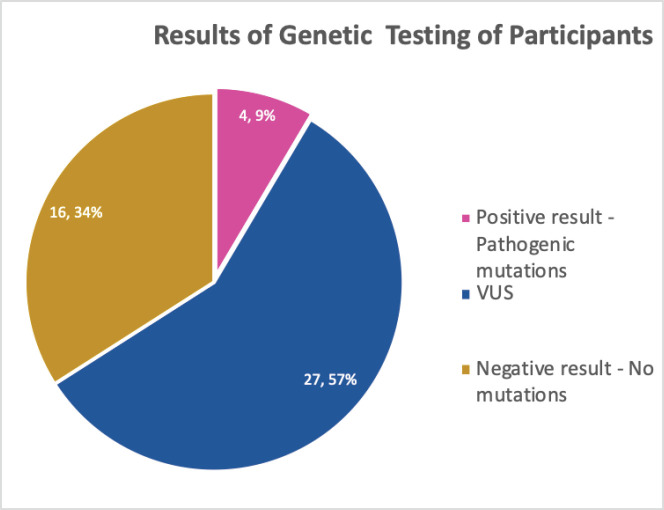
Forty-seven patients - 40 with BC, five with OC and two with endometrial cancer received GC, and all chose to undergo GT. The average age at testing was 48.2 ± 12.1 years. Eight women reported a known family cancer history and there were more perceived benefits than barriers to GT with the patients experiencing the desire for none of their relative to have cancer. Results revealed no mutations in 27 (57.4%), 16 (4.0%) variants of unknown significance and 4 (8.5%) pathogenic mutations.
Personalised cancer care utilises GC and testing for cancer risk assessment towards prevention and early detection in high risk women. The study indicates the necessity of expanded cancer genetic services for integration into patient care and cancer prevention.
尼日利亚乳腺癌(BC)患者中已证实BRCA突变频率较高。最近,通过我们在尼日利亚开展的宣传活动,患者及其一级亲属对癌症遗传风险评估的兴趣有所提高。这导致了由护士主导的癌症遗传咨询(CGC)和检测的出现,旨在为遗传性乳腺癌和卵巢癌风险增加的个体提供标准治疗。
2018年6月,与Color Genomics公司合作,开始对乳腺癌和卵巢癌(OC)患者进行CGC和检测,进行30基因检测。伊巴丹大学学院医院先前接受过CGC培训的护士在四个门诊肿瘤诊所和科室为愿意接受检测的乳腺癌和妇科癌症患者提供遗传咨询(GC),用于试点研究。咨询包括CGC、患者病史、家系和基因检测(GT)样本采集。
47名患者——40名乳腺癌患者、5名卵巢癌患者和2名子宫内膜癌患者接受了GC,且均选择接受GT。检测的平均年龄为48.2±12.1岁。8名女性报告有已知的家族癌症病史,GT带来的益处多于障碍因素,患者希望其亲属都不患癌症。结果显示,27例(57.4%)未发现突变,16例(4.0%)为意义不明的变异,4例(8.5%)为致病突变。
个性化癌症护理利用GC和检测进行癌症风险评估,以预防和早期发现高危女性。该研究表明有必要扩大癌症遗传服务,以纳入患者护理和癌症预防。