Tao Gerard, Auvrez Clarissa, Nightscales Russell, Barnard Sarah, McCartney Lara, Malpas Charles B, Perucca Piero, Chen Zhibin, Adams Sophia, McIntosh Anne, Ignatiadis Sophia, O'Brien Patrick, Cook Mark J, Kwan Patrick, Berkovic Samuel F, D'Souza Wendyl, Velakoulis Dennis, O'Brien Terence J
Departments of Medicine and Neurology (GT, CA, RN, CBM, PP, ZC, AM, PK, TJO), The Royal Melbourne Hospital, The University of Melbourne; Department of Neuroscience (RN, SB, CBM, PP, ZC, AM, PK, TJO), The Alfred Hospital, Monash University Central Clinical School, Melbourne; Melbourne Neuropsychiatry Centre (LM, SA, DV), Department of Psychiatry, The Royal Melbourne Hospital, The University of Melbourne; Departments of Medicine and Neurology (SI, POB, MJC, WDS), St. Vincent's Hospital Melbourne, The University of Melbourne; and Department of Medicine (Neurology) (SFB), The University of Melbourne (Austin Health), Victoria, Australia.
Neurol Clin Pract. 2021 Oct;11(5):429-437. doi: 10.1212/CPJ.0000000000001114.
To explore the impact of psychiatric comorbidities on all-cause mortality in adults with epilepsy from a cohort of patients admitted for video-EEG monitoring (VEM) over 2 decades.
A retrospective medical record audit was conducted on 2,709 adults admitted for VEM and diagnosed with epilepsy at 3 Victorian comprehensive epilepsy programs from 1995 to 2015. A total of 1,805 patients were identified in whom the record of a clinical evaluation by a neuropsychiatrist was available, excluding 27 patients who died of a malignant brain tumor known at the time of VEM admission. Epilepsy and lifetime psychiatric diagnoses were determined from consensus opinion of epileptologists and neuropsychiatrists involved in the care of each patient. Mortality and cause of death were determined by linkage to the Australian National Death Index and National Coronial Information System.
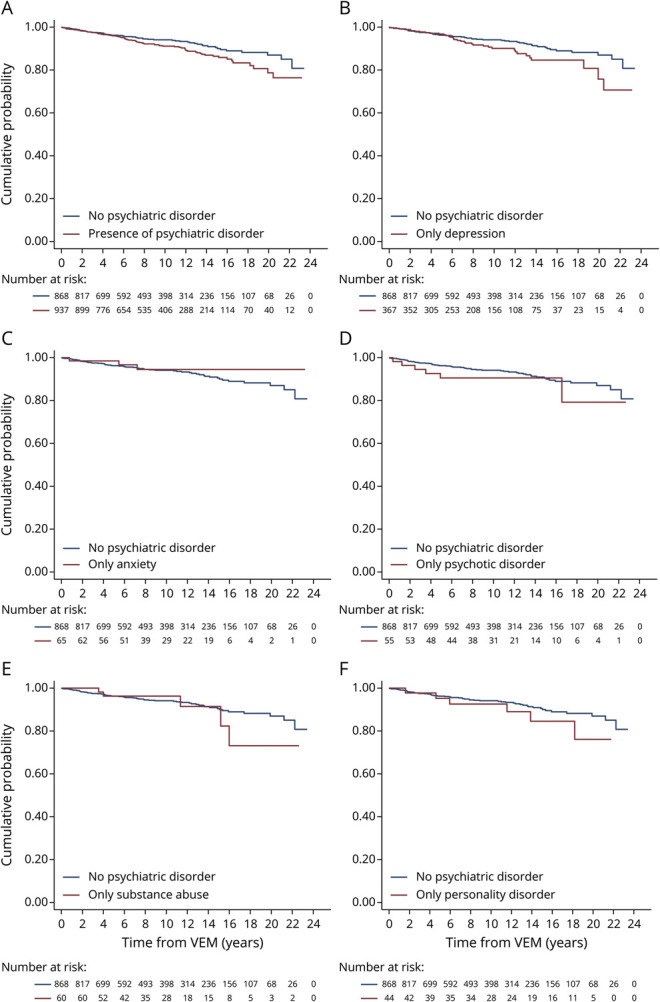
Compared with the general population, mortality was higher in people with epilepsy (PWE) with a psychiatric illness (standardized mortality ratio [SMR] 3.6) and without a psychiatric illness (SMR 2.5). PWE with a psychiatric illness had greater mortality compared with PWE without (hazard ratio 1.41, 95% confidence interval 1.02-1.97) after adjusting for age and sex. No single psychiatric disorder by itself conferred increased mortality in PWE. The distribution of causes of death remained similar between PWE with psychiatric comorbidities and those without.
The presence of comorbid psychiatric disorders in adults with epilepsy is associated with increased mortality, highlighting the importance of identifying and treating psychiatric comorbidities in these patients.
通过对20多年来因视频脑电图监测(VEM)入院的一组患者进行研究,探讨精神疾病合并症对成人癫痫患者全因死亡率的影响。
对1995年至2015年在维多利亚州3个综合癫痫项目中因VEM入院并被诊断为癫痫的2709名成人进行回顾性病历审核。共识别出1805名患者,他们有神经精神科医生的临床评估记录,排除了27名在VEM入院时已知患有恶性脑肿瘤的死亡患者。癫痫和终生精神疾病诊断由参与每位患者护理的癫痫专家和神经精神科医生的共识意见确定。死亡率和死因通过与澳大利亚国家死亡指数和国家死因信息系统的关联来确定。
与普通人群相比,患有精神疾病的癫痫患者(PWE)死亡率更高(标准化死亡率[SMR]3.6),无精神疾病的癫痫患者死亡率也更高(SMR 2.5)。在调整年龄和性别后,患有精神疾病的PWE比没有精神疾病的PWE死亡率更高(风险比1.41,95%置信区间1.02 - 1.97)。没有单一的精神障碍本身会使PWE的死亡率增加。患有精神疾病合并症的PWE和没有合并症的PWE之间的死因分布仍然相似。
成人癫痫患者合并精神疾病与死亡率增加有关,突出了识别和治疗这些患者精神疾病合并症的重要性。