Gillard Justine, Clerbaux Laure-Alix, Nachit Maxime, Sempoux Christine, Staels Bart, Bindels Laure B, Tailleux Anne, Leclercq Isabelle A
Laboratory of Hepato-Gastroenterology, Institute of Experimental and Clinical Research, Université catholique de Louvain, Brussels, Belgium.
Metabolism and Nutrition Research Group, Louvain Drug Research Institute, Université catholique de Louvain, Brussels, Belgium.
JHEP Rep. 2021 Oct 13;4(1):100387. doi: 10.1016/j.jhepr.2021.100387. eCollection 2022 Jan.
BACKGROUND & AIMS: Through FXR and TGR5 signaling, bile acids (BAs) modulate lipid and glucose metabolism, inflammation and fibrosis. Hence, BAs returning to the liver after enteric secretion, modification and reabsorption may contribute to the pathogenesis of non-alcoholic steatohepatitis (NASH). Herein, we characterized the enterohepatic profile and signaling of BAs in preclinical models of NASH, and explored the consequences of experimental manipulation of BA composition.
We used high-fat diet (HFD)-fed and high-fructose western diet-fed C57BL/6J mice, and compared them to their respective controls. Mice received a diet supplemented with deoxycholic acid (DCA) to modulate BA composition.
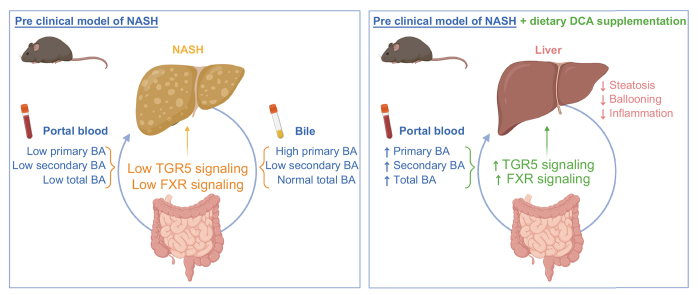
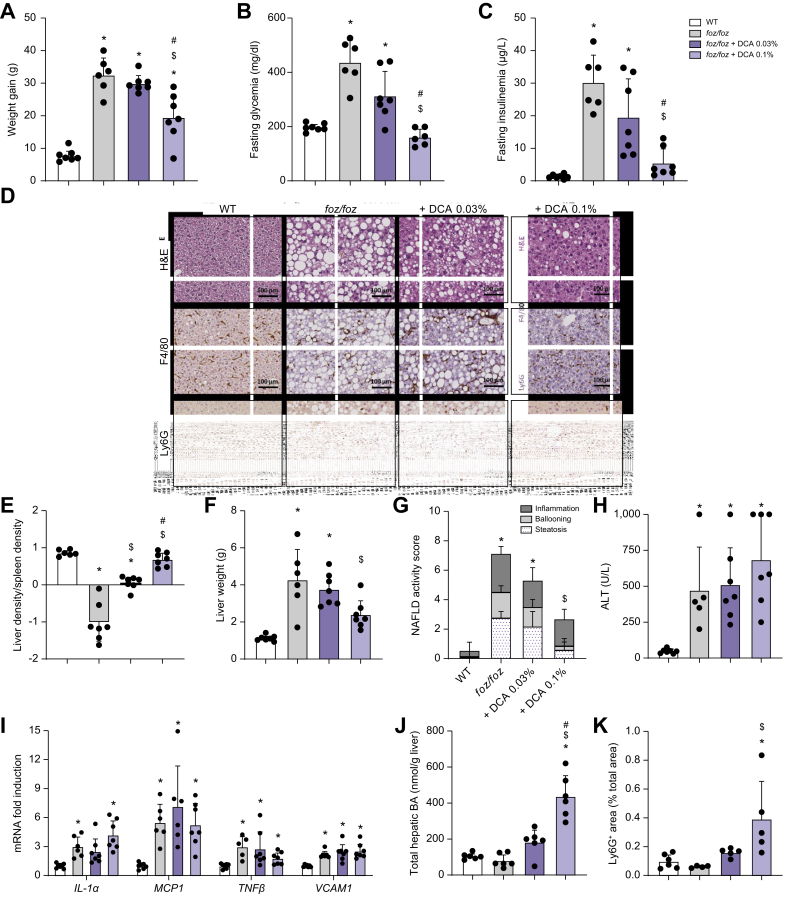
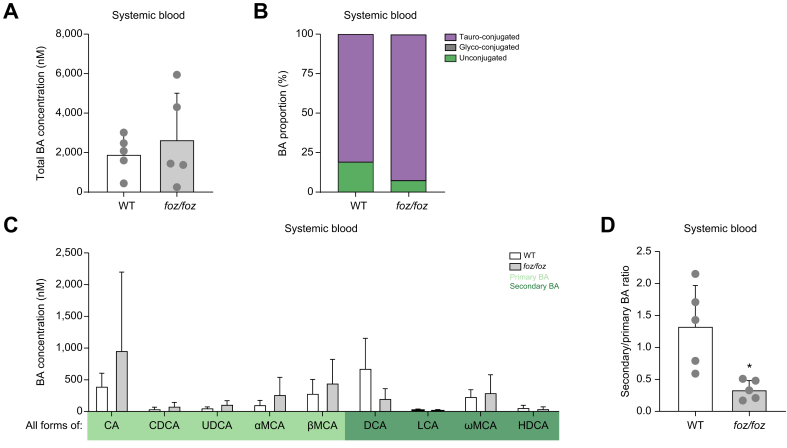
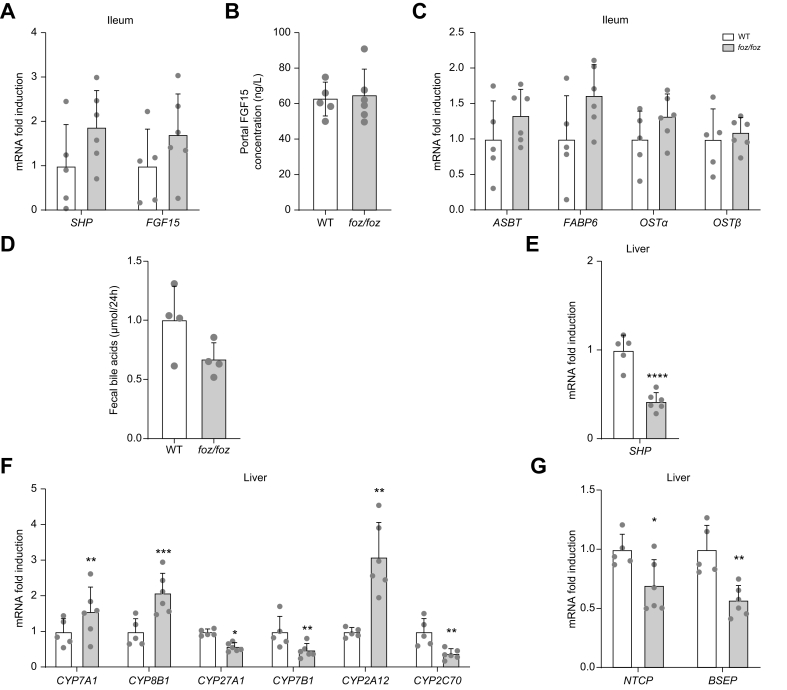
Compared to controls, mice with NASH had lower concentrations of BAs in their portal blood and bile, while systemic BA concentrations were not significantly altered. Notably, the concentrations of secondary BAs, and especially of DCA, and the ratio of secondary to primary BAs were strikingly lower in bile and portal blood of mice with NASH. Hence, portal blood was poor in FXR and TGR5 ligands, and conferred poor anti-inflammatory protection in mice with NASH. Enhanced primary BAs synthesis and conversion of secondary to primary BAs in NASH livers contributed to the depletion in secondary BAs. Dietary DCA supplementation in HFD-fed mice restored the BA concentrations in portal blood, increased TGR5 and FXR signaling, improved the dysmetabolic status, protected from steatosis and hepatocellular ballooning, and reduced macrophage infiltration.
BA composition in the enterohepatic cycle, but not in systemic circulation, is profoundly altered in preclinical models of NASH, with specific depletion in secondary BAs. Dietary correction of the BA profile protected from NASH, supporting a role for enterohepatic BAs in the pathogenesis of NASH.
This study clearly demonstrates that the alterations of enterohepatic bile acids significantly contribute to the development of non-alcoholic steatohepatitis in relevant preclinical models. Indeed, experimental modulation of bile acid composition restored perturbed FXR and TGR5 signaling and prevented non-alcoholic steatohepatitis and associated metabolic disorders.
通过法尼醇X受体(FXR)和G蛋白偶联胆汁酸受体5(TGR5)信号通路,胆汁酸(BA)可调节脂质和葡萄糖代谢、炎症及纤维化。因此,经肠道分泌、修饰和重吸收后返回肝脏的胆汁酸可能参与非酒精性脂肪性肝炎(NASH)的发病机制。在此,我们在NASH临床前模型中对胆汁酸的肝肠循环特征及信号通路进行了表征,并探讨了实验性改变胆汁酸组成的后果。
我们使用高脂饮食(HFD)喂养和高果糖西式饮食喂养的C57BL/6J小鼠,并将它们与其各自的对照组进行比较。小鼠接受补充脱氧胆酸(DCA)的饮食以调节胆汁酸组成。
与对照组相比,NASH小鼠门静脉血和胆汁中的胆汁酸浓度较低,而全身胆汁酸浓度无显著变化。值得注意的是,NASH小鼠胆汁和门静脉血中次级胆汁酸,尤其是DCA的浓度以及次级与初级胆汁酸的比例显著降低。因此,门静脉血中FXR和TGR5配体含量较低,对NASH小鼠的抗炎保护作用较差。NASH肝脏中初级胆汁酸合成增强以及次级胆汁酸向初级胆汁酸的转化导致次级胆汁酸耗竭。在HFD喂养的小鼠中补充膳食DCA可恢复门静脉血中的胆汁酸浓度,增加TGR5和FXR信号传导,改善代谢紊乱状态,预防脂肪变性和肝细胞气球样变,并减少巨噬细胞浸润。
在NASH临床前模型中,肝肠循环中的胆汁酸组成发生了深刻改变,而非体循环中的胆汁酸组成,次级胆汁酸有特定的耗竭。通过饮食纠正胆汁酸谱可预防NASH,支持肝肠胆汁酸在NASH发病机制中的作用。
本研究清楚地表明,肝肠胆汁酸的改变在相关临床前模型中对非酒精性脂肪性肝炎的发展有显著贡献。事实上,对胆汁酸组成的实验性调节可恢复受干扰的FXR和TGR5信号传导,并预防非酒精性脂肪性肝炎及相关代谢紊乱。