Bruno Kessler Foundation, Trento, Italy.
Bruno Kessler Foundation, Trento, Italy; Department of Mathematics, Computer Science and Physics, University of Udine, Udine, Italy.
Epidemics. 2021 Dec;37:100530. doi: 10.1016/j.epidem.2021.100530. Epub 2021 Nov 17.
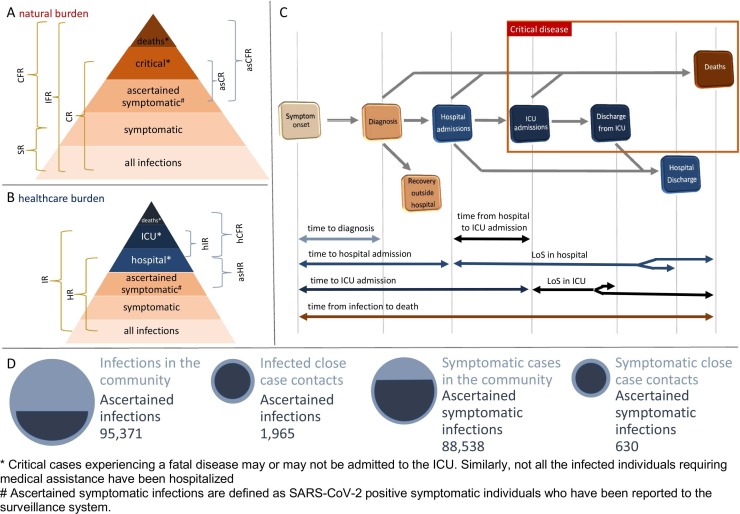
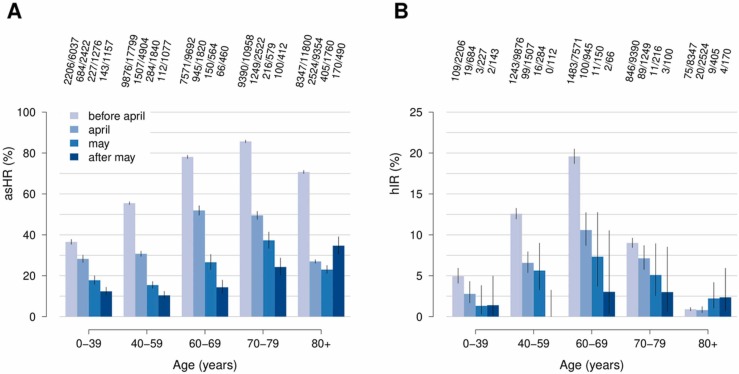
Solid estimates describing the clinical course of SARS-CoV-2 infections are still lacking due to under-ascertainment of asymptomatic and mild-disease cases. In this work, we quantify age-specific probabilities of transitions between stages defining the natural history of SARS-CoV-2 infection from 1965 SARS-CoV-2 positive individuals identified in Italy between March and April 2020 among contacts of confirmed cases. Infected contacts of cases were confirmed via RT-PCR tests as part of contact tracing activities or retrospectively via IgG serological tests and followed-up for symptoms and clinical outcomes. In addition, we provide estimates of time intervals between key events defining the clinical progression of cases as obtained from a larger sample, consisting of 95,371 infections ascertained between February and July 2020. We found that being older than 60 years of age was associated with a 39.9% (95%CI: 36.2-43.6%) likelihood of developing respiratory symptoms or fever ≥ 37.5 °C after SARS-CoV-2 infection; the 22.3% (95%CI: 19.3-25.6%) of the infections in this age group required hospital care and the 1% (95%CI: 0.4-2.1%) were admitted to an intensive care unit (ICU). The corresponding proportions in individuals younger than 60 years were estimated at 27.9% (95%CI: 25.4-30.4%), 8.8% (95%CI: 7.3-10.5%) and 0.4% (95%CI: 0.1-0.9%), respectively. The infection fatality ratio (IFR) ranged from 0.2% (95%CI: 0.0-0.6%) in individuals younger than 60 years to 12.3% (95%CI: 6.9-19.7%) for those aged 80 years or more; the case fatality ratio (CFR) in these two age classes was 0.6% (95%CI: 0.1-2%) and 19.2% (95%CI: 10.9-30.1%), respectively. The median length of stay in hospital was 10 (IQR: 3-21) days; the length of stay in ICU was 11 (IQR: 6-19) days. The obtained estimates provide insights into the epidemiology of COVID-19 and could be instrumental to refine mathematical modeling work supporting public health decisions.
由于对无症状和轻症病例的确诊不足,目前仍缺乏描述 SARS-CoV-2 感染临床过程的可靠数据。本研究通过对 2020 年 3 月至 4 月间意大利确诊病例的接触者中 1965 名 SARS-CoV-2 阳性个体进行回顾性 IgG 血清学检测或实时逆转录聚合酶链反应(RT-PCR)检测,定量分析了年龄特异性的 SARS-CoV-2 感染自然史各阶段之间的转移概率。接触者感染后,通过接触者追踪活动或通过 RT-PCR 检测作为确诊病例的一部分进行确认,并对症状和临床结果进行随访。此外,我们还提供了从包含 2020 年 2 月至 7 月期间确诊的 95371 例感染病例的更大样本中获得的关键临床事件时间间隔的估计值。我们发现,与 60 岁以下的人相比,60 岁以上的人感染 SARS-CoV-2 后出现呼吸道症状或发热≥37.5°C 的可能性高 39.9%(95%CI:36.2-43.6%);该年龄组中 22.3%(95%CI:19.3-25.6%)的感染者需要住院治疗,1%(95%CI:0.4-2.1%)的感染者需要入住重症监护病房(ICU)。60 岁以下人群的相应比例估计为 27.9%(95%CI:25.4-30.4%)、8.8%(95%CI:7.3-10.5%)和 0.4%(95%CI:0.1-0.9%)。60 岁以下人群的感染病死率(IFR)为 0.2%(95%CI:0.0-0.6%),80 岁及以上人群的 IFR 为 12.3%(95%CI:6.9-19.7%);这两个年龄组的病例病死率(CFR)分别为 0.6%(95%CI:0.1-2%)和 19.2%(95%CI:10.9-30.1%)。住院中位时间为 10 天(IQR:3-21),入住 ICU 的中位时间为 11 天(IQR:6-19)。获得的估计值提供了对 COVID-19 流行病学的深入了解,并有助于完善支持公共卫生决策的数学建模工作。