Loosen Sven H, Roderburg Christoph, Alizai Patrick H, Roeth Anjali A, Schmitz Sophia M, Vucur Mihael, Luedde Mark, Schöler David, Paffenholz Pia, Tacke Frank, Trautwein Christian, Luedde Tom, Neumann Ulf P, Ulmer Tom F
Clinic for Gastroenterology, Hepatology and Infectious Diseases, University Hospital Düsseldorf, Medical Faculty of Heinrich Heine University Düsseldorf, 40225 Düsseldorf, Germany.
Department of Visceral and Transplantation Surgery, University Hospital RWTH Aachen, Pauwelsstrasse 30, 52074 Aachen, Germany.
Diagnostics (Basel). 2021 Oct 27;11(11):1999. doi: 10.3390/diagnostics11111999.
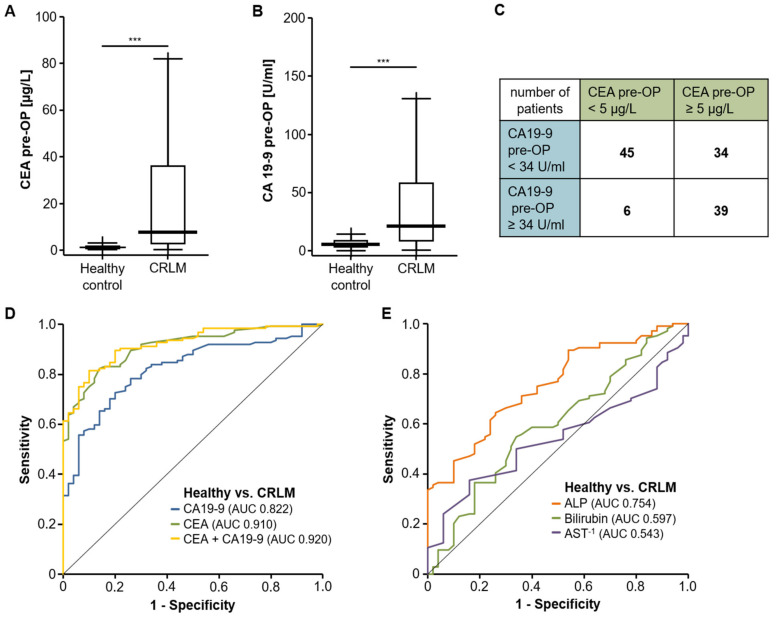
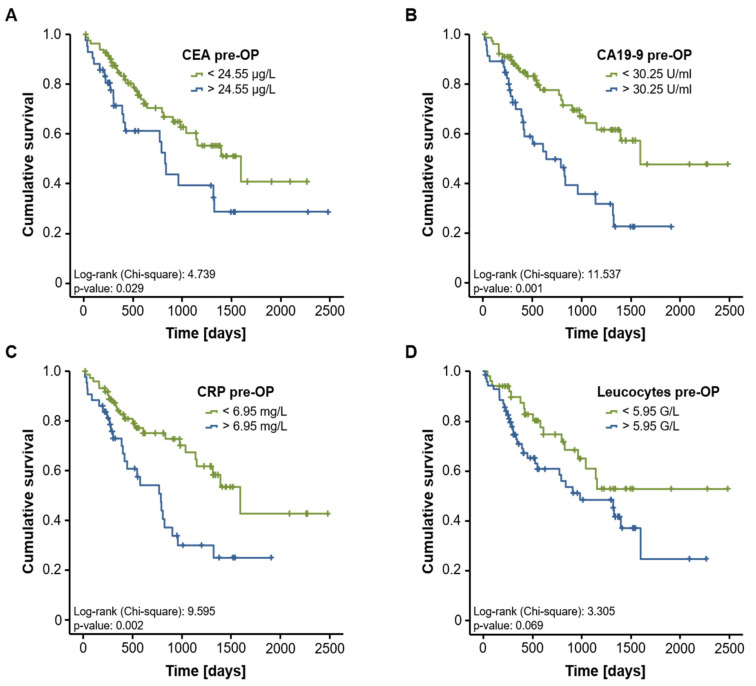
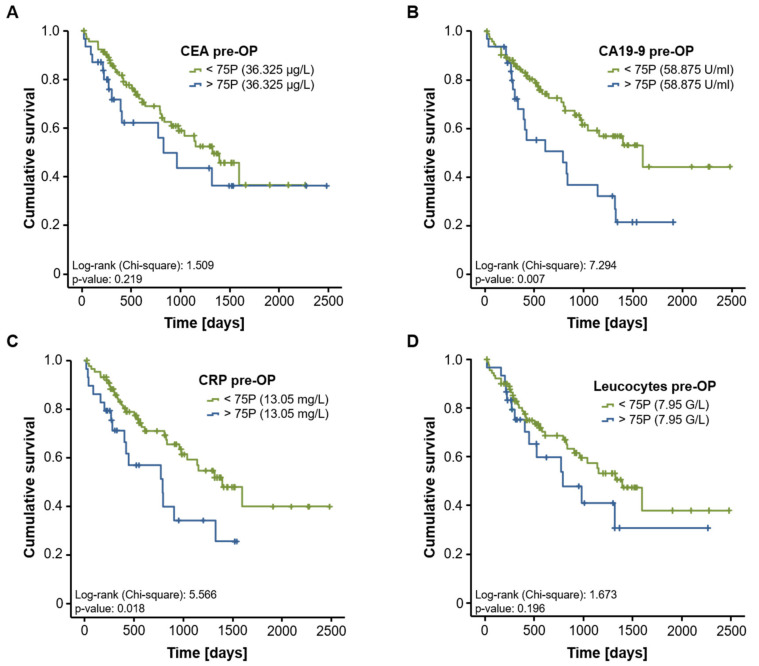
Surgical tumor resection has evolved as a potentially curative therapy for patients with resectable colorectal liver metastases (CRLM). However, disease recurrence is common and the available preoperative stratification strategies are often imprecise to identify the ideal candidates for surgical treatment, resulting in a postoperative 5-year survival rate below 50%. Data on the prognostic value of CEA, CA19-9 and other common laboratory parameters after CRLM resection are scarce and partly inconclusive. Here, we analyzed the prognostic potential of circulating CEA and CA19-9 in comparison to other standard laboratory markers in resectable CRLM patients. Serum levels of tumor markers and other laboratory parameters were analyzed in 125 patients with CRLM undergoing tumor resection at a tertiary referral center. Results were correlated with clinical data and outcome. Both tumor markers were significantly elevated in CRLM patients compared to healthy controls. Interestingly, elevated levels of CEA, CA19-9 and C-reactive protein (CRP) were associated with an unfavorable prognosis after CRLM resection in Kaplan-Meier curve analysis. However, only CEA and not CA19-9 or CRP serum levels were an independent prognostic marker in multivariate Cox regression analysis. Our data demonstrate that circulating levels of CEA rather than CA19-9 might be a valuable addition to the existing preoperative stratification algorithms to identify patients with a poor prognosis after CRLM resection.
手术切除肿瘤已发展成为一种针对可切除结直肠癌肝转移(CRLM)患者的潜在治愈性疗法。然而,疾病复发很常见,现有的术前分层策略往往难以精确识别手术治疗的理想候选人,导致术后5年生存率低于50%。关于CRLM切除术后癌胚抗原(CEA)、糖类抗原19-9(CA19-9)及其他常见实验室参数的预后价值的数据稀缺且部分尚无定论。在此,我们分析了可切除CRLM患者中循环CEA和CA19-9与其他标准实验室标志物相比的预后潜力。对一家三级转诊中心125例接受肿瘤切除的CRLM患者的肿瘤标志物血清水平和其他实验室参数进行了分析。结果与临床数据及转归相关。与健康对照相比,CRLM患者的两种肿瘤标志物均显著升高。有趣的是,在Kaplan-Meier曲线分析中,CEA、CA19-9和C反应蛋白(CRP)水平升高与CRLM切除术后不良预后相关。然而,在多变量Cox回归分析中,只有CEA而非CA19-9或CRP血清水平是独立的预后标志物。我们的数据表明,CEA的循环水平而非CA19-9水平可能是现有术前分层算法的有价值补充,以识别CRLM切除术后预后不良的患者。