Christopher Kwon Ye In, Xie Wei, Zhu Haizhou, Xie Jiashu, Shinn Keaton, Juckel Nicholas, Vince Robert, More Swati S, Lee Michael K
Department of Neuroscience, University of Minnesota, Minneapolis, MN 55455, USA.
Center for Drug Design, College of Pharmacy, University of Minnesota, Minneapolis, MN 55455, USA.
Antioxidants (Basel). 2021 Nov 10;10(11):1796. doi: 10.3390/antiox10111796.
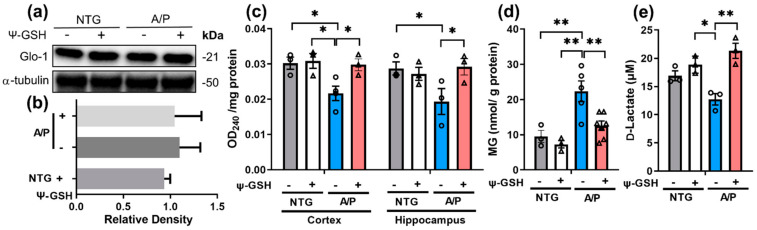
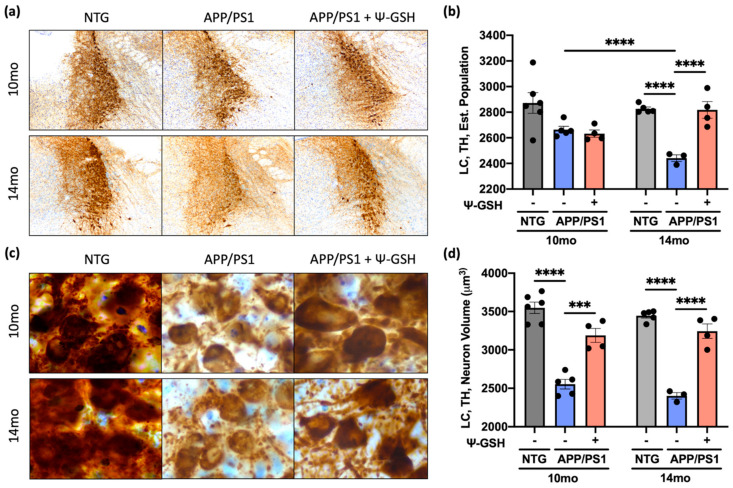
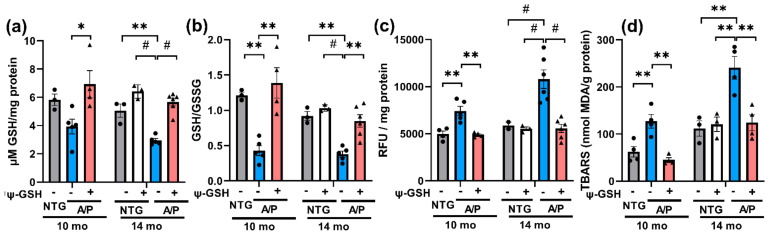
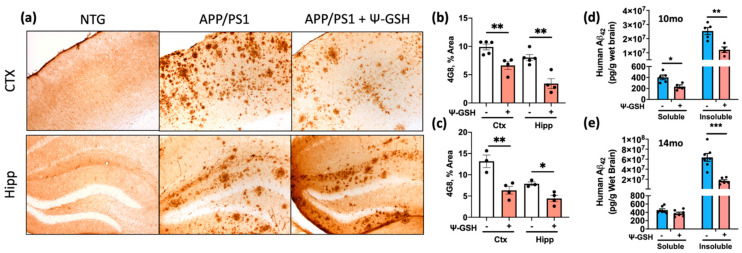
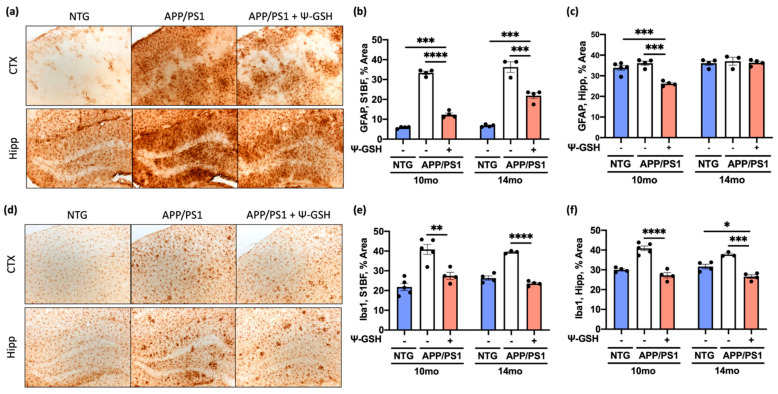
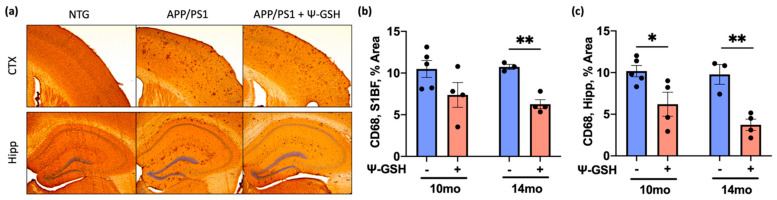
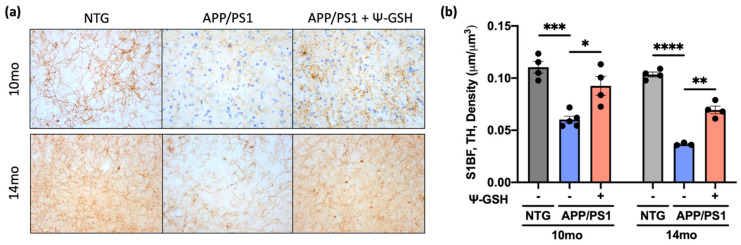
Oxidative stress in Alzheimer's disease (AD) is mediated, in part, by the loss of glutathione (GSH). Previous studies show that γ-glutamyl transpeptidase (GGT)-resistant GSH analog, Ψ-GSH, improves brain GSH levels, reduces oxidative stress markers in brains of APP/PS1 transgenic mice, a mouse model of AD, and attenuates early memory deficits in the APP/PS1 model. Herein, we examined whether Ψ-GSH can attenuate the disease progression when administered following the onset of AD-like pathology in vivo. Cohorts of APP/PS1 mice were administered Ψ-GSH for 2 months starting at 8 month or 12 months of age. We show that Ψ-GSH treatment reduces indices of oxidative stress in older mice by restoration of enzyme glyoxalase-1 (Glo-1) activity and reduces levels of insoluble Aβ. Quantitative neuropathological analyses show that Ψ-GSH treatment significantly reduces Aβ deposition and brain inflammation in APP/PS1 mice compared to vehicle-treated mice. More importantly, Ψ-GSH treatment attenuated the progressive loss of cortical TH+ afferents and the loss of TH+ neurons in the locus coeruleus (LC). Collectively, the results show that Ψ-GSH exhibits significant antioxidant activity in aged APP/PS1 mice and chronic Ψ-GSH treatment administered after the onset of AD pathology can reverse/slow further progression of AD-like pathology and neurodegeneration in vivo.
阿尔茨海默病(AD)中的氧化应激部分是由谷胱甘肽(GSH)的缺失介导的。先前的研究表明,γ-谷氨酰转肽酶(GGT)抗性GSH类似物Ψ-GSH可提高脑内GSH水平,降低AD小鼠模型APP/PS1转基因小鼠脑内的氧化应激标志物,并减轻APP/PS1模型中的早期记忆缺陷。在此,我们研究了在体内出现AD样病理后给予Ψ-GSH是否能减缓疾病进展。从8个月或12个月大开始,对APP/PS1小鼠队列给予Ψ-GSH治疗2个月。我们发现,Ψ-GSH治疗通过恢复乙二醛酶-1(Glo-1)活性降低了老年小鼠的氧化应激指标,并降低了不溶性Aβ的水平。定量神经病理学分析表明,与载体处理的小鼠相比,Ψ-GSH治疗显著减少了APP/PS1小鼠的Aβ沉积和脑炎症。更重要的是,Ψ-GSH治疗减轻了皮质TH+传入纤维的渐进性丧失以及蓝斑(LC)中TH+神经元的丧失。总体而言,结果表明,Ψ-GSH在老年APP/PS1小鼠中表现出显著的抗氧化活性,并且在AD病理发生后给予慢性Ψ-GSH治疗可在体内逆转/减缓AD样病理和神经退行性变的进一步进展。