Department of Biomedicine and Prevention, Medical Genetics Section, University of Rome "Tor Vergata", Via Montpellier 1, 00133 Rome, Italy.
IRCCS (Institute for Treatment and Research) Neuromed, 86077 Pozzilli, Italy.
Int J Mol Sci. 2021 Nov 22;22(22):12594. doi: 10.3390/ijms222212594.
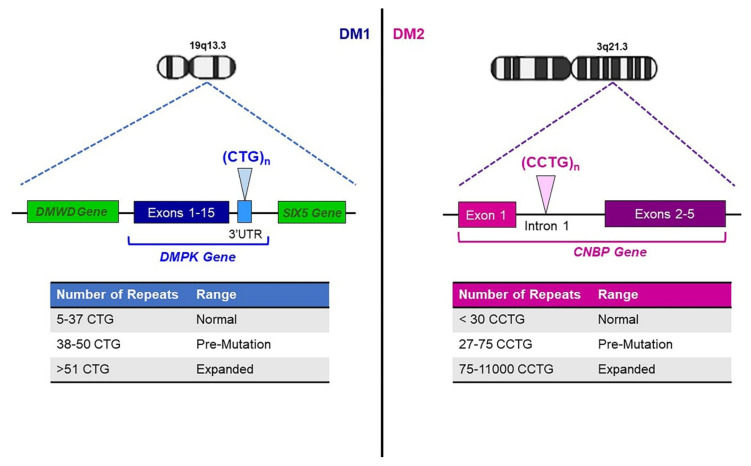
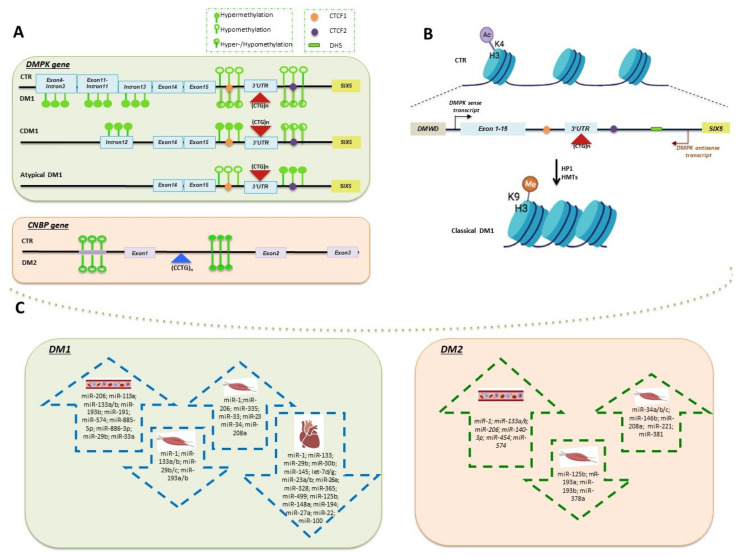
Myotonic dystrophy type 1 and 2 (DM1 and DM2) are two multisystemic autosomal dominant disorders with clinical and genetic similarities. The prevailing paradigm for DMs is that they are mediated by an toxic RNA mechanism, triggered by untranslated CTG and CCTG repeat expansions in the and genes for DM1 and DM2, respectively. Nevertheless, increasing evidences suggest that epigenetics can also play a role in the pathogenesis of both diseases. In this review, we discuss the available information on epigenetic mechanisms that could contribute to the DMs outcome and progression. Changes in DNA cytosine methylation, chromatin remodeling and expression of regulatory noncoding RNAs are described, with the intent of depicting an epigenetic signature of DMs. Epigenetic biomarkers have a strong potential for clinical application since they could be used as targets for therapeutic interventions avoiding changes in DNA sequences. Moreover, understanding their clinical significance may serve as a diagnostic indicator in genetic counselling in order to improve genotype-phenotype correlations in DM patients.
肌强直性营养不良 1 型和 2 型(DM1 和 DM2)是两种具有临床和遗传相似性的多系统常染色体显性遗传病。DM 的主要观点是,由分别位于 DM1 和 DM2 基因中的未翻译 CTG 和 CCTG 重复扩增引起的毒性 RNA 机制介导。然而,越来越多的证据表明,表观遗传学也可能在这两种疾病的发病机制中发挥作用。在这篇综述中,我们讨论了关于表观遗传机制的现有信息,这些机制可能有助于 DM 的结果和进展。描述了 DNA 胞嘧啶甲基化、染色质重塑和调节性非编码 RNA 表达的变化,旨在描绘 DM 的表观遗传特征。表观遗传生物标志物具有很强的临床应用潜力,因为它们可以作为治疗干预的靶点,避免 DNA 序列的改变。此外,了解它们的临床意义可以作为遗传咨询中的诊断指标,以改善 DM 患者的基因型-表型相关性。