Nabergoj Marko, Neyton Lionel, Bothorel Hugo, Ho Sean W L, Wang Sidi, Chong Xue Ling, Lädermann Alexandre
Valdoltra Orthopaedic Hospital, 6280 Ankaran, Slovenia.
Faculty of Medicine, University of Ljubljana, 1000 Ljubljana, Slovenia.
J Clin Med. 2021 Nov 13;10(22):5274. doi: 10.3390/jcm10225274.
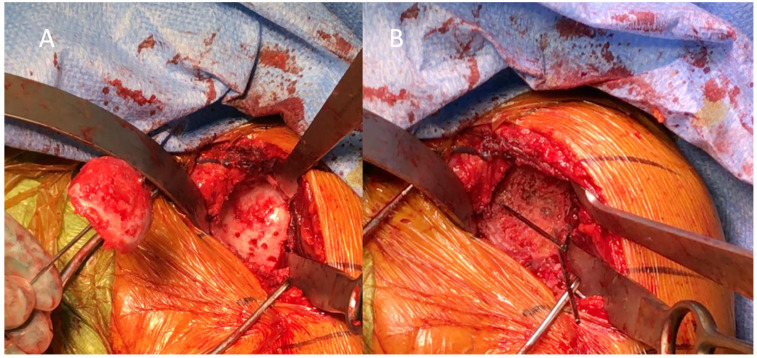
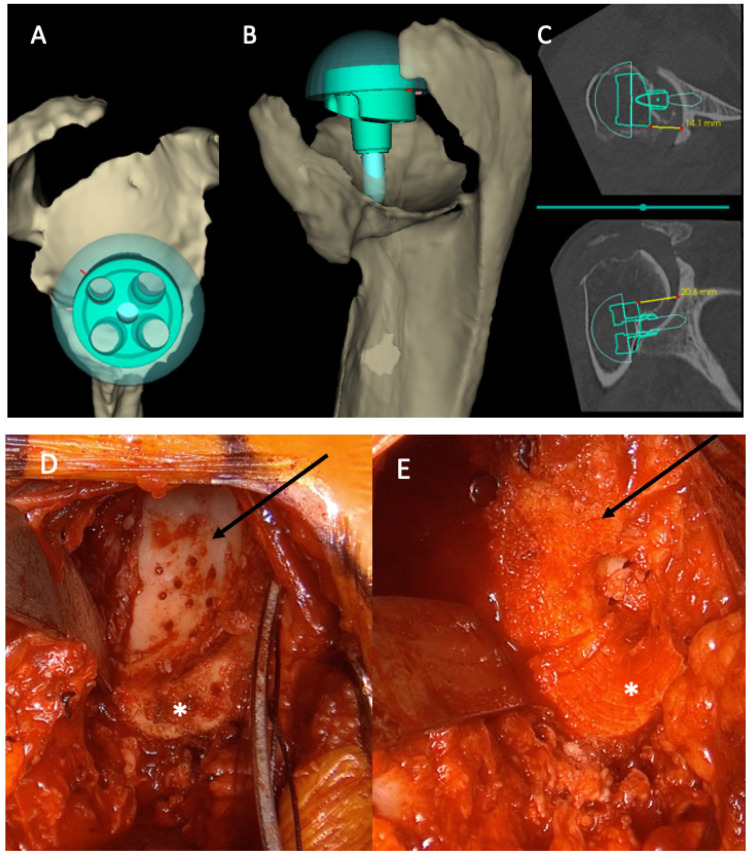
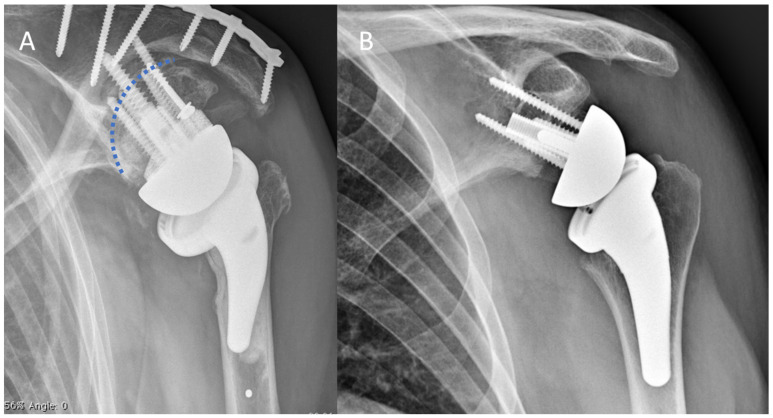
There are different techniques to address severe glenoid erosion during reverse shoulder arthroplasty (RSA). This study assessed the clinical and radiological outcomes of RSA with combined bony and metallic augment (BMA) glenoid reconstruction compared to bony augmentation (BA) alone. A review of patients who underwent RSA with severe glenoid bone loss requiring reconstruction from January 2017 to January 2019 was performed. Patients were divided into two groups: BMA versus BA alone. Clinical outcome measurements included two years postoperative ROM, Constant score, subjective shoulder value (SSV), and the American Shoulder and Elbow Surgeons Shoulder (ASES) score. Radiological outcomes included radiographic evidence of scapular complications and graft incorporation. The BMA group had significantly different glenoid morphology ( < 0.001) and greater bone loss thickness than the BA group (16.3 ± 3.8 mm vs. 12.0 ± 0.0 mm, = 0.020). Both groups had significantly improved ROM (anterior forward flexion and external rotation) and clinical scores (Constant, SSV and ASES scores) at 2 years. Greater improvement was observed in the BMA group in terms of anterior forward flexion (86.3° ± 27.9° vs. 43.8° ± 25.6°, = 0.013) and Constant score (56.6 ± 10.1 vs. 38.3 ± 16.7, = 0.021). The BA group demonstrated greater functional and clinical improvements with higher postoperative active external rotation and ASES results (active external rotation, 49.4° ± 17.0° vs. 29.4° ± 14.7°, = 0.017; ASES, 89.1 ± 11.3 vs. 76.8 ± 11.0, = 0.045). The combination use of bone graft and metallic augments in severe glenoid bone loss during RSA is safe and effective and can be considered in cases of severe glenoid bone loss where bone graft alone may be insufficient.
在反肩关节置换术(RSA)中,有多种技术可用于处理严重的肩胛盂侵蚀。本研究评估了与单纯骨增强(BA)相比,联合使用骨和金属增强物(BMA)进行肩胛盂重建的RSA的临床和放射学结果。对2017年1月至2019年1月期间因严重肩胛盂骨丢失需要重建而接受RSA的患者进行了回顾性研究。患者分为两组:BMA组和单纯BA组。临床结果测量包括术后两年的活动度(ROM)、Constant评分、主观肩关节评分(SSV)以及美国肩肘外科医师学会肩关节(ASES)评分。放射学结果包括肩胛并发症和移植物融合的影像学证据。BMA组的肩胛盂形态与BA组有显著差异(<0.001),且骨丢失厚度大于BA组(16.3±3.8mm对12.0±0.0mm,P = 0.02)。两组在术后2年时的ROM(前屈和外旋)和临床评分(Constant、SSV和ASES评分)均有显著改善。BMA组在前屈方面改善更大(86.3°±27.9°对43.8°±25.6°,P = 0.013),Constant评分也更高(56.6±10.1对38.3±16.7,P = 0.021)。BA组在术后主动外旋和ASES结果方面表现出更大的功能和临床改善(主动外旋,49.4°±17.0°对29.4°±14.7°,P = 0.017;ASES,89.1±11.3对76.8±11.0,P = 0.045)。在RSA中,对于严重肩胛盂骨丢失联合使用骨移植和金属增强物是安全有效的,在单纯骨移植可能不足的严重肩胛盂骨丢失病例中可以考虑使用。