Mid-Atlantic Permanente Research Institute, 2101 E. Jefferson Street, Rockville, MD 20852, USA.
Mid-Atlantic Permanente Medical Group, Kaiser Permanente Mid-Atlantic States, 2101 E. Jefferson Street, Rockville, MD 20852, USA.
Viruses. 2021 Oct 23;13(11):2140. doi: 10.3390/v13112140.
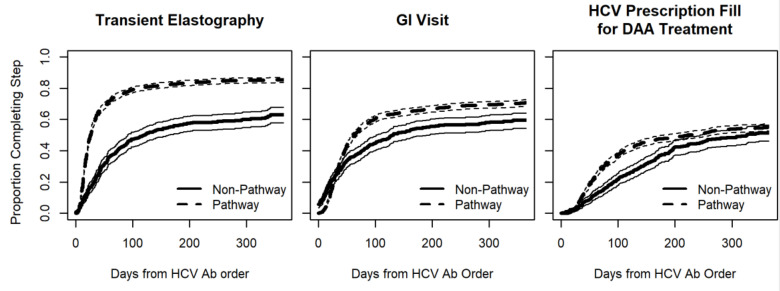
Since 2020, the US Preventive Services Taskforce has recommended expanding hepatitis C virus (HCV) screening to include ages 18-79, in addition to baby boomers (born 1945-1965) and those at-risk for hepatitis C virus. This retrospective cohort analysis compared patients (18 years and above) tested for HCV through usual care versus a coordinator-supported program (HCV pathway) during 2015-2018 within Kaiser Permanente Mid-Atlantic States (KPMAS). In total, 131,176 patients were tested through the HCV pathway and 128,311 through usual care (non-standardized testing). Of those tested, 1.6% (HCV pathway) and 0.5% (usual care) had chronic HCV. Of those with chronic HCV, more patients tested within the HCV pathway completed hepatic transient elastography (82.6% HCV pathway vs. 45.6% usual care; < 0.001) and a gastroenterology visit (72.2% HCV pathway vs. 46.5% usual care; < 0.001), and had filled prescriptions for treatment (56.5% HCV pathway vs. 40.3% usual care; < 0.001). The median time to complete each step was shorter for those tested through the HCV pathway (hepatic transient elastography (26 vs. 118 days), gastroenterology visit (63 vs. 131 days), and prescription fill (222 vs. 326 days)). More patients tested through a coordinator-supported, standardized testing pathway completed the necessary testing steps, in less time, compared to usual care. These findings may inform institutions seeking to create effective population-wide testing programs for HCV and other conditions.
自 2020 年以来,美国预防服务工作组建议扩大丙型肝炎病毒 (HCV) 筛查范围,纳入 18-79 岁人群,此外还包括婴儿潮一代(1945-1965 年出生)和有感染 HCV 风险的人群。本回顾性队列分析比较了 2015-2018 年期间 Kaiser Permanente Mid-Atlantic States(KPMAS)内通过常规护理(常规护理)与协调员支持计划(HCV 途径)接受 HCV 检测的患者(18 岁及以上)。共有 131176 名患者通过 HCV 途径接受了检测,128311 名患者通过常规护理(非标准检测)接受了检测。在接受检测的患者中,有 1.6%(HCV 途径)和 0.5%(常规护理)患有慢性 HCV。在患有慢性 HCV 的患者中,更多通过 HCV 途径接受检测的患者完成了肝瞬时弹性成像(82.6% HCV 途径 vs. 45.6% 常规护理;<0.001)和胃肠病就诊(72.2% HCV 途径 vs. 46.5% 常规护理;<0.001),并开具了治疗处方(56.5% HCV 途径 vs. 40.3% 常规护理;<0.001)。通过 HCV 途径接受检测的患者完成每一步的中位时间更短(肝瞬时弹性成像(26 天 vs. 118 天),胃肠病就诊(63 天 vs. 131 天),处方填写(222 天 vs. 326 天))。与常规护理相比,更多通过协调员支持的标准化检测途径接受检测的患者能够在更短的时间内完成必要的检测步骤。这些发现可能为寻求为 HCV 和其他疾病创建有效人群检测计划的机构提供信息。