Wani Farooq Ahmed, Bandy Altaf, Alenzi Mohammed Jayed S, Alzarea Abdulaziz Ibrahim, Alanazi Abdullah S, Sayeed Mohammed Ubaidullah, Thirunavukkarasu Ashokkumar, Tantry Bilal, Dar Mushtaq
Department of Pathology, College of Medicine, Jouf University, Sakaka 72388, Saudi Arabia.
Department of Community Medicine, College of Medicine, Jouf University, Sakaka 72388, Saudi Arabia.
Microorganisms. 2021 Oct 28;9(11):2246. doi: 10.3390/microorganisms9112246.
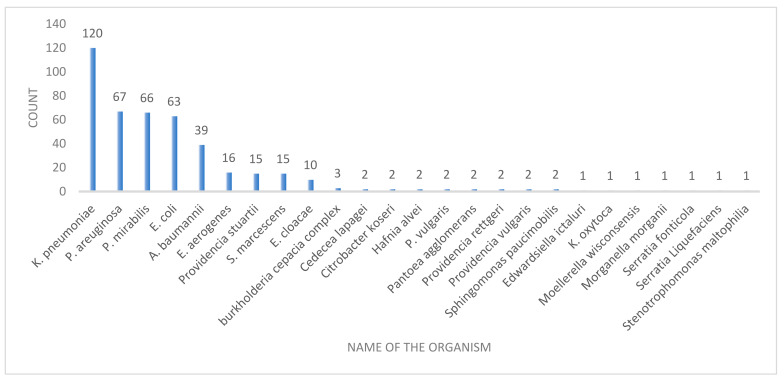
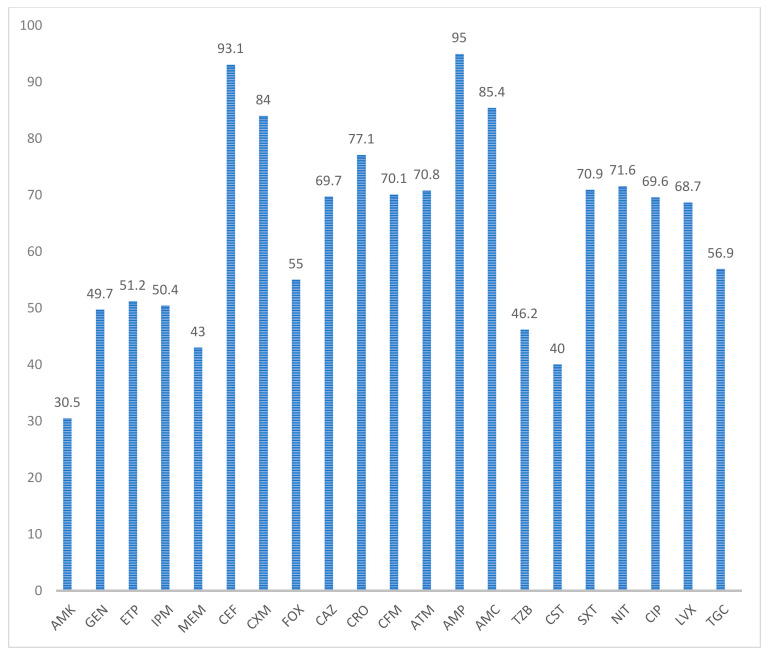
Intensive care units are complex environments favoring high resistance in microorganisms. This study evaluated the resistance and the distribution dynamics of resistant Gram-negative bacteria (GNB) in patients admitted to intensive care units. This retrospective, record-based, cross-sectional study analyzed all of the antibiograms of patients admitted to the ICUs. The BD Phoenix system (BD Diagnostics, Sparks, MD, USA) was used for bacterial identification and antimicrobial testing. Clinical and Laboratory Standard Institute recommendations were used for antimicrobial testing. Frequencies and percentages of multidrug and pan-drug resistance were calculated. A total of 570 bacterial growths were observed, out of which 437 (76.7%) were of GNB. (21.0%), (11.8%), and (13.2%) were the most frequent disease-causing bacteria in intensive care patients. Resistance rates of 73.2% and 70.1% were observed for third- and fourth-generation cephalosporins, respectively, while 48.2% carbapenem and > 65% fluoroquinolones resistance rates were observed. Amikacin was the most effective antibiotic, with a sensitivity rate of 69.5%. A total of 372 (85.1%) of GNB were multidrug resistant. The majority of infections in intensive care patients are caused by multidrug-resistant (MDR) Gram-negative bacteria. Female gender and advancing age are factors favoring MDR. Enhanced surveillance and strengthening of the antimicrobial stewardship program are warranted.
重症监护病房是有利于微生物产生高耐药性的复杂环境。本研究评估了入住重症监护病房患者中革兰氏阴性菌(GNB)的耐药性及耐药菌的分布动态。这项基于记录的回顾性横断面研究分析了所有入住重症监护病房患者的抗菌谱。使用BD Phoenix系统(美国马里兰州斯帕克斯市BD诊断公司)进行细菌鉴定和抗菌药物检测。抗菌药物检测采用临床和实验室标准协会的建议。计算多重耐药和泛耐药的频率及百分比。共观察到570次细菌生长,其中437次(76.7%)为革兰氏阴性菌。(21.0%)、(11.8%)和(13.2%)是重症监护患者中最常见的致病菌。第三代和第四代头孢菌素的耐药率分别为73.2%和70.1%,而碳青霉烯类耐药率为48.2%,氟喹诺酮类耐药率>65%。阿米卡星是最有效的抗生素,敏感率为69.5%。共有372株(85.1%)革兰氏阴性菌对多种药物耐药。重症监护患者中的大多数感染是由多重耐药革兰氏阴性菌引起的。女性和年龄增长是有利于产生多重耐药的因素。有必要加强监测并强化抗菌药物管理计划。