
德国野猪戊型肝炎病毒株的细胞培养分离及全基因组特征分析
Cell Culture Isolation and Whole Genome Characterization of Hepatitis E Virus Strains from Wild Boars in Germany.
作者信息
Schilling-Loeffler Katja, Viera-Segura Oliver, Corman Victor Max, Schneider Julia, Gadicherla Ashish K, Schotte Ulrich, Johne Reimar
机构信息
Department of Biological Safety, German Federal Institute for Risk Assessment, 10589 Berlin, Germany.
Laboratorio de Diagnóstico de Enfermedades Emergentes y Reemergentes, Departamento de Microbiología y Patología, Centro Universitario de Ciencias de la Salud, Universidad de Guadalajara, 44340 Guadalajara, Mexico.
出版信息
Microorganisms. 2021 Nov 5;9(11):2302. doi: 10.3390/microorganisms9112302.
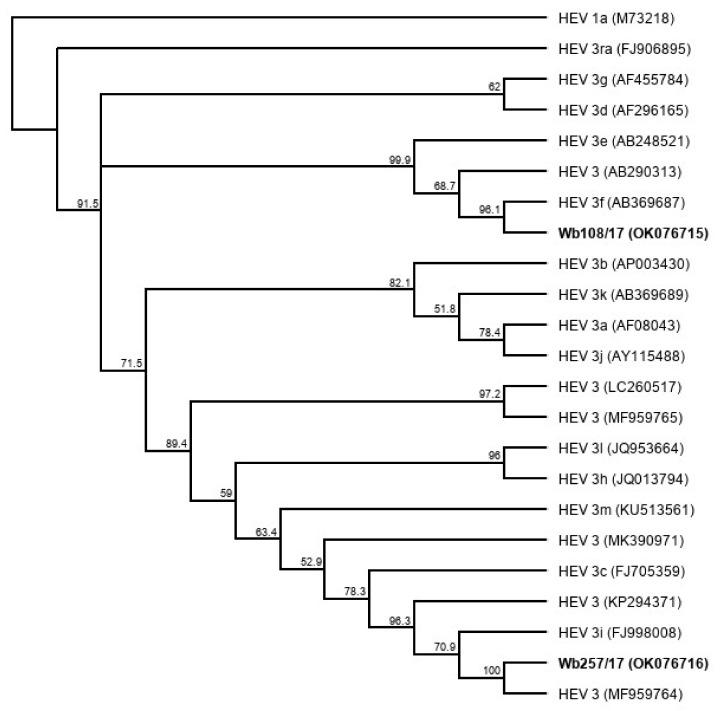
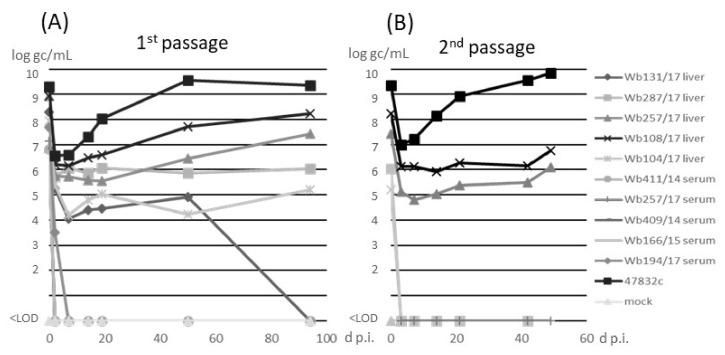
Infection with hepatitis E virus (HEV) can cause acute and chronic hepatitis in humans. The HEV genotype 3 can be zoonotically transmitted from animals to humans, with wild boars representing an important reservoir species. Cell culture isolation of HEV is generally difficult and mainly described for human isolates so far. Here, five sera and five liver samples from HEV-RNA-positive wild boar samples were inoculated onto PLC/PRF/5 cells, incubated for 3 months and thereafter passaged for additional 6 weeks. As demonstrated by RT-qPCR, immunofluorescence and immune electron microscopy, virus was successfully isolated from two liver samples, which originally contained high HEV genome copy numbers. Both isolates showed slower growth than the culture-adapted HEV strain 47832c. In contrast to this strain, the isolated strains had no insertions in their hypervariable genome region. Next generation sequencing using an HEV sequence-enriched library enabled full genome sequencing. Strain Wb108/17 belongs to subtype 3f and strain Wb257/17 to a tentative novel subtype recently described in Italian wild boars. The results indicate that HEV can be successfully isolated in cell culture from wild boar samples containing high HEV genome copy numbers. The isolates may be used further to study the zoonotic potential of wild boar-derived HEV subtypes.
戊型肝炎病毒(HEV)感染可导致人类急性和慢性肝炎。HEV 基因型 3 可通过人畜共患病的方式从动物传播给人类,野猪是重要的宿主物种。迄今为止,HEV 的细胞培养分离通常较为困难,且主要是针对人类分离株进行描述。在此,将来自 HEV-RNA 阳性野猪样本的 5 份血清和 5 份肝脏样本接种到 PLC/PRF/5 细胞上,培养 3 个月,之后再传代 6 周。经逆转录定量聚合酶链反应(RT-qPCR)、免疫荧光和免疫电子显微镜检测表明,病毒成功从最初含有高 HEV 基因组拷贝数的两份肝脏样本中分离出来。两种分离株的生长速度均比适应细胞培养的 HEV 毒株 47832c 慢。与该毒株不同的是,分离出的毒株在其高变基因组区域没有插入序列。使用富含 HEV 序列的文库进行的二代测序实现了全基因组测序。Wb108/17 毒株属于 3f 亚型,Wb257/17 毒株属于最近在意大利野猪中描述的一个暂定新亚型。结果表明,HEV 能够从含有高 HEV 基因组拷贝数的野猪样本中成功分离到细胞培养物中。这些分离株可进一步用于研究野猪源性 HEV 亚型的人畜共患病潜力。



 Zotero 插件