Graduate School of Public Health, Teikyo University, 2-11-1 Kaga, Itabashi-ku, Tokyo, 173-8605, Japan.
Department of Health Communication, Graduate School of Medicine, The University of Tokyo, 7-3-1 Hongo, Bunkyo-ku, Tokyo, 113-8655, Japan.
BMC Public Health. 2021 Nov 27;21(1):2180. doi: 10.1186/s12889-021-12092-x.
During the coronavirus disease 2019 (COVID-19) pandemic, the importance of health literacy (HL) was addressed by public health researchers. We longitudinally examined the changes in general HL and health-related quality of life (HRQOL) between immediately before the COVID-19 outbreak and 1 year later, and how general HL before the outbreak was related to changes in HRQOL in the Japanese general population.
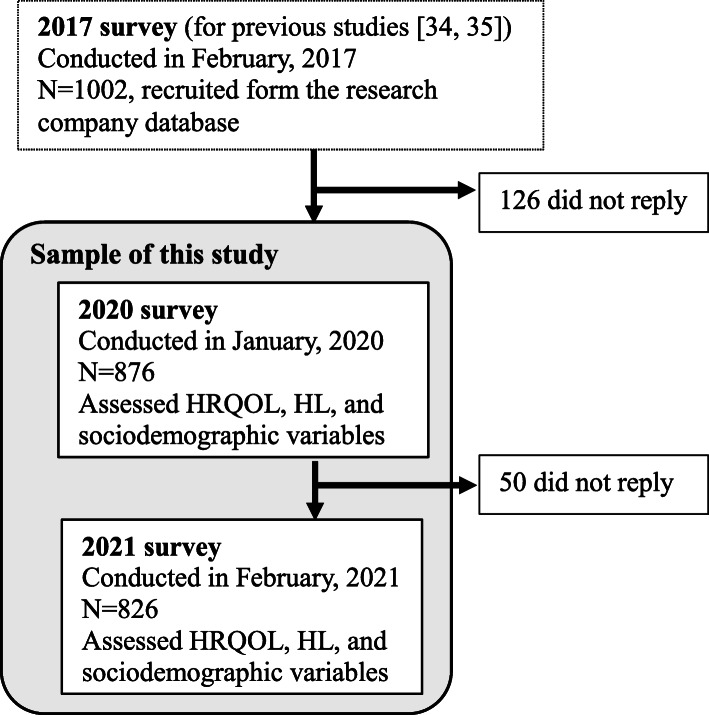
Among the Japanese residents aged 20-79 years who participated in our previous study in 2017, 826 were followed-up via self-administered questionnaires in January 2020 and February 2021, for the purposes of this study. The HRQOL was measured using the SF-8, a short version of the SF-36 Health Survey, and general HL was measured using the short form of the European Health Literacy Survey Questionnaire (HL-SF12) in the 2020 and 2021 surveys.
The physical and mental dimensions of HRQOL as well as general HL declined significantly from immediately before the COVID-19 outbreak to 1 year later (p = .010, p < .001 and p < .001, respectively). The decline in HRQOL, especially the mental dimension, was more significant among women. A lower economic status was also related to a greater decline in HRQOL (p = .026 for the physical dimension and p = .012 for the mental dimension). Higher general HL before the COVID-19 outbreak was associated with a lesser decline in HRQOL in both the physical and mental dimensions (p = .040 and p < .001, respectively) after controlling for possible confounding variables such as gender and economic status.
Healthcare support is crucial for vulnerable populations during and after the pandemic. General HL may be important for attenuating the decline in HRQOL, by enabling effective use of health information and adaptive behaviors toward health threats. Further studies are needed to better understand the association between HL and HRQOL.
在 2019 年冠状病毒病(COVID-19)大流行期间,公共卫生研究人员强调了健康素养(HL)的重要性。我们纵向研究了 COVID-19 爆发前和 1 年后一般 HL 和健康相关生活质量(HRQOL)的变化,以及爆发前一般 HL 如何与日本一般人群 HRQOL 的变化相关。
在参加我们 2017 年之前研究的日本 20-79 岁居民中,有 826 人在 2020 年 1 月和 2021 年 2 月通过自我管理的问卷进行了随访,以进行这项研究。使用 SF-8(SF-36 健康调查的简短版本)测量 HRQOL,使用欧洲健康素养调查问卷(HL-SF12)的简短版本在 2020 年和 2021 年的调查中测量一般 HL。
从 COVID-19 爆发前到 1 年后,HRQOL 的身体和心理维度以及一般 HL 显著下降(p=.010,p<.001 和 p<.001,分别)。女性的 HRQOL 下降更显著,特别是心理维度。较低的经济地位也与 HRQOL 的更大下降有关(身体维度为 p=.026,心理维度为 p=.012)。在控制性别和经济地位等可能的混杂变量后,COVID-19 爆发前较高的一般 HL 与身体和心理维度 HRQOL 的下降幅度较小相关(分别为 p=.040 和 p<.001)。
在大流行期间和之后,医疗保健支持对于弱势群体至关重要。一般 HL 可能通过有效利用健康信息和针对健康威胁的适应性行为,对减轻 HRQOL 的下降很重要。需要进一步研究以更好地了解 HL 与 HRQOL 之间的关系。