Department of Chemical and Biological Engineering, University of Saskatchewan, 57 Campus Drive, Saskatoon, SK, S7N 5A9, Canada.
Division of Biomedical Engineering, University of Saskatchewan, 57 Campus Drive, Saskatoon, SK, S7N 5A9, Canada.
Sci Rep. 2021 Nov 29;11(1):23080. doi: 10.1038/s41598-021-01660-1.
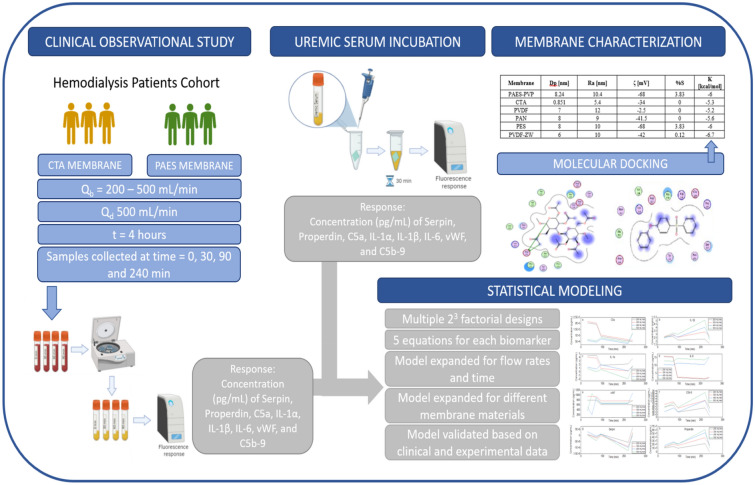
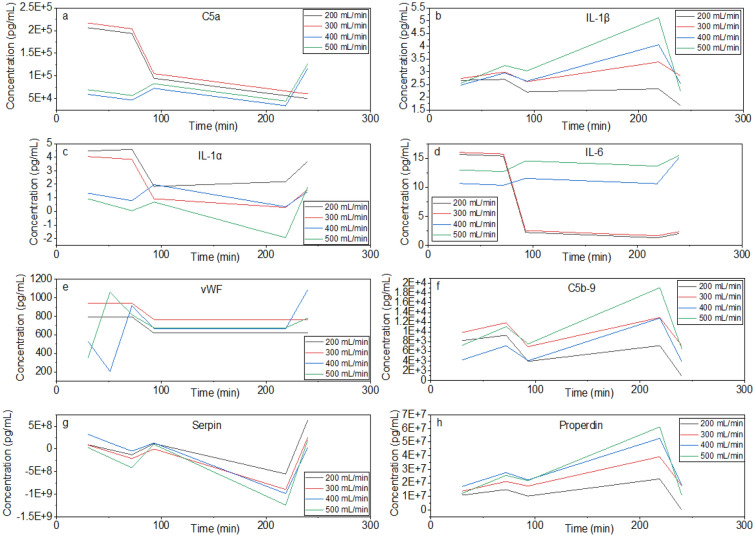
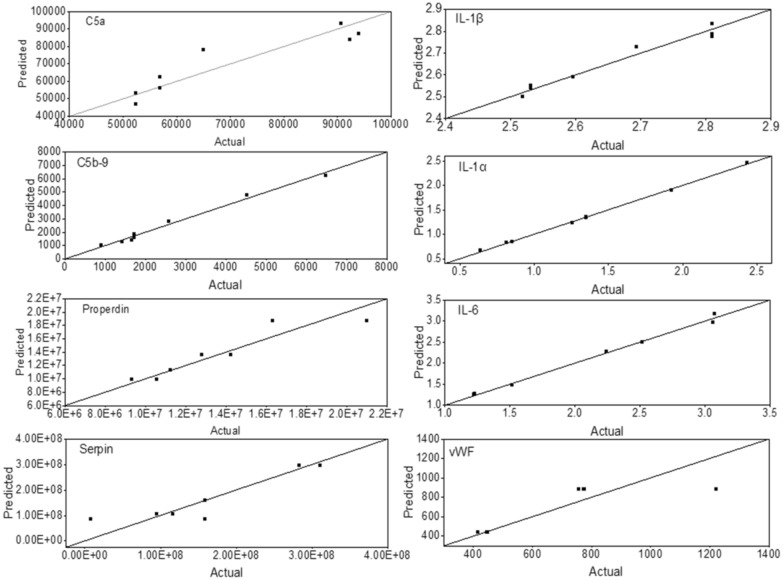
Chronic kidney disease affects millions of people around the globe and many patients rely on hemodialysis (HD) to survive. HD is associated with undesired life-threatening side effects that are linked to membrane biocompatibility and clinical operating conditions. The present study develops a mathematical model to predict the inflammatory biomarkers released in HD patients based on membrane morphology, chemistry, and interaction affinity. Based on the morphological characteristics of two clinical-grade HD membrane modules (CTA and PAES-PVP) commonly used in Canadian hospitals, a molecular docking study, and the release of inflammatory cytokines during HD and in vitro incubation experiments, we develop five sets of equations that describe the concentration of eight biomarkers (serpin/antithrombin-III, properdin, C5a, 1L-1α, 1L-1β, C5b-9, IL6, vWF). The equations developed are functions of membrane properties (pore size, roughness, chemical composition, affinity to fibrinogen, and surface charge) and HD operating conditions (blood flow rate, Qb, and treatment time, t). We expand our model based on available clinical data and increase its range of applicability in terms of flow rate and treatment time. We also modify the original equations to expand their range of applicability in terms of membrane materials, allowing the prediction and validation of the inflammatory response of several clinical and synthesized membrane materials. Our affinity-based model solely relies on theoretical values of molecular docking, which can significantly reduce the experimental load related to the development of more biocompatible materials. Our model predictions agree with experimental clinical data and can guide the development of novel materials and support evidence-based membrane synthesis of HD membranes, reducing the need for trial-and-error approaches.
慢性肾脏病影响着全球数百万人,许多患者依赖血液透析(HD)来维持生命。HD 与膜生物相容性和临床操作条件相关的不良危及生命的副作用有关。本研究开发了一种数学模型,根据膜形态、化学性质和相互作用亲和力,预测 HD 患者释放的炎症生物标志物。基于两种常用于加拿大医院的临床级 HD 膜模块(CTA 和 PAES-PVP)的形态特征、分子对接研究以及在 HD 和体外孵育实验中炎症细胞因子的释放,我们开发了五组方程,描述了 8 种生物标志物(丝氨酸蛋白酶抑制剂/抗凝血酶-III、备解素、C5a、1L-1α、1L-1β、C5b-9、IL6、vWF)的浓度。所开发的方程是膜特性(孔径、粗糙度、化学成分、对纤维蛋白原的亲和力和表面电荷)和 HD 操作条件(血流速度 Qb 和治疗时间 t)的函数。我们根据可用的临床数据扩展我们的模型,并扩大其在流速和治疗时间方面的适用性范围。我们还修改了原始方程,以扩大其在膜材料方面的适用性范围,允许对几种临床和合成膜材料的炎症反应进行预测和验证。我们的基于亲和力的模型仅依赖于分子对接的理论值,这可以显著减少与开发更生物相容材料相关的实验负荷。我们的模型预测与实验临床数据一致,可以指导新型材料的开发,并支持基于证据的 HD 膜合成,减少试错方法的需要。