Zhang Lin, Zhang Shan-Shan, Wang Kai-Fang, Li Yi-Hui, Xu Hui-Juan, Sun Kuan-Xiang, Ma Shi, Leng Hong-Mei, Chen Si-Zhu, Jia Wen-Jing, Zhu Xian-Jun, Li Jie
Department of Ophthalmology, Sichuan Provincial People's Hospital, School of Medicine, University of Electronic Science and Technology of China, Chengdu, Sichuan 610072, China.
Sichuan Provincial Key Laboratory for Human Disease Gene Study and Department of Laboratory Medicine, Sichuan Provincial People's Hospital, School of Medicine, University of Electronic Science and Technology of China, Chengdu, Sichuan 610072, China.
Zool Res. 2022 Jan 18;43(1):64-74. doi: 10.24272/j.issn.2095-8137.2021.281.
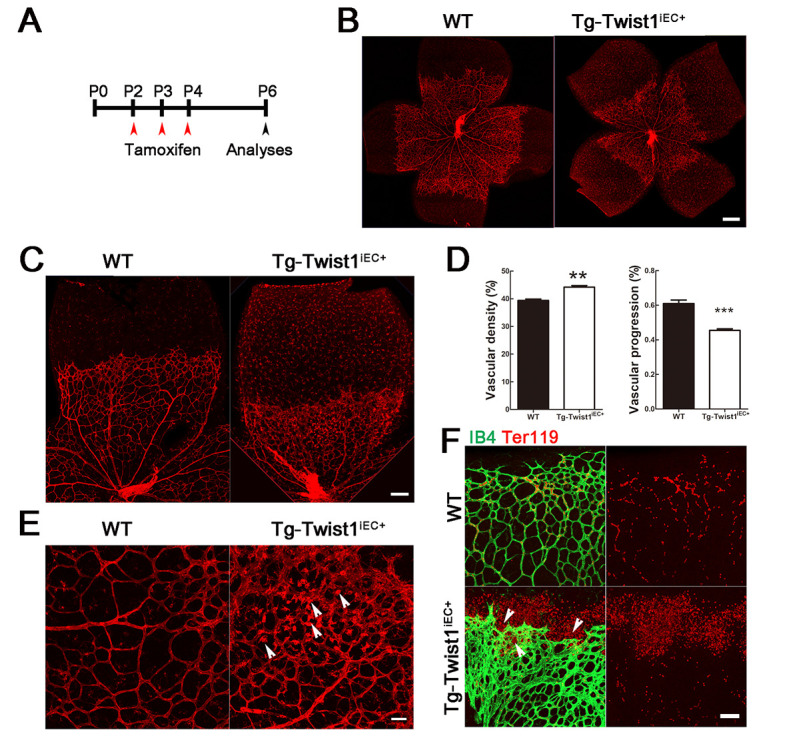
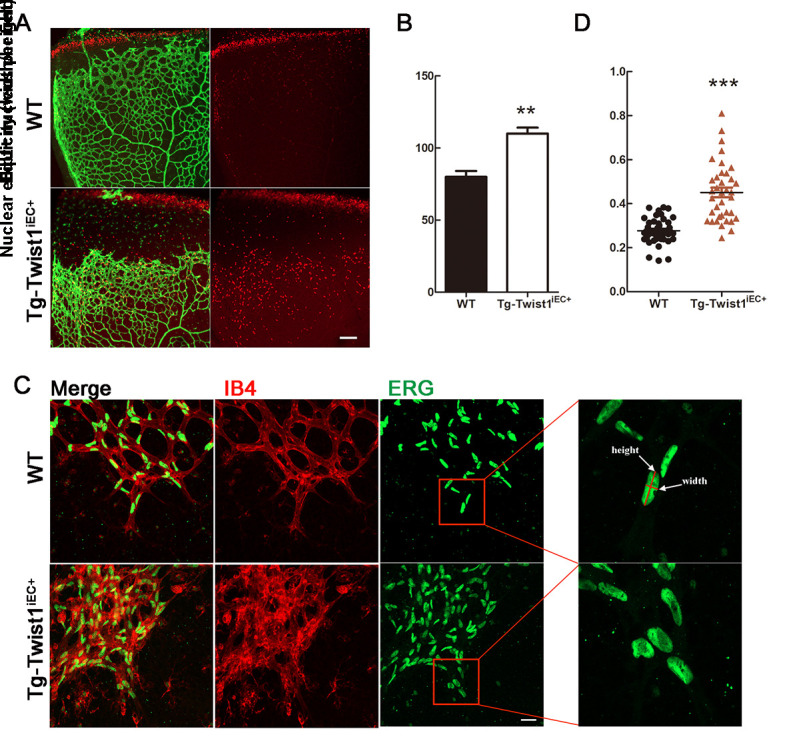
Retinal angiogenesis is a critical process for normal retinal function. However, uncontrolled angiogenesis can lead to pathological neovascularization (NV), which is closely related to most irreversible blindness-causing retinal diseases. Understanding the molecular basis behind pathological NV is important for the treatment of related diseases. Twist-related protein 1 (TWIST1) is a well-known transcription factor and principal inducer of epithelial-mesenchymal transition (EMT) in many human cancers. Our previous study showed that expression is elevated in pathological retinal NV. To date, however, the role of TWIST1 in retinal pathological angiogenesis remains to be elucidated. To study the role of TWIST1 in pathological retinal NV and identify specific molecular targets for antagonizing pathological NV, we generated an inducible vascular endothelial cell (EC)-specific transgenic mouse model ( ). Whole-mount retinas from mice showed retarded vascular progression and increased vascular density in the front end of the growing retinal vasculature, as well as aneurysm-like pathological retinal NV. Furthermore, overexpression of in the ECs promoted cell proliferation but disturbed cell polarity, thus leading to uncontrolled retinal angiogenesis. TWIST1 promoted pathological NV by activating the Wnt/β-catenin signaling pathway and inducing the expression of NV formation-related genes, thereby acting as a 'valve' in the regulation of pathological angiogenesis. This study identified the critical role of TWIST1 in retinal pathological NV, thus providing a potential therapeutic target for pathological NV.
视网膜血管生成是正常视网膜功能的关键过程。然而,不受控制的血管生成会导致病理性新生血管形成(NV),这与大多数导致不可逆失明的视网膜疾病密切相关。了解病理性NV背后的分子基础对于相关疾病的治疗很重要。Twist相关蛋白1(TWIST1)是一种著名的转录因子,也是许多人类癌症中上皮-间质转化(EMT)的主要诱导因子。我们之前的研究表明,其在病理性视网膜NV中表达升高。然而,迄今为止,TWIST1在视网膜病理性血管生成中的作用仍有待阐明。为了研究TWIST1在病理性视网膜NV中的作用并确定拮抗病理性NV的特定分子靶点,我们构建了一种可诱导的血管内皮细胞(EC)特异性转基因小鼠模型( )。来自 小鼠的全视网膜显示血管进展延迟,视网膜血管生长前端的血管密度增加,以及动脉瘤样病理性视网膜NV。此外,ECs中TWIST1的过表达促进细胞增殖但扰乱细胞极性,从而导致不受控制的视网膜血管生成。TWIST1通过激活Wnt/β-连环蛋白信号通路并诱导NV形成相关基因的表达来促进病理性NV,从而在病理性血管生成的调节中充当“阀门”。本研究确定了TWIST1在视网膜病理性NV中的关键作用,从而为病理性NV提供了一个潜在治疗靶点