Unidad de Genómica Avanzada (Langebio), Cinvestav-IPN, Irapuato, Guanajuato, Mexico.
Departamento de Ingeniería Genética, Unidad Irapuato, Cinvestav-IPN, Irapuato, Guanajuato, México.
Microb Genom. 2021 Nov;7(11). doi: 10.1099/mgen.0.000684.
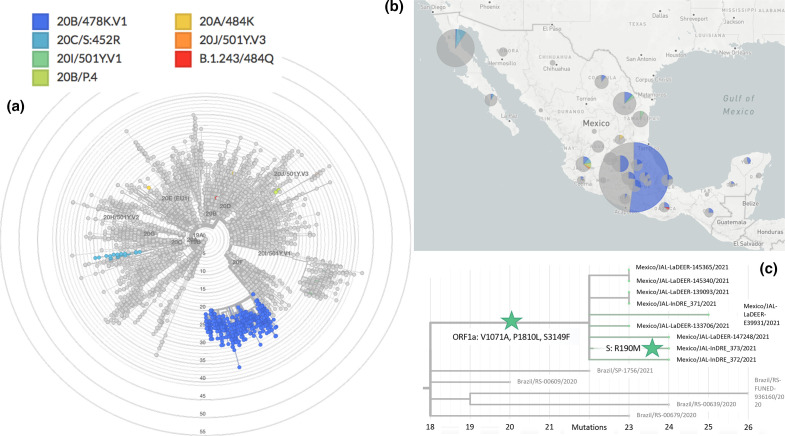
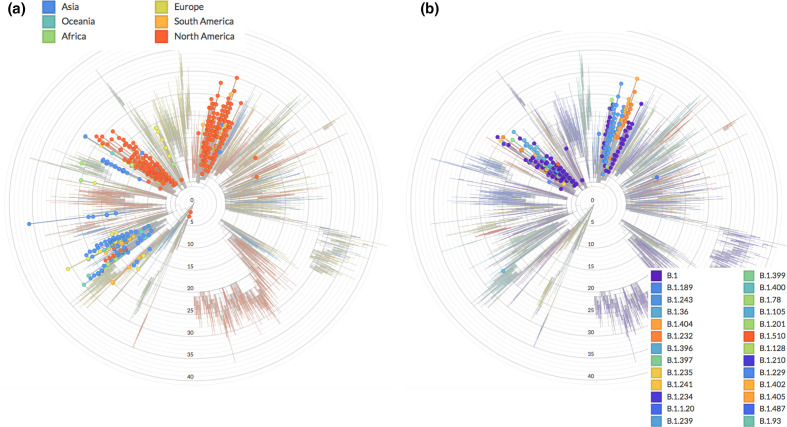
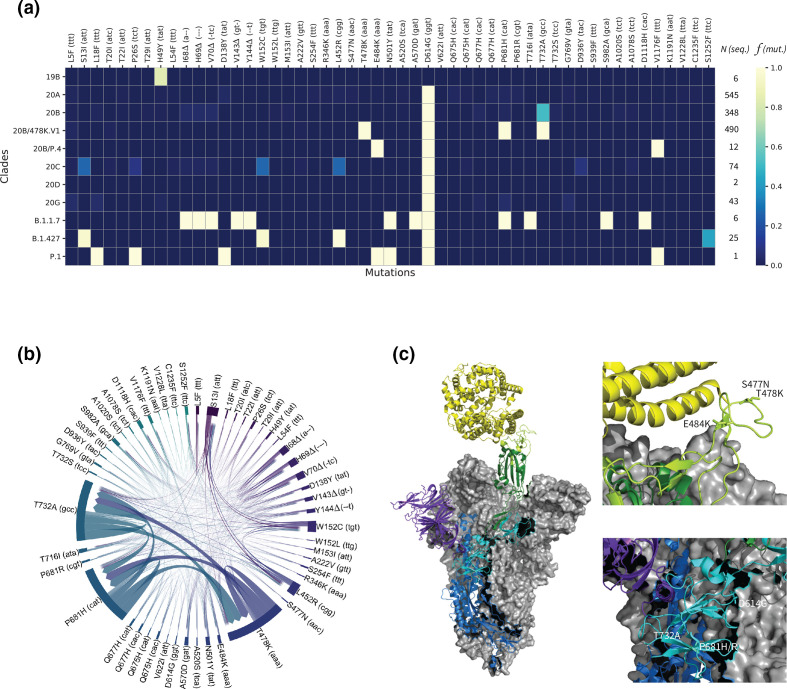
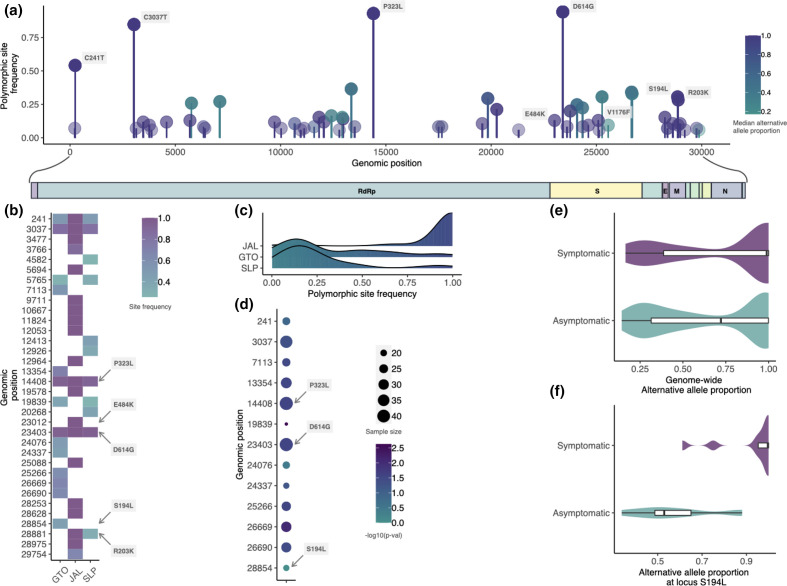
Understanding the evolution of the SARS-CoV-2 virus in various regions of the world during the Covid-19 pandemic is essential to help mitigate the effects of this devastating disease. We describe the phylogenomic and population genetic patterns of the virus in Mexico during the pre-vaccination stage, including asymptomatic carriers. A real-time quantitative PCR screening and phylogenomic reconstructions directed at sequence/structure analysis of the spike glycoprotein revealed mutation of concern E484K in genomes from central Mexico, in addition to the nationwide prevalence of the imported variant 20C/S:452R (B.1.427/9). Overall, the detected variants in Mexico show spike protein mutations in the N-terminal domain (i.e. R190M), in the receptor-binding motif (i.e. T478K, E484K), within the S1-S2 subdomains (i.e. P681R/H, T732A), and at the basis of the protein, V1176F, raising concerns about the lack of phenotypic and clinical data available for the variants of interest we postulate: 20B/478K.V1 (B.1.1.222 or B.1.1.519) and 20B/P.4 (B.1.1.28.4). Moreover, the population patterns of single nucleotide variants from symptomatic and asymptomatic carriers obtained with a self-sampling scheme confirmed the presence of several fixed variants, and differences in allelic frequencies among localities. We identified the mutation N:S194L of the nucleocapsid protein associated with symptomatic patients. Phylogenetically, this mutation is frequent in Mexican sub-clades. Our results highlight the dual and complementary role of spike and nucleocapsid proteins in adaptive evolution of SARS-CoV-2 to their hosts and provide a baseline for specific follow-up of mutations of concern during the vaccination stage.
了解 COVID-19 大流行期间世界各地区 SARS-CoV-2 病毒的进化对于减轻这种毁灭性疾病的影响至关重要。我们描述了墨西哥在疫苗接种前阶段(包括无症状携带者)病毒的系统发生基因组学和群体遗传学模式。实时定量 PCR 筛选和针对刺突糖蛋白进行的序列/结构分析的系统发生重建揭示了来自墨西哥中部基因组中与关注的 E484K 突变,除了全国范围内流行的进口变异 20C/S:452R(B.1.427/9)。总体而言,在墨西哥检测到的变体在刺突蛋白的 N 端结构域(即 R190M)、受体结合基序(即 T478K、E484K)、S1-S2 亚结构域(即 P681R/H、T732A)和蛋白基础(V1176F)中均存在突变,这引起了人们对我们推测的感兴趣的变体缺乏表型和临床数据的关注:20B/478K.V1(B.1.1.222 或 B.1.1.519)和 20B/P.4(B.1.1.28.4)。此外,采用自我采样方案获得的有症状和无症状携带者的单核苷酸变体的群体模式证实了存在几种固定变体,以及当地之间等位基因频率的差异。我们鉴定了与有症状患者相关的核衣壳蛋白的突变 N:S194L。从系统发生的角度来看,这种突变在墨西哥亚谱系中很常见。我们的研究结果突出了刺突蛋白和核衣壳蛋白在 SARS-CoV-2 对其宿主的适应性进化中的双重和互补作用,并为疫苗接种阶段关注的突变的特定随访提供了基线。