Nie Shanjing, Shen Chao, Guo Yunliang, Hou Xunyao, Hong Yan, Xu Song, Lv Renjun, Liu Xueping
Department of Geriatrics, Shandong Provincial Hospital Affiliated to Shandong First Medical University, Jinan, Shandong, People's Republic of China.
Department of Geriatric Neurology, Shandong Provincial Hospital Affiliated to Shandong First Medical University, Jinan, Shandong, People's Republic of China.
Neuropsychiatr Dis Treat. 2021 Nov 18;17:3379-3394. doi: 10.2147/NDT.S338717. eCollection 2021.
Cerebral small vessel disease is the primary cause of cognitive impairment. Therefore, early recognition is of great significance. Some studies have shown that asymptomatic cerebral small vessel disease (aCSVD) patients have abnormal neurocognitive function, but this is not readily apparent at the initial stage. The objective of this paper was to assess visual spatial attention by event-related potential (ERP) examination and to analyze the relationship between ERP data and clinical characteristics in patients with aCSVD.
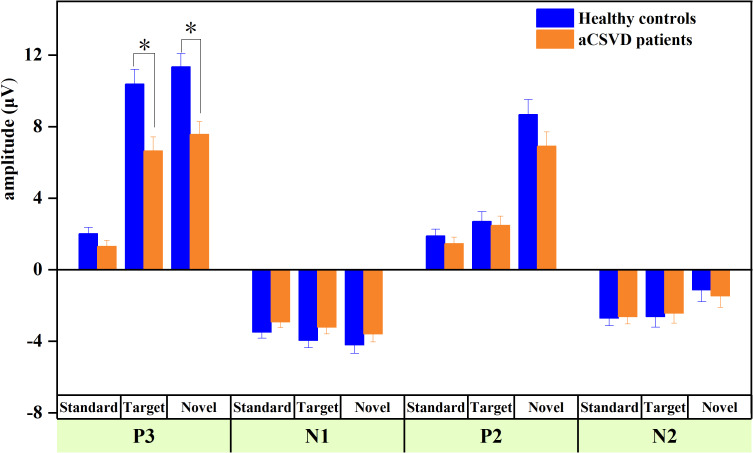
We selected 25 aCSVD patients and enrolled 23 age-matched normal subjects as the control group. We measured the latency and amplitude of original/corresponding differential ERP components using the modified visual oddball paradigm, which included a standard stimulus, target stimulus, and new stimulus. Additionally, we selected aberrant ERP components to study the correlations between the ERP data and clinical characteristics of the patients with aCSVD.
We found not only lower amplitude but also significantly longer P3 latency in the aCSVD patients. The above results were further verified by analyzing the different components (target minus standard and novel minus standard) of P3. Furthermore, abnormal ERPs in the aCSVD patients were closely related to the changes observed with imaging.
It was demonstrated that the speed and capability of processing visual spatial information was impaired in aCSVD patients compared with healthy controls. Thus, ERP examination could detect the presence of attentional deficits and might become a rapid and sensitive method for the early diagnosis of aCSVD. However, its availability needs further investigation.
脑小血管病是认知障碍的主要原因。因此,早期识别具有重要意义。一些研究表明,无症状脑小血管病(aCSVD)患者存在神经认知功能异常,但在疾病初期并不明显。本文旨在通过事件相关电位(ERP)检查评估视觉空间注意力,并分析aCSVD患者ERP数据与临床特征之间的关系。
我们选取了25例aCSVD患者,并纳入23例年龄匹配的正常受试者作为对照组。我们使用改良的视觉Oddball范式测量原始/相应差异ERP成分的潜伏期和波幅,该范式包括标准刺激、目标刺激和新刺激。此外,我们选择异常ERP成分来研究aCSVD患者ERP数据与临床特征之间的相关性。
我们发现aCSVD患者不仅波幅较低,而且P3潜伏期明显延长。通过分析P3的不同成分(目标减去标准和新刺激减去标准),上述结果得到进一步验证。此外,aCSVD患者的异常ERP与影像学观察到的变化密切相关。
结果表明,与健康对照组相比,aCSVD患者处理视觉空间信息的速度和能力受损。因此,ERP检查可以检测到注意力缺陷的存在,并可能成为aCSVD早期诊断的一种快速、敏感的方法。然而,其可用性需要进一步研究。