He Xiang, Zhang Lei, Hu Lingjuan, Liu Shengbin, Xiong Anying, Wang Junyi, Xiong Ying, Li Guoping
Laboratory of Allergy and Precision Medicine, Chengdu Institute of Respiratory Health, The Third People's Hospital of Chengdu, Affiliated Hospital of Southwest Jiaotong University, Chengdu, 610031, People's Republic of China.
Department of Pulmonary and Critical Care Medicine, Chengdu Third People's Hospital Branch of National Clinical Research Center for Respiratory Disease, Affiliated Hospital of ChongQing Medical University, Chengdu, 610031, People's Republic of China.
J Asthma Allergy. 2021 Nov 20;14:1411-1423. doi: 10.2147/JAA.S335590. eCollection 2021.
Exposure to air pollutants cause exacerbation of asthma, but the experimental evidence and the mechanisms still need to be collected and addressed.
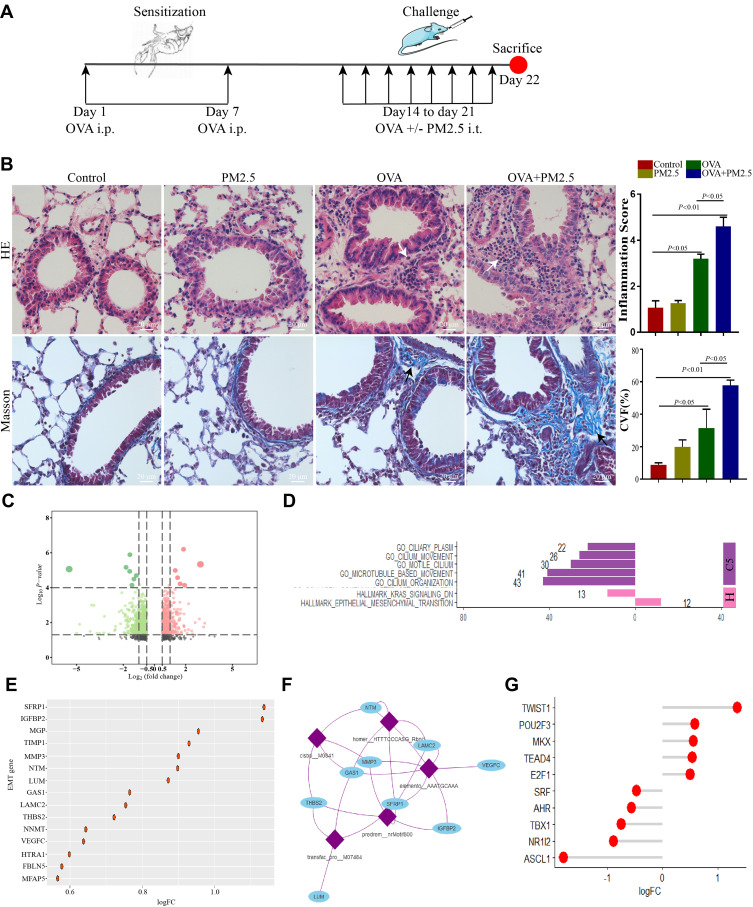
Asthma model was constructed by ovalbumin (OVA) combined with or without airborne fine particulate matter 2.5 (PM2.5) exposure. Lung sections were stained by hematoxylin-eosin staining (H&E) and Masson's trichrome. RNA-seq and gene set enrichment analysis (GSEA) was performed to identify the key pathway. TdT mediated dUTP Nick End Labeling (TUNEL) assay, real-time qPCR, Western blot, immunofluorescence and lentivirus transfection were applied for mechanism discovery.
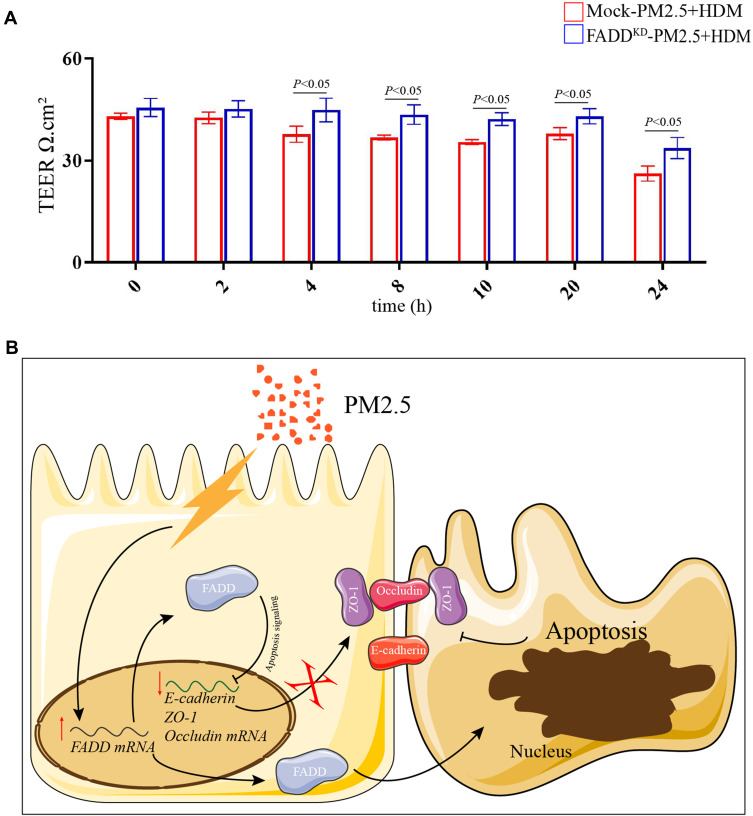
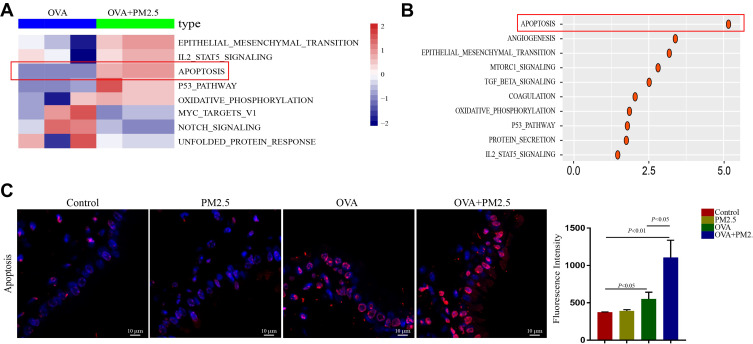
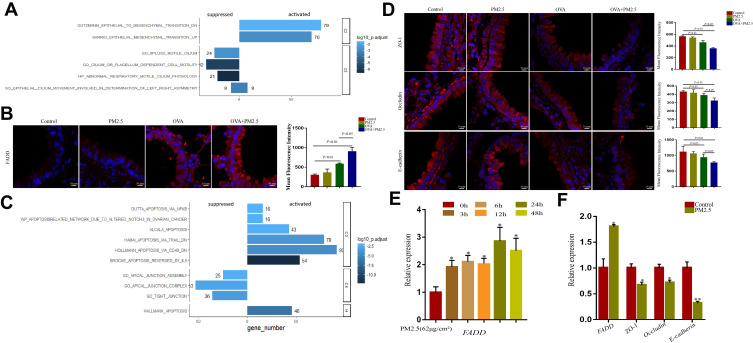
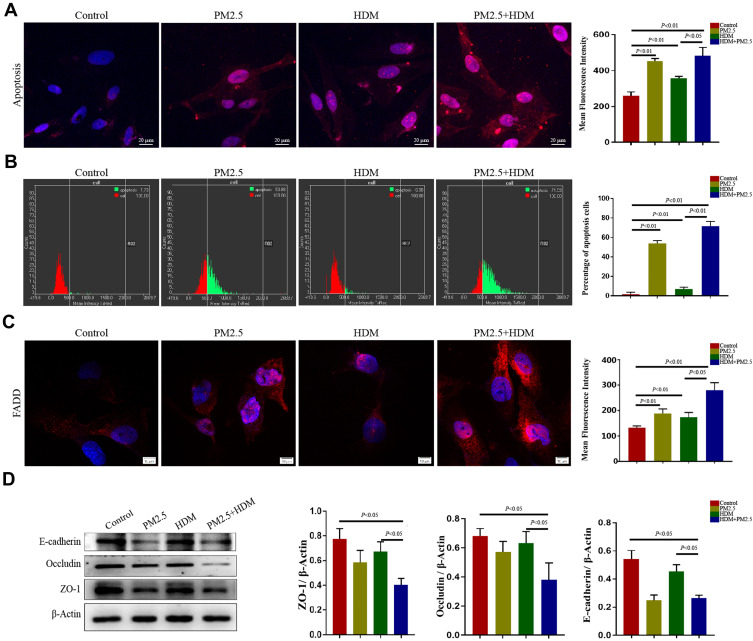
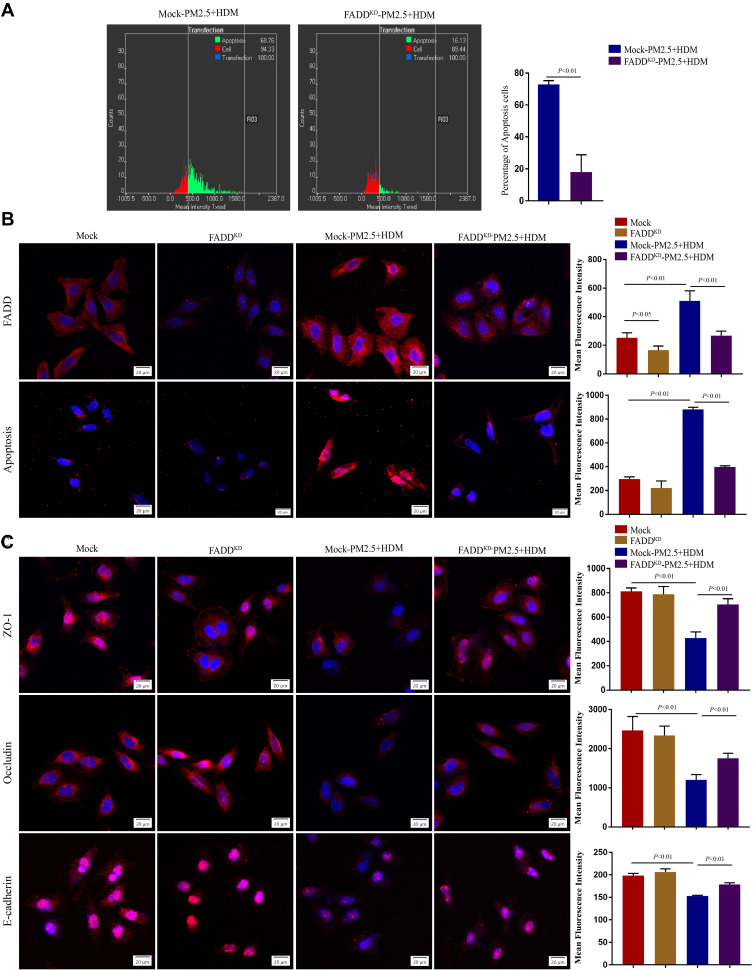
In this study, we found PM2.5 aggravated airway inflammation in OVA-induced asthmatic mice. RNA-seq analysis also showed that epithelial mesenchymal transition (EMT) was enhanced in OVA-induced mice exposed to PM2.5 compared with that in OVA-induced mice. In the meantime, we observed that apoptosis was significantly increased in asthmatic mice exposed to PM2.5 by using GSEA analysis, which was validated by TUNEL assay. By using bioinformatic analysis, Fas associated via death domain (FADD), a new actor in innate immunity and inflammation, was identified to be related to apoptosis, EMT and tight junction. Furthermore, we found that the transcript and protein levels of tight junction markers, E-cadherin, zonula occludens (ZO)-1 and Occludin, were decreased after PM2.5 exposure in vivo and in vitro by using RT-qPCR and immunofluorescence, with the increased expression of FADD. Moreover, down-regulation of FADD attenuated PM2.5-induced apoptosis and tight junction disruption in human airway epithelial cells.
Taken together, we demonstrated that PM2.5 aggravated epithelial tight junction disruption through apoptosis mediated by up-regulation of FADD in OVA-induced model.
暴露于空气污染物会导致哮喘加重,但实验证据和机制仍需收集和阐明。
通过卵清蛋白(OVA)联合或不联合暴露于空气中细颗粒物2.5(PM2.5)构建哮喘模型。肺组织切片用苏木精-伊红染色(H&E)和Masson三色染色法染色。进行RNA测序(RNA-seq)和基因集富集分析(GSEA)以确定关键途径。应用末端脱氧核苷酸转移酶介导的dUTP缺口末端标记(TUNEL)检测、实时定量聚合酶链反应(qPCR)、蛋白质免疫印迹法、免疫荧光法和慢病毒转染来发现机制。
在本研究中,我们发现PM2.5加重了OVA诱导的哮喘小鼠的气道炎症。RNA-seq分析还显示,与OVA诱导的小鼠相比,暴露于PM2.5的OVA诱导小鼠的上皮-间质转化(EMT)增强。同时,通过GSEA分析,我们观察到暴露于PM2.5的哮喘小鼠的细胞凋亡显著增加,这通过TUNEL检测得到验证。通过生物信息学分析,发现死亡结构域关联蛋白(FADD),一种先天免疫和炎症中的新因子,与细胞凋亡、EMT和紧密连接有关。此外,我们发现通过RT-qPCR和免疫荧光法,体内和体外PM2.5暴露后紧密连接标志物E-钙黏蛋白、闭合蛋白(ZO)-1和闭合小环蛋白的转录本和蛋白质水平降低,而FADD的表达增加。此外,FADD的下调减轻了PM2.5诱导的人气道上皮细胞凋亡和紧密连接破坏。
综上所述,我们证明在OVA诱导的模型中,PM2.5通过上调FADD介导的细胞凋亡加重上皮紧密连接破坏。