Garg Rachel, McQueen Amy, Roberts Christina, Butler Taylor, Grimes Lauren M, Thompson Tess, Caburnay Charlene, Wolff Jennifer, Javed Irum, Carpenter Kelly M, Wartts Jordyn G, Charles Cindy, Howard Valerie, Kreuter Matthew W
Health Communication Research Laboratory, Brown School at Washington University in St. Louis, St. Louis, MO, USA.
Division of General Medical Sciences, Washington University School of Medicine in St. Louis, St. Louis, Missouri, USA.
Contemp Clin Trials Commun. 2021 Nov 11;24:100857. doi: 10.1016/j.conctc.2021.100857. eCollection 2021 Dec.
Low-income Americans smoke cigarettes at higher rates and quit less than other groups.
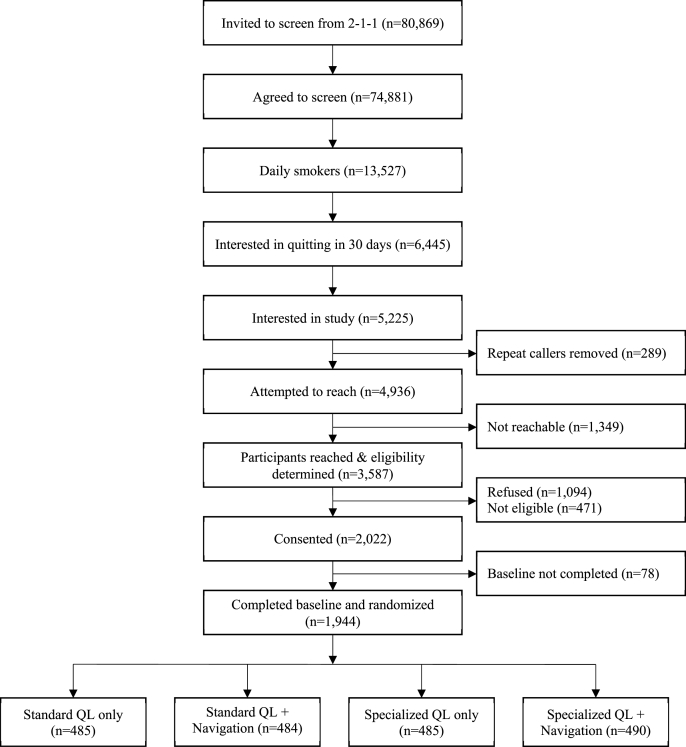
To increase their engagement in and success using evidence-based cessation methods, we tested two interventions using a 2x2 randomized factorial design: (1) telephone navigation to reduce financial strain and address social needs such as food, rent and utility payment; and (2) a specialized tobacco quitline designed for low-income smokers. From June 2017 to November 2020, we enrolled 1,944 low-income smokers in Missouri, USA, recruited through the Missouri 2-1-1 helpline, into the trial. This paper describes recruitment, key characteristics and life circumstances of this high-risk population.
After eligibility screening, 1,944 participants completed baseline and were randomized. Participants were racially diverse (58% African American), poor (51% < $10,000 annual pre-tax household income) and many reported less than high school education (30%). They reported a mean of 2.5 unmet social needs, especially childcare and paying bills, had high rates of stress, depressive symptoms and sleep problems, and most were in fair or poor health. There were few differences between these variables, and no differences between tobacco use and cessation variables, across the four study groups and between participants recruited pre and during the COVID-19 pandemic.
Trial recruitment through the 2-1-1 helpline is feasible for reaching a population of low-income smokers. Low-income smokers face myriad daily challenges beyond quitting smoking. Cessation interventions need to account for and address these life circumstances.
Clinicaltrials.gov NCT03194958.
美国低收入人群吸烟率较高,且戒烟成功率低于其他群体。
为提高他们对循证戒烟方法的参与度和成功率,我们采用2×2随机析因设计测试了两种干预措施:(1)电话导航,以减轻经济压力并满足诸如食品、房租和水电费支付等社会需求;(2)为低收入吸烟者设计的专业戒烟热线。2017年6月至2020年11月,我们通过密苏里州2-1-1求助热线招募了美国密苏里州的1944名低收入吸烟者参加试验。本文描述了这一高危人群的招募情况、关键特征和生活状况。
经过资格筛选,1944名参与者完成了基线调查并被随机分组。参与者种族多样(58%为非裔美国人),贫困(51%家庭税前年收入低于10,000美元),许多人报告受教育程度低于高中(30%)。他们报告平均有2.5项未满足的社会需求,尤其是儿童保育和支付账单方面,压力、抑郁症状和睡眠问题发生率较高,且大多数人健康状况一般或较差。在四个研究组之间以及在新冠疫情之前和期间招募的参与者之间,这些变量几乎没有差异,吸烟与戒烟变量之间也没有差异。
通过2-1-1求助热线进行试验招募,对于接触低收入吸烟者群体是可行的。低收入吸烟者在戒烟之外还面临着无数日常挑战。戒烟干预措施需要考虑并应对这些生活状况。
Clinicaltrials.gov NCT03194958。