• 文献检索
  • 文档翻译
  • 深度研究
  • 学术资讯
  • Suppr Zotero 插件Zotero 插件
  • 邀请有礼
  • 套餐&价格
  • 历史记录
应用&插件
Suppr Zotero 插件Zotero 插件浏览器插件Mac 客户端Windows 客户端微信小程序
定价
高级版会员购买积分包购买API积分包
服务
文献检索文档翻译深度研究API 文档MCP 服务
关于我们
关于 Suppr公司介绍联系我们用户协议隐私条款
关注我们

Suppr 超能文献

核心技术专利:CN118964589B侵权必究
粤ICP备2023148730 号-1Suppr @ 2026

文献检索

告别复杂PubMed语法,用中文像聊天一样搜索,搜遍4000万医学文献。AI智能推荐,让科研检索更轻松。

立即免费搜索

文件翻译

保留排版,准确专业,支持PDF/Word/PPT等文件格式,支持 12+语言互译。

免费翻译文档

深度研究

AI帮你快速写综述,25分钟生成高质量综述,智能提取关键信息,辅助科研写作。

立即免费体验

美国、欧盟和法国移动健康应用程序处方的监管、法律和医疗条件分析

Analysis of the Regulatory, Legal, and Medical Conditions for the Prescription of Mobile Health Applications in the United States, The European Union, and France.

作者信息

Hassanaly Parina, Dufour Jean Charles

机构信息

Aix Marseille Université, Inserm, IRD, SESSTIM, Sciences Economiques & Sociales de la Santé & Traitement de l'Information Médicale, ISSPAM, Marseille, France.

Aix Marseille Université, APHM, Inserm, IRD, SESSTIM, Sciences Economiques & Sociales de la Santé & Traitement de l'Information Médicale, ISSPAM, Hop Timone, BioSTIC, Biostatistique et Technologies de l'Information et de la Communication, Marseille, France.

出版信息

Med Devices (Auckl). 2021 Nov 24;14:389-409. doi: 10.2147/MDER.S328996. eCollection 2021.

DOI:10.2147/MDER.S328996
PMID:34853541
原文链接:https://pmc.ncbi.nlm.nih.gov/articles/PMC8628128/
Abstract

INTRODUCTION

Mobile health (mHealth) is now considered an important approach to extend traditional health services and to meet the growing medical needs. The prescribability of mHealth applications is a complex problem because it depends on a large number of factors and concerns a wide range of disciplines and actors in the industrial, health, normative, and regulatory domains.

OBJECTIVE

Our study correlated data from the scientific literature with data on regulatory developments in the United States, the European Union, and France with the aim of identifying the conditions for the prescription of mHealth applications.

METHODS

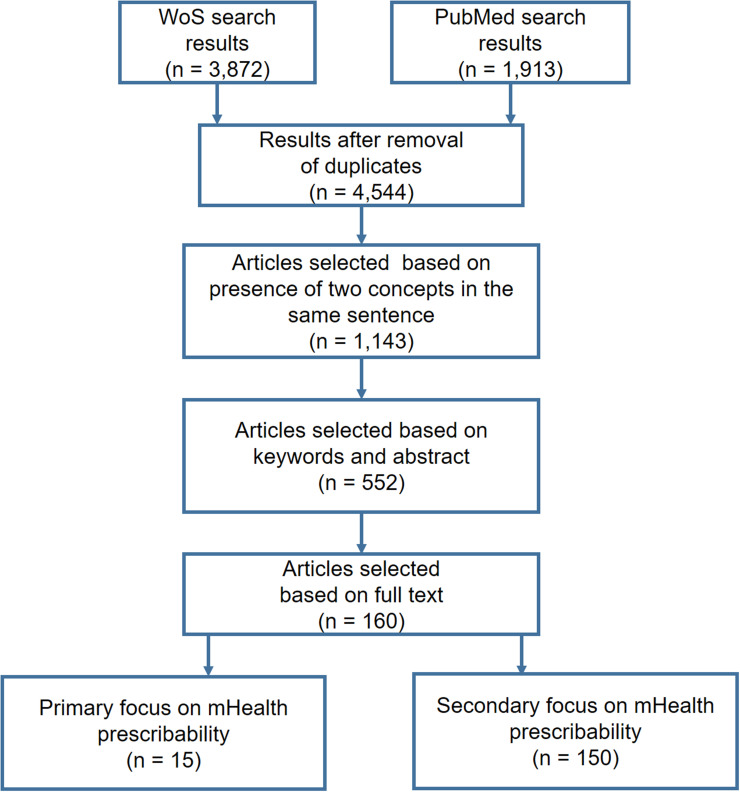
The search method adopted was the systematic literature review process by Brereton et al. All empirical evidence from the relevant fields of study was gathered and then evaluated to answer our predefined research questions. The WoS and PubMed databases were queried for the period between 1 January 1975 and 30 November 2020. A total of 165 articles (15 with a direct focus and 150 with an indirect focus on mHealth prescribing) were analyzed/cross-referenced. The ScienceDirect database was consulted to complement the collected data when needed. Data published by international and national regulatory bodies were analyzed in light of the scientific data obtained from the WoS, PubMed, and ScienceDirect databases.

RESULTS

The International Medical Device Regulators Forum has ensured the international structuring of the regulatory field in collaboration with participating countries. The creation and updating of databases have allowed the tracking of medical device versions/upgrades and incidents. The regulatory organizations of the United States, the European Union, and France are currently consulting healthcare personnel, manufacturers, and patients to establish evaluation criteria for usability and quality of instructions for use that take into consideration patients' level of literacy. These organizations are also providing support to manufacturers who wish to file marketing applications. Marketing, privacy, and cybersecurity measures are evolving with developments in technology and state cooperation policies. The prescription of mHealth applications will gain social acceptance only if consistency and coordination are ensured at all stages of the process: from pre-design, through verification of medical effectiveness, to ethical consideration during data collection and use, and on to marketing.

CONCLUSION

The conditions for mHealth prescribability include the adaptation of international regulation by the different states, the state provision of marketing support, and the evaluation of mHealth applications. For mHealth to gain social acceptance, increased collaboration among physicians, manufacturers, and "information technology stakeholders" is needed. Once this is achieved, MHealth can become the cornerstone of successful health care reform.
https://cdn.ncbi.nlm.nih.gov/pmc/blobs/d4f2/8628128/94968c81a717/MDER-14-389-g0001.jpg
摘要

引言

移动健康(mHealth)如今被视为扩展传统医疗服务以及满足日益增长的医疗需求的重要途径。移动健康应用的可处方性是一个复杂问题,因为它取决于大量因素,涉及工业、健康、规范和监管领域的众多学科及参与者。

目的

我们的研究将科学文献数据与美国、欧盟和法国的监管发展数据相关联,旨在确定移动健康应用的处方条件。

方法

采用的检索方法是布雷雷顿等人的系统文献综述流程。收集并评估来自相关研究领域的所有实证证据,以回答我们预先设定的研究问题。查询了Web of Science(WoS)和PubMed数据库在1975年1月1日至2020年11月30日期间的数据。共分析/交叉引用了165篇文章(15篇直接聚焦移动健康处方,150篇间接聚焦)。必要时参考ScienceDirect数据库以补充所收集的数据。根据从WoS、PubMed和ScienceDirect数据库获得的科学数据,对国际和国家监管机构发布的数据进行分析。

结果

国际医疗器械监管者论坛与参与国合作确保了监管领域的国际架构。数据库的创建和更新使得能够追踪医疗器械版本/升级及事件。美国、欧盟和法国的监管组织目前正在咨询医护人员、制造商和患者,以制定考虑患者文化水平的可用性和使用说明质量的评估标准。这些组织还为希望提交上市申请的制造商提供支持。随着技术和国家合作政策的发展,营销、隐私和网络安全措施也在不断演变。只有在从设计前、通过医疗有效性验证、到数据收集和使用期间的伦理考量以及直至营销的整个过程的所有阶段都确保一致性和协调性,移动健康应用的处方才能获得社会认可。

结论

移动健康可处方性的条件包括各国对国际法规的调整、国家提供营销支持以及对移动健康应用进行评估。为使移动健康获得社会认可,医生、制造商和“信息技术利益相关者”之间需要加强合作。一旦实现这一点,移动健康就能成为成功医疗改革的基石。

相似文献

1
Analysis of the Regulatory, Legal, and Medical Conditions for the Prescription of Mobile Health Applications in the United States, The European Union, and France.美国、欧盟和法国移动健康应用程序处方的监管、法律和医疗条件分析
Med Devices (Auckl). 2021 Nov 24;14:389-409. doi: 10.2147/MDER.S328996. eCollection 2021.
2
The future of Cochrane Neonatal.考克兰新生儿协作网的未来。
Early Hum Dev. 2020 Nov;150:105191. doi: 10.1016/j.earlhumdev.2020.105191. Epub 2020 Sep 12.
3
Folic acid supplementation and malaria susceptibility and severity among people taking antifolate antimalarial drugs in endemic areas.在流行地区,服用抗叶酸抗疟药物的人群中,叶酸补充剂与疟疾易感性和严重程度的关系。
Cochrane Database Syst Rev. 2022 Feb 1;2(2022):CD014217. doi: 10.1002/14651858.CD014217.
4
Beyond the black stump: rapid reviews of health research issues affecting regional, rural and remote Australia.超越黑木树:影响澳大利亚地区、农村和偏远地区的健康研究问题的快速综述。
Med J Aust. 2020 Dec;213 Suppl 11:S3-S32.e1. doi: 10.5694/mja2.50881.
5
6
Need for the Development of a Specific Regulatory Framework for Evaluation of Mobile Health Apps in Peru: Systematic Search on App Stores and Content Analysis.秘鲁需要制定专门的监管框架来评估移动健康应用程序:对应用商店的系统搜索和内容分析。
JMIR Mhealth Uhealth. 2020 Jul 10;8(7):e16753. doi: 10.2196/16753.
7
8
Visualizing Collaboration Characteristics and Topic Burst on International Mobile Health Research: Bibliometric Analysis.可视化国际移动健康研究中的合作特征与主题爆发:文献计量分析
JMIR Mhealth Uhealth. 2018 Jun 5;6(6):e135. doi: 10.2196/mhealth.9581.
9
Development of an mHealth platform for HIV Care: Gathering User Perspectives Through Co-Design Workshops and Interviews.开发用于艾滋病护理的移动健康平台:通过协同设计研讨会和访谈收集用户观点。
JMIR Mhealth Uhealth. 2018 Oct 19;6(10):e184. doi: 10.2196/mhealth.9856.
10
Culture of Care: Organizational Responsibilities关怀文化:组织职责

引用本文的文献

1
Barriers to the Utilization of mHealth Applications in Saudi Arabia: Insights from Patients with Chronic Diseases.沙特阿拉伯移动健康应用使用的障碍:来自慢性病患者的见解
Healthcare (Basel). 2025 Mar 18;13(6):665. doi: 10.3390/healthcare13060665.
2
How Social Influence Promotes the Adoption of Mobile Health among Young Adults in China: A Systematic Analysis of Trust, Health Consciousness, and User Experience.社会影响如何促进中国年轻人对移动健康的采用:对信任、健康意识和用户体验的系统分析
Behav Sci (Basel). 2024 Jun 14;14(6):498. doi: 10.3390/bs14060498.
3
Leveraging patient experience data to guide medicines development, regulation, access decisions and clinical care in the EU.

本文引用的文献

1
Evolving Frontier: A Review of the Role of Mobile Medical Application Prescribing.不断发展的前沿领域:移动医疗应用处方作用的综述
J Pharm Technol. 2016 Jun;32(3):91-97. doi: 10.1177/8755122516633873. Epub 2016 Feb 23.
2
Approval of artificial intelligence and machine learning-based medical devices in the USA and Europe (2015-20): a comparative analysis.美国和欧洲对人工智能和基于机器学习的医疗器械的审批(2015-20):比较分析。
Lancet Digit Health. 2021 Mar;3(3):e195-e203. doi: 10.1016/S2589-7500(20)30292-2. Epub 2021 Jan 18.
3
Assessing the Food and Drug Administration's Risk-Based Framework for Software Precertification With Top Health Apps in the United States: Quality Improvement Study.
利用患者体验数据指导欧盟的药物研发、监管、准入决策和临床护理。
Front Med (Lausanne). 2024 May 23;11:1408636. doi: 10.3389/fmed.2024.1408636. eCollection 2024.
4
Transformative Frontiers: A Comprehensive Review of Emerging Technologies in Modern Healthcare.变革性前沿:现代医疗保健中新兴技术的全面综述
Cureus. 2024 Mar 20;16(3):e56538. doi: 10.7759/cureus.56538. eCollection 2024 Mar.
5
Modelling the Predictors of Mobile Health (mHealth) Adoption among Healthcare Professionals in Low-Resource Environments.在资源匮乏环境中,对医疗保健专业人员采用移动医疗(mHealth)的预测因素进行建模。
Int J Environ Res Public Health. 2023 Nov 26;20(23):7112. doi: 10.3390/ijerph20237112.
6
The promise of digital healthcare technologies.数字医疗技术的前景。
Front Public Health. 2023 Sep 26;11:1196596. doi: 10.3389/fpubh.2023.1196596. eCollection 2023.
7
Use and Acceptance of Smart Elderly Care Apps Among Chinese Medical Staff and Older Individuals: Web-Based Hybrid Survey Study.中国医护人员和老年人对智能养老应用程序的使用与接受情况:基于网络的混合调查研究
JMIR Form Res. 2023 Jun 13;7:e41919. doi: 10.2196/41919.
8
Quality of Mobile Apps for Child Development Support: Search in App Stores and Content Analysis.支持儿童发展的移动应用程序质量:在应用商店中的搜索与内容分析
JMIR Pediatr Parent. 2022 Nov 8;5(4):e38793. doi: 10.2196/38793.
9
Use of Smartphone Health Apps Among Patients Aged 18 to 69 Years in Primary Care: Population-Based Cross-sectional Survey.基层医疗中18至69岁患者使用智能手机健康应用程序的情况:基于人群的横断面调查。
JMIR Form Res. 2022 Jun 16;6(6):e34882. doi: 10.2196/34882.
评估美国食品和药物管理局基于风险的软件预认证框架与顶级健康类应用:质量改进研究。
JMIR Mhealth Uhealth. 2020 Oct 26;8(10):e20482. doi: 10.2196/20482.
4
Reporting guidelines for clinical trial reports for interventions involving artificial intelligence: the CONSORT-AI extension.临床试验报告报告指南涉及人工智能的干预措施:CONSORT-AI 扩展。
Nat Med. 2020 Sep;26(9):1364-1374. doi: 10.1038/s41591-020-1034-x. Epub 2020 Sep 9.
5
Challenges for the evaluation of digital health solutions-A call for innovative evidence generation approaches.数字健康解决方案评估面临的挑战——呼吁采用创新的证据生成方法。
NPJ Digit Med. 2020 Aug 27;3:110. doi: 10.1038/s41746-020-00314-2. eCollection 2020.
6
Barriers to and Facilitators of the Prescription of mHealth Apps in Australian General Practice: Qualitative Study.澳大利亚全科医疗中移动医疗应用程序处方的障碍和促进因素:定性研究。
JMIR Mhealth Uhealth. 2020 Jul 30;8(7):e17447. doi: 10.2196/17447.
7
Development of a health technology assessment module for evaluating mobile medical applications.开发一个健康技术评估模块,用于评估移动医疗应用程序。
Int J Technol Assess Health Care. 2020 Jun;36(3):252-261. doi: 10.1017/S0266462320000288. Epub 2020 May 18.
8
Beyond validation: getting health apps into clinical practice.超越验证:将健康应用程序应用于临床实践。
NPJ Digit Med. 2020 Feb 3;3:14. doi: 10.1038/s41746-019-0212-z. eCollection 2020.
9
What is the clinical value of mHealth for patients?移动健康对患者的临床价值是什么?
NPJ Digit Med. 2020 Jan 13;3:4. doi: 10.1038/s41746-019-0206-x. eCollection 2020.
10
Trial designs using real-world data: The changing landscape of the regulatory approval process.使用真实世界数据的试验设计:监管审批流程的不断变化态势。
Pharmacoepidemiol Drug Saf. 2020 Oct;29(10):1201-1212. doi: 10.1002/pds.4932. Epub 2019 Dec 10.