Department of Critical Care Medicine of Liver Disease, Beijing Youan Hospital, Capital Medical University, Beijing 100069, China.
Biomed Res Int. 2021 Nov 22;2021:1074565. doi: 10.1155/2021/1074565. eCollection 2021.
The liver is the primary organ for amino acid metabolism, and metabolic disorder of amino acids is common in liver disease. However, the characteristics of plasma amino acid profiles in patients with HBV-related cirrhosis and the impacts of late-evening snack (LES) on cirrhosis are unclear.
To investigate the characteristics of plasma amino acid profiles in patients with HBV-related chronic hepatitis, cirrhosis, and the effects of late-evening snacks on plasma amino acid profiles.
86 patients with HBV-related cirrhosis and eighty patients with chronic hepatitis B were included in this study. The plasma amino acid profiles were measured by the amino acid analyzer. Patients were randomly divided into two groups, of which the liver cirrhosis group was to receive daily LES ( = 43) or non-LES ( = 43) for 6 months. Plasma amino acid profiles and biochemical parameters were measured in both groups at baseline and after 1, 3, and 6 months.
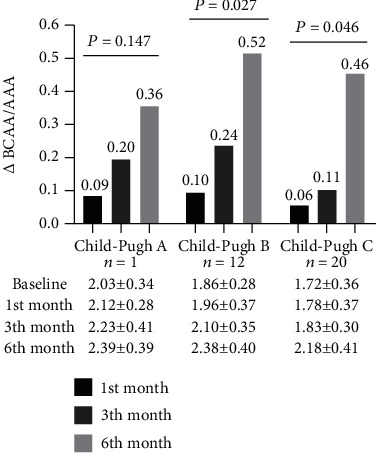
Compared to healthy controls, the plasma concentration in the liver cirrhosis group of threonine, serine, glycine, glutamine, cysteine, tyrosine, phenylalanine, arginine, and methionine increased significantly ( < 0.05), while the ratio of branched chain amino acids (BCAA) to aromatic amino acids (AAA) decreased significantly ( < 0.05). A carbohydrate-predominant LES treatment resulted in a significant increase in BCAA/AAA and decrease in the level of ammonia and glutamine compared with baseline after 6 months of supplementation ( < 0.05). Patients with Child-Pugh B and C are more responsive to changes in amino acid profiles than those with Child-Pugh A.
The application of an LES carbohydrate module for six months in liver cirrhosis patients was associated with increased BCAA/AAA and decreased level of ammonia. Patients with Child-Pugh B and C grades were the most beneficial population.
肝脏是氨基酸代谢的主要器官,氨基酸代谢紊乱在肝病中很常见。然而,HBV 相关肝硬化患者的血浆氨基酸谱特征以及夜宵(LES)对肝硬化的影响尚不清楚。
探讨 HBV 相关慢性肝炎、肝硬化患者血浆氨基酸谱特征及夜宵对血浆氨基酸谱的影响。
纳入 86 例 HBV 相关肝硬化患者和 80 例慢性乙型肝炎患者。采用氨基酸分析仪测定血浆氨基酸谱。患者随机分为两组,其中肝硬化组每天接受 LES(=43)或非 LES(=43)治疗 6 个月。两组患者分别于基线及治疗 1、3、6 个月时检测血浆氨基酸谱及生化指标。
与健康对照组相比,肝硬化组血浆苏氨酸、丝氨酸、甘氨酸、谷氨酸、半胱氨酸、酪氨酸、苯丙氨酸、精氨酸和蛋氨酸浓度明显升高(<0.05),支链氨基酸(BCAA)与芳香族氨基酸(AAA)比值明显降低(<0.05)。6 个月碳水化合物为主的 LES 治疗后,与基线相比,BCAA/AAA 显著升高,氨和谷氨酸水平显著降低(<0.05)。Child-Pugh B 和 C 级患者对氨基酸谱变化的反应优于 Child-Pugh A 级患者。
肝硬化患者应用 LES 碳水化合物模块 6 个月可增加 BCAA/AAA,降低氨水平。Child-Pugh B 和 C 级患者是最受益人群。