Department of Diabetes, Endocrinology and Nutrition, Kyoto University Graduate School of Medicine, Kyoto, Japan.
Division of Nephrology and Endocrinology, The University of Tokyo Graduate School of Medicine, Tokyo, Japan.
Adv Ther. 2022 Jan;39(1):674-691. doi: 10.1007/s12325-021-01984-4. Epub 2021 Dec 2.
This long-term post-marketing surveillance (SAPPHIRE) collected information on the safety and effectiveness of canagliflozin (approved dose 100 mg) prescribed to patients with type 2 diabetes mellitus (T2DM) in real-world practice in Japan.
Patients with T2DM who were prescribed canagliflozin between December 2014 and September 2016 were registered and observed for up to 3 years. Safety was evaluated in terms of adverse drug reactions (ADRs). Effectiveness was assessed in terms of glycaemic control. Data were also analysed across age subgroups (< 65, ≥ 65 to < 75, and ≥ 75 years old) and the estimated glomerular filtration rate (eGFR) categories for chronic kidney disease (G1-G5 based on eGFR) at baseline.
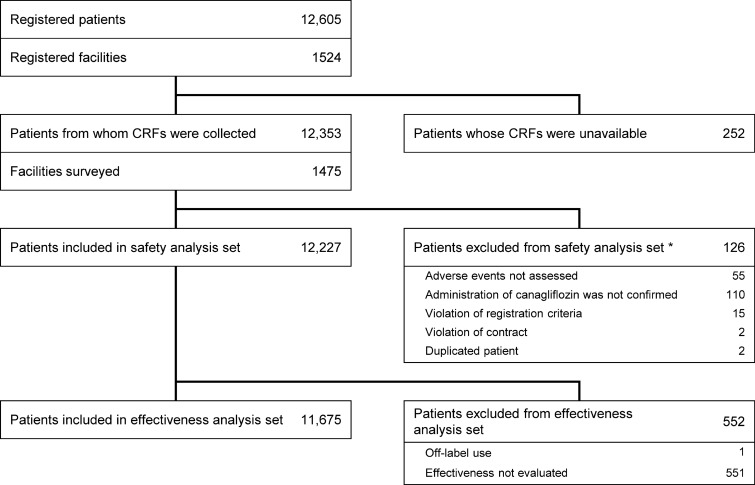
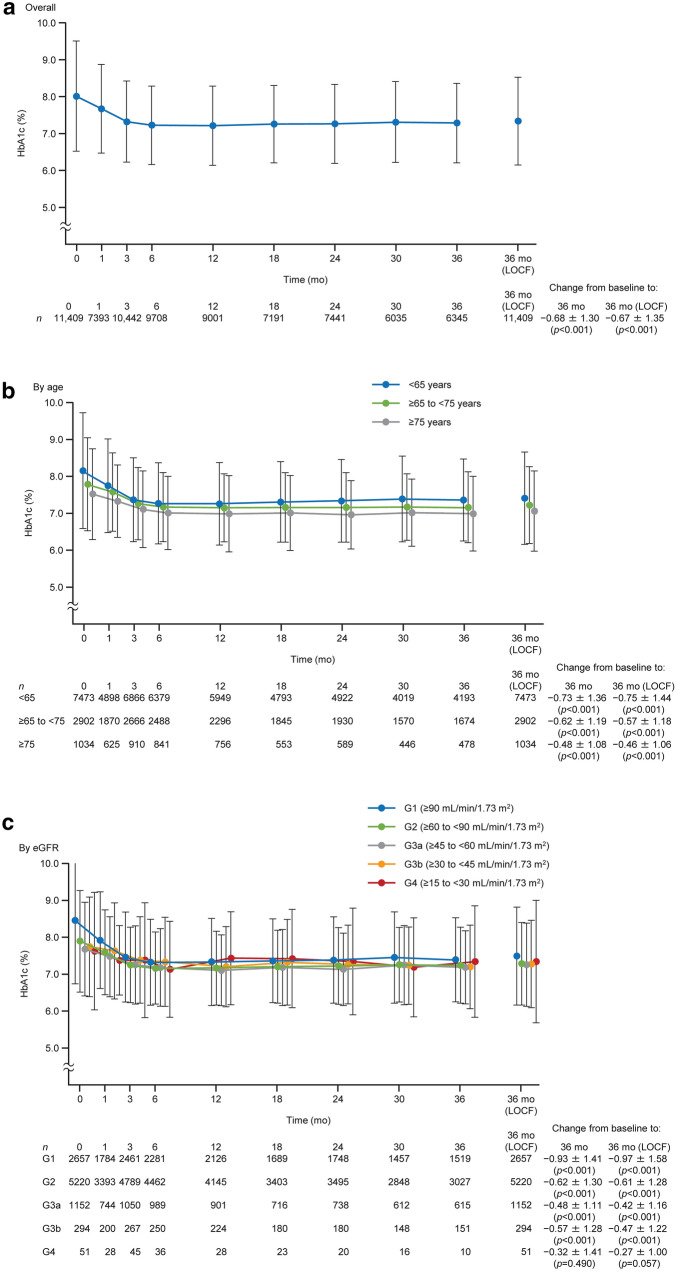
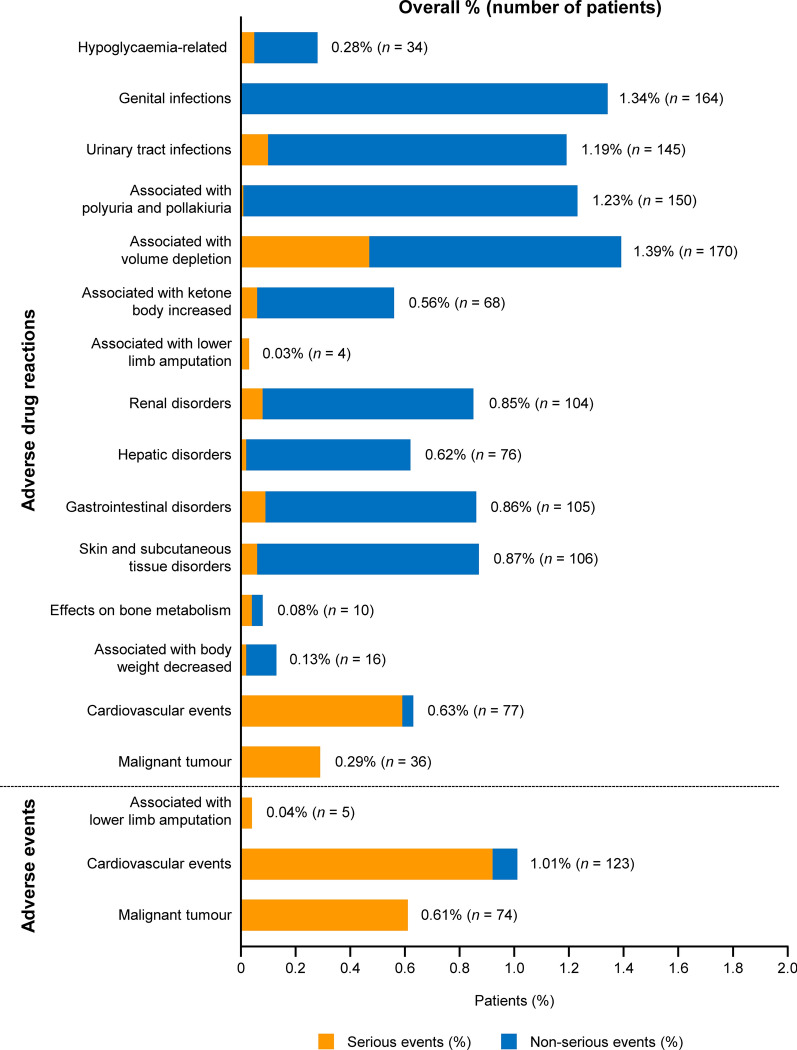
A total of 12,227 patients were included in the safety analyses and 11,675 in effectiveness analyses. Overall, 7104 patients were treated with canagliflozin for ≥ 3 years. The mean age, haemoglobin A1c (HbA1c), and eGFR at baseline were 58.4 ± 12.5 years, 8.01 ± 1.49%, and 80.04 ± 21.85 mL/min/1.73 m, respectively. There were 1836 ADRs in 1312 patients (10.73%) and 268 serious ADRs in 225 patients (1.84%). The most common ADRs were those related to volume depletion (1.39%), genital infection (1.34%), polyuria/pollakiuria (1.23%), and urinary tract infection (1.19%). The frequencies of ADRs tended to increase with age and stage of chronic kidney disease. The reductions in mean HbA1c after starting canagliflozin were maintained for up to 3 years with a mean change of - 0.68% (n = 6345 at 3 years). Maintained reductions in mean HbA1c were observed in each age subgroup and in patients with G1-G3b renal function.
This surveillance in real-world clinical practice showed that canagliflozin provides sustained glucose-lowering effects in patients with T2DM, including elderly patients and patients with moderate renal impairment, without new safety concerns beyond those already described in the Japanese package insert.
JapicCTI-153048.
本项长期上市后监测(SAPPHIRE)收集了在日本的真实世界实践中,2 型糖尿病(T2DM)患者接受卡格列净(批准剂量 100mg)治疗的安全性和有效性信息。
2014 年 12 月至 2016 年 9 月期间,接受卡格列净治疗的 T2DM 患者进行了登记并观察了长达 3 年。安全性评估基于药物不良反应(ADR)。有效性评估基于血糖控制情况。数据还按年龄亚组(<65 岁、≥65 岁至<75 岁和≥75 岁)和慢性肾脏病(CKD)的估计肾小球滤过率(eGFR)类别(基于 eGFR 的 G1-G5)进行了分析。
安全性分析共纳入 12227 例患者,有效性分析共纳入 11675 例患者。总体而言,7104 例患者接受卡格列净治疗≥3 年。基线时患者的平均年龄、血红蛋白 A1c(HbA1c)和 eGFR 分别为 58.4±12.5 岁、8.01±1.49%和 80.04±21.85mL/min/1.73m。1312 例患者中有 1836 例发生 1836 例 ADR(10.73%),225 例患者中有 268 例发生 268 例严重 ADR(1.84%)。最常见的 ADR 是与容量耗竭相关的 ADR(1.39%)、生殖器感染(1.34%)、多尿/尿频(1.23%)和尿路感染(1.19%)。ADR 的频率随年龄和 CKD 阶段的增加而增加。接受卡格列净治疗后,平均 HbA1c 下降幅度可维持长达 3 年,平均下降 0.68%(3 年时 n=6345)。在每个年龄亚组和肾功能为 G1-G3b 的患者中均观察到平均 HbA1c 的持续降低。
本项在真实世界临床实践中的监测结果表明,卡格列净可在包括老年患者和中度肾功能损害患者在内的 T2DM 患者中持续降低血糖,且无新的安全性问题,与日本说明书中已描述的安全性问题一致。
JapicCTI-153048。