German Center for Neurodegenerative Diseases (DZNE) Rostock/Greifswald, Rostock, Germany.
Department of Neurology, Rostock University Medical Center, Rostock, Germany.
Brain Behav. 2022 Jan;12(1):e2439. doi: 10.1002/brb3.2439. Epub 2021 Dec 2.
Behavioral impairment occurs in amyotrophic lateral sclerosis (ALS) and ALS-fronto-temporal dementia (ALS-FTD). It has been proposed that ALS patients without FTD retain an awareness of their behavioral impairment while ALS-FTD patients lose this awareness (referred to as retention vs. loss of "insight"). Loss of insight has not yet been studied across the entire ALS-FTD spectrum; our study addresses this gap by including patients with all the ALS cognitive-behavioral profiles.
Eighty-three ALS patients (and their informants) took part in this bicentric study involving two German recruitment sites. Patients and informants completed the Frontal Systems Behavior Scale covering the domains of apathy, disinhibition, and executive dysfunctioning. Patients were classified into five groups according to the Strong and Rascovsky criteria: cognitively unimpaired (ALSni), cognitively impaired without dementia (ALSci), behaviorally impaired (ALSbi), a combination of behaviorally and cognitively impaired (ALScbi), and ALS-FTD. We applied Bayesian two-way ANOVA to test whether there were subgroup differences regarding insight into their behavioral decline.
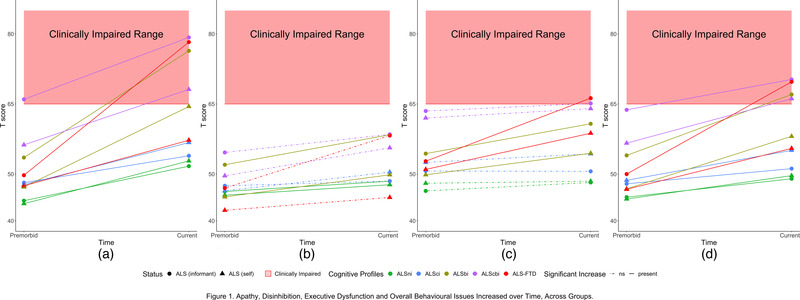
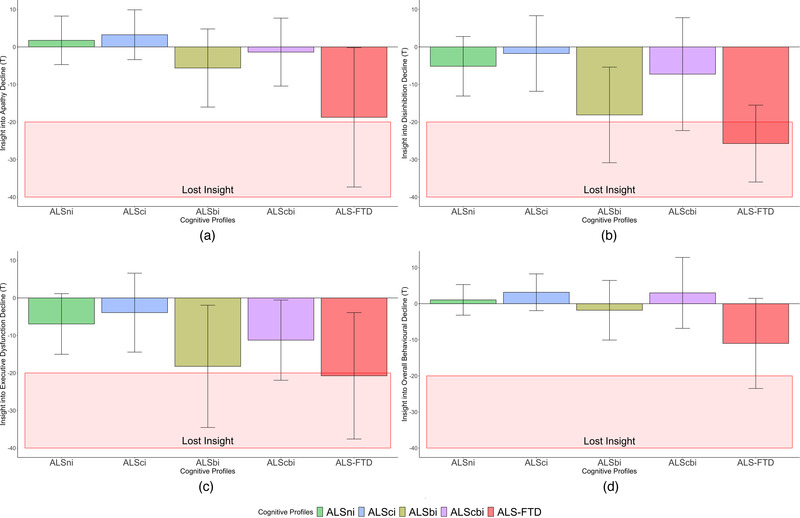
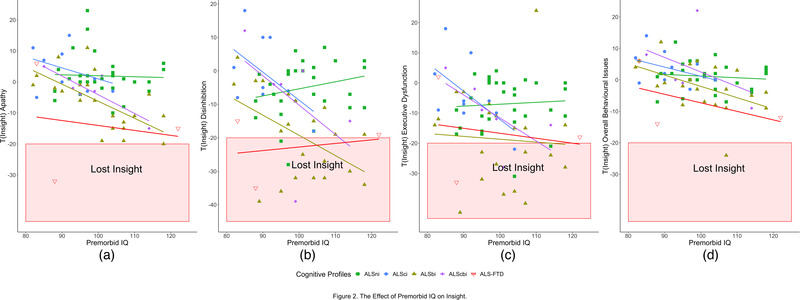
All patient subgroups experienced behavioral decline (Bayes factor > 3). Only ALS-FTD patients lost insight into disinhibition and executive dysfunctioning. ALSbi patients exhibited worse insight than ALSni and ALSci patients (Bayes factor > 10). Evidence regarding the ALScbi patients was inconclusive. Higher IQ was associated with worse insight (Bayes factor > 3).
Our findings provide solid support for the notion that ALS patients without dementia experience behavioral decline regardless of their cognitive-behavioral profile and retain different levels of insight into this decline. The inverse association of premorbid verbal intelligence with insight was unexpected, leaving room for further investigation.
肌萎缩侧索硬化症(ALS)和 ALS-额颞叶痴呆(ALS-FTD)患者存在行为障碍。据提出,无额颞叶痴呆的 ALS 患者保留对其行为障碍的意识,而 ALS-FTD 患者则丧失这种意识(称为保留或丧失“洞察力”)。目前尚未在整个 ALS-FTD 谱系中研究洞察力丧失的情况;我们的研究通过纳入具有所有 ALS 认知行为特征的患者来填补这一空白。
83 名 ALS 患者(及其家属)参加了这项涉及两个德国招募地点的双中心研究。患者和家属完成了涵盖冷漠、抑制障碍和执行功能障碍领域的额叶系统行为量表。根据 Strong 和 Rascovsky 标准,患者被分为五组:认知未受损(ALSni)、认知受损但无痴呆(ALSci)、行为受损(ALSbi)、行为和认知受损的组合(ALScbi)和 ALS-FTD。我们应用贝叶斯双向 ANOVA 检验是否存在关于他们行为下降的洞察力的亚组差异。
所有患者亚组均经历了行为下降(贝叶斯因子>3)。只有 ALS-FTD 患者丧失了对抑制和执行功能障碍的洞察力。ALSbi 患者的洞察力比 ALSni 和 ALSci 患者差(贝叶斯因子>10)。关于 ALScbi 患者的证据尚无定论。较高的智商与较差的洞察力相关(贝叶斯因子>3)。
我们的研究结果为这样一种观点提供了有力支持,即无论其认知行为特征如何,无痴呆的 ALS 患者都会经历行为下降,并保留对这种下降的不同程度的洞察力。认知前言语智力与洞察力呈负相关,这一结果出乎意料,需要进一步研究。