Division of Clinical Geriatrics, Center for Alzheimer Research, Department of Neurobiology, Care Sciences and Society, Karolinska Institutet, Neo, Blickagången 16, 14152, Huddinge, Sweden.
Department of Neurology, Second Faculty of Medicine, Charles University, Motol University Hospital, Prague, Czech Republic.
Alzheimers Res Ther. 2021 Dec 2;13(1):197. doi: 10.1186/s13195-021-00934-0.
The effect of antidiabetic medication on cognitive function is unclear. We analyzed the association between five antidiabetic drugs and change in Mini-Mental State Examination (MMSE) scores in patients with diabetes and dementia.
Using the Swedish Dementia Registry and four supplementary Swedish registers/databases, we identified 1873 patients (4732 observations) with diagnosis of type 2 diabetes (diabetes) and Alzheimer's disease or mixed-pathology dementia who were followed up at least once after dementia diagnosis. Use of metformin, insulin, sulfonylurea, thiazolidinediones (TZD), and dipeptidyl-peptidase-4 inhibitors (DPP-4i) was identified at baseline. Prevalent-user, incident-user, and drug-drug cohorts were sampled, and propensity-score matching was used to analyze comparable subjects. Beta coefficients with 95% confidence intervals (CI) from the random intercept and slope linear mixed-effects models determined the association between the use of antidiabetic medications and decline in MMSE score points between the follow-ups. Inverse-probability weighting was used to account for patient dropout.
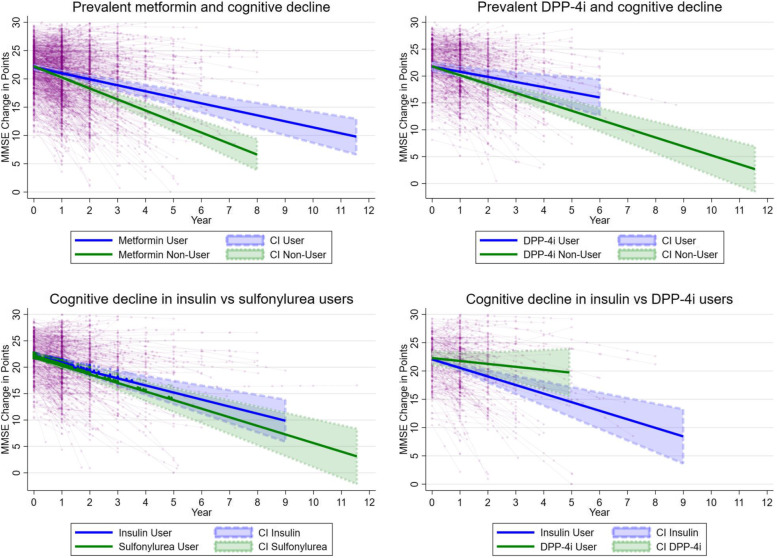
Compared to non-users, prevalent users of metformin (beta 0.89, 95% CI 0.44; 1.33) and DPP-4i (0.72, 0.06; 1.37) experienced a slower cognitive decline with time. Secondly, compared to DPP-4i, the use of insulin (-1.00, -1.95; -0.04) and sulfonylureas (-1.19; -2.33; -0.04) was associated with larger point-wise decrements in MMSE with annual intervals.
In this large cohort of patients with diabetes and dementia, the use of metformin and DPP-4i was associated with a slower decline in MMSE scores. Further examination of the cognitive effects of metformin and incretin-based medications is warranted.
抗糖尿病药物对认知功能的影响尚不清楚。我们分析了五种抗糖尿病药物与糖尿病和痴呆患者的简易精神状态检查(MMSE)评分变化之间的关系。
利用瑞典痴呆症登记处和四个补充的瑞典登记处/数据库,我们确定了 1873 名患有 2 型糖尿病(糖尿病)和阿尔茨海默病或混合病理痴呆的患者(4732 次观察),他们在痴呆症诊断后至少随访一次。在基线时确定了二甲双胍、胰岛素、磺酰脲类、噻唑烷二酮(TZD)和二肽基肽酶-4 抑制剂(DPP-4i)的使用情况。采用现患使用者、新发使用者和药物-药物队列进行抽样,并采用倾向评分匹配分析可比对象。随机截距和斜率线性混合效应模型的β系数及其 95%置信区间(CI)确定了抗糖尿病药物使用与随访期间 MMSE 评分下降之间的关联。逆概率加权用于解释患者脱落。
与非使用者相比,二甲双胍(β 0.89,95%CI 0.44;1.33)和 DPP-4i(0.72,0.06;1.37)的现患使用者随时间推移认知衰退速度较慢。其次,与 DPP-4i 相比,胰岛素(-1.00,-1.95;-0.04)和磺酰脲类(-1.19;-2.33;-0.04)的使用与 MMSE 的年度间隔呈更大的点差下降相关。
在这个患有糖尿病和痴呆的大型患者队列中,二甲双胍和 DPP-4i 的使用与 MMSE 评分的下降速度较慢有关。进一步研究二甲双胍和肠促胰岛素类药物的认知影响是有必要的。